The Treaties That Ended Europe's Deadliest War
On October 24, 1648, treaties signed at Münster and Osnabrück ended the Thirty Years' War and redrew Europe around the idea of sovereign states.
After five years of negotiation in two small German cities, the pens finally moved on October 24, 1648. In Münster and Osnabrück, in the region of Westphalia, envoys of the Holy Roman Emperor, France, Sweden, and their many allies signed the treaties that ended the Thirty Years' War — a conflict that had begun as a religious quarrel in Bohemia in 1618 and grown into a continent-wide catastrophe that killed millions and left entire regions of Germany in ruins.
The talks themselves were a logistical marvel. Because the warring sides refused to meet face to face, the congress was split in two: Catholic delegations gathered in Münster, Protestant ones in Osnabrück, with messengers shuttling between them. For half a decade, while armies still marched, diplomats haggled over borders, faith, and crowns — inventing, as they went, much of the machinery of modern diplomacy.
The settlement they produced redrew Europe. The independence of the Dutch Republic — and of the Swiss cantons — was formally recognized. Within the empire, rulers won the right to determine the religion of their own territories, and Calvinism joined Catholicism and Lutheranism as a legally recognized faith, ending a century of religious wars. France and Sweden emerged as the continent's great powers, each enriched with new territory, while the authority of the Holy Roman Emperor was permanently diminished.
Historians call what came out of Westphalia the seed of the modern state system: the principle that each state is sovereign within its own borders, answerable to no higher earthly power. It was an imperfect peace — Spain and France kept fighting until 1659, and it took later wars to settle what Westphalia left vague — but the idea it planted, that nations deal with each other as equals under negotiated law, still underpins international relations nearly four centuries later. The treaties ran to well over a hundred clauses apiece, settling everything from the return of seized lands to the rights of religious minorities, and diplomats studied them as a manual for a century afterward.
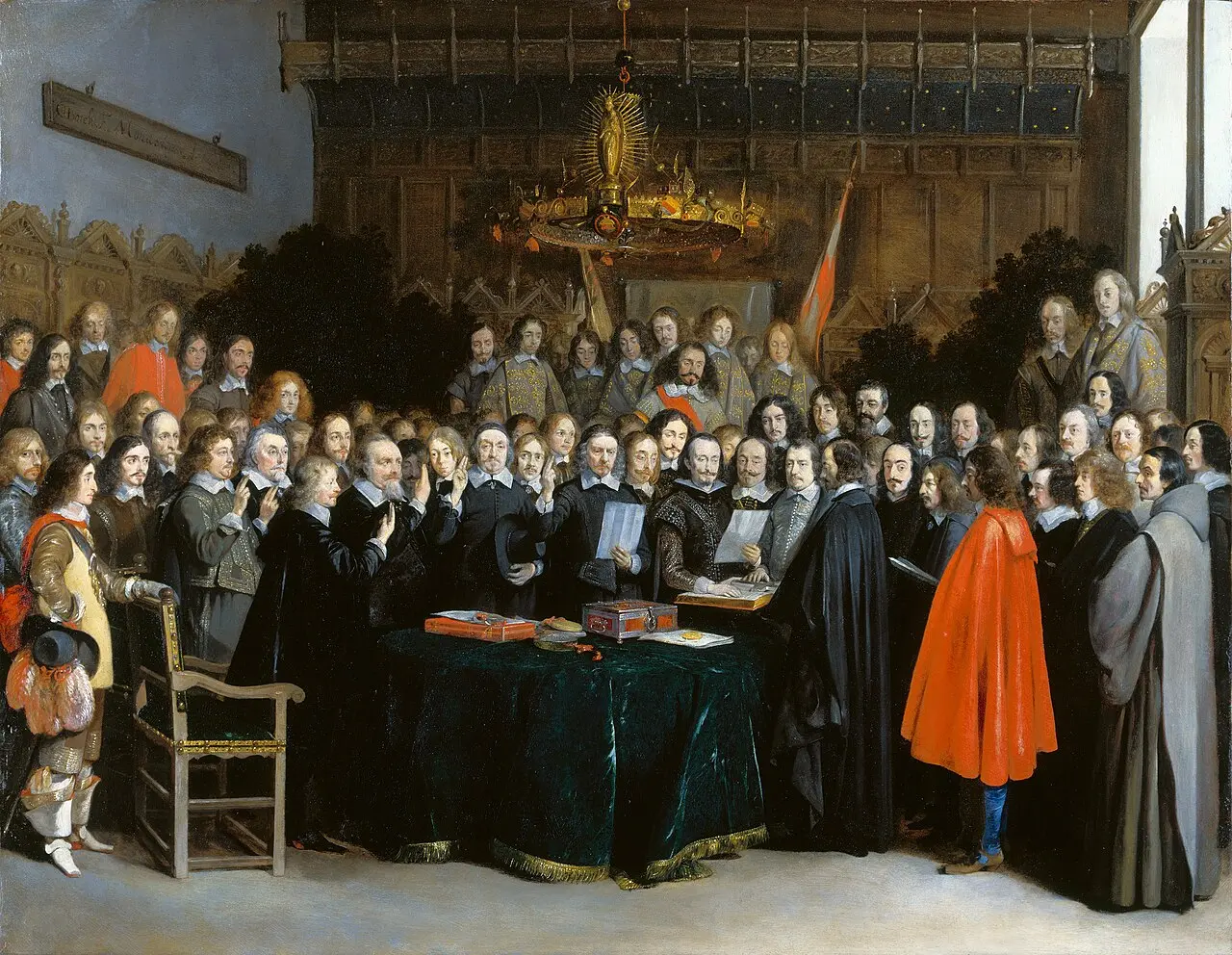
The painting with this story shows the other end of the settlement: Gerard ter Borch's 1648 depiction of the oath sworn on May 15, 1648, ratifying the Treaty of Münster, which ended the Eighty Years' War between Spain and the Dutch Republic as part of the Peace of Westphalia.
Painting: 'The Ratification of the Treaty of Münster' (1648) by Gerard ter Borch, in the public domain via Wikimedia Commons.