The First Photograph of Earth from Space
On October 24, 1946, a captured German V-2 rocket carried a movie camera 65 miles above New Mexico and snapped the first photograph of Earth from outer space.
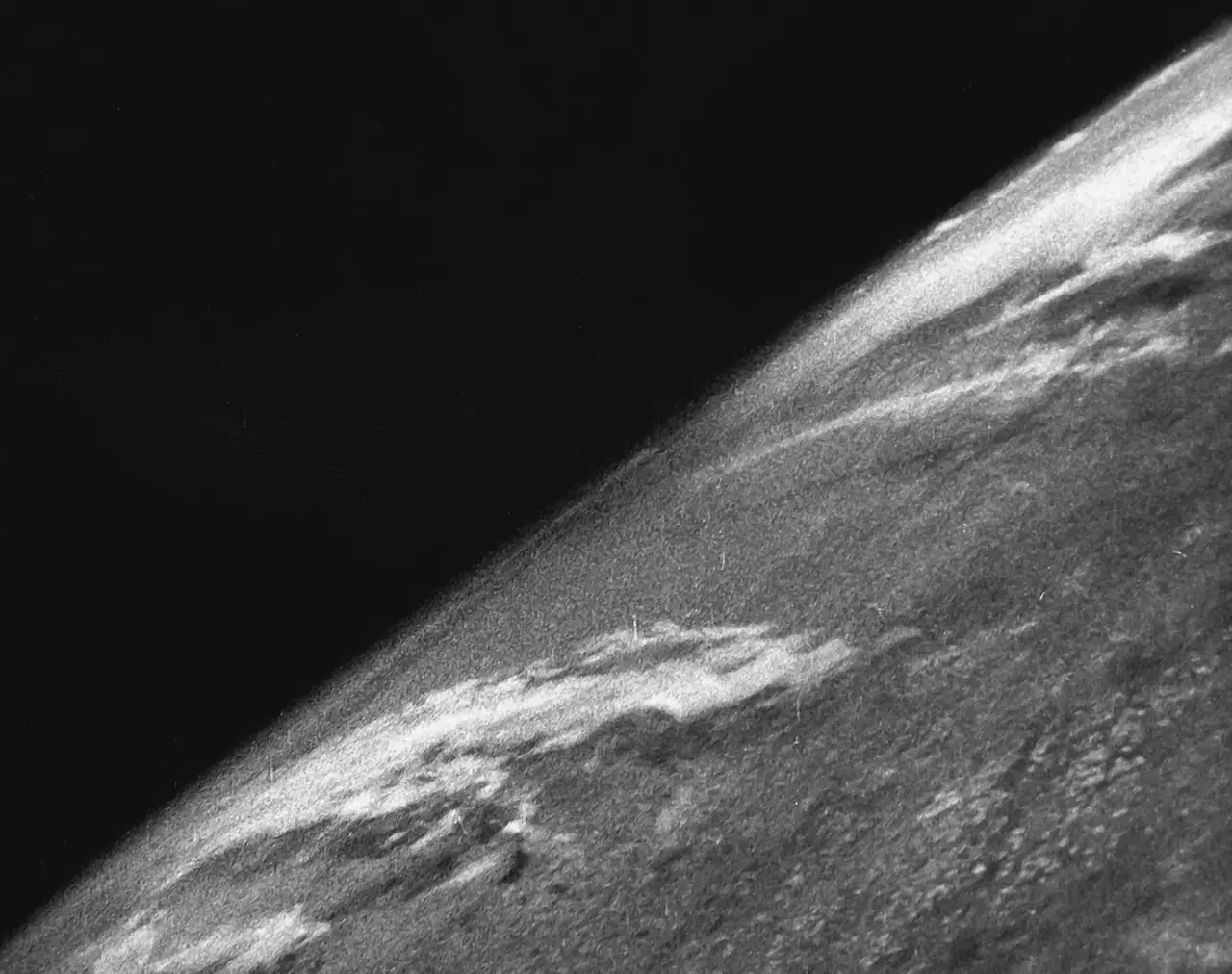
The rocket that took the first photograph of Earth from space was built to be a weapon. On October 24, 1946, a captured German V-2 — reassembled by American engineers at New Mexico's White Sands Missile Range — roared off its launch pad carrying an unusual passenger: a 35-millimeter DeVry movie camera, modified by engineer Clyde Holliday of the Johns Hopkins Applied Physics Laboratory, bolted into the missile's nose and set to snap one frame every second and a half.
V-2 No. 13 climbed to 65 miles — 105 kilometers, just past the line now treated as the edge of space, and five times higher than any photograph had ever been taken before. (The previous record belonged to the Explorer II balloon, which had reached 13.7 miles in 1935.) Then gravity took over. The rocket fell back to Earth and smashed itself to pieces in the desert — the camera with it.
But the film survived. Sealed in a steel cassette designed to withstand the crash, the 35mm strip was recovered from the wreckage and developed to reveal something no human eye had ever seen: the curved limb of the Earth, a thin bright arc against the blackness of space, clouds and land wheeling below. Frame by frame, the tumbling rocket had shot a short movie of the planet from the outside — the first motion picture of Earth from space.
The flight was one of dozens of captured V-2 launches from White Sands in the late 1940s. With German rocket engineers now working for the U.S. Army, the missiles became flying laboratories, carrying instruments that measured cosmic rays, the upper atmosphere, and the sun's ultraviolet light — the first halting steps toward space science.
The images were not widely published for years, but their descendants are everywhere. Every photograph of Earth from orbit — from the Apollo 8 crew's Earthrise to the Blue Marble to Voyager's Pale Blue Dot — follows from that strip of film pulled out of a crashed rocket in the New Mexico desert. On an October morning in 1946, eleven years before Sputnik, humanity saw its home as a world for the first time. The camera had been built to record weapons tests; instead it recorded the beginning of a new way of seeing.
Photograph: the first image of Earth from space, taken October 24, 1946, from V-2 No. 13, by the U.S. Army / White Sands Missile Range, in the public domain via Wikimedia Commons.