The Austerity Games: London's Olympics on Rations
On July 29, 1948, war-scarred London opened the first Olympics in twelve years — with rationed food, borrowed kit, and a spirit the world desperately needed.
Britain could barely feed itself in the summer of 1948 — so naturally, it invited the world to dinner.
It had been twelve years since the last Olympics, the Nazi-staged Berlin Games of 1936. In between had come a world war that left London scarred by the Blitz, its people still living on rations — bread rationed, clothes rationed, everything in short supply. Britain had nearly handed the Games to the United States; instead, London decided to stage them on a shoestring and call it a virtue. Athletes were billeted in RAF camps, schools, and colleges. Equipment was borrowed or improvised. And somehow, it worked.
The world chipped in to feed the guests. Holland sent 100 tons of fresh vegetables. Denmark sent 160,000 eggs. Ireland and Czechoslovakia sent tens of thousands of bottles of mineral water. British bakers got special government permission to bake white bread for the competitors, because the grey ration loaf would have been, as one official delicately put it, unpalatable to visitors. For the first time, the Olympics would be broadcast into people's homes by the BBC — which drew up a contract and insisted on paying the organizers 1,000 guineas for the rights. The organizing committee, not wanting to be tainted by money, never cashed the cheque.
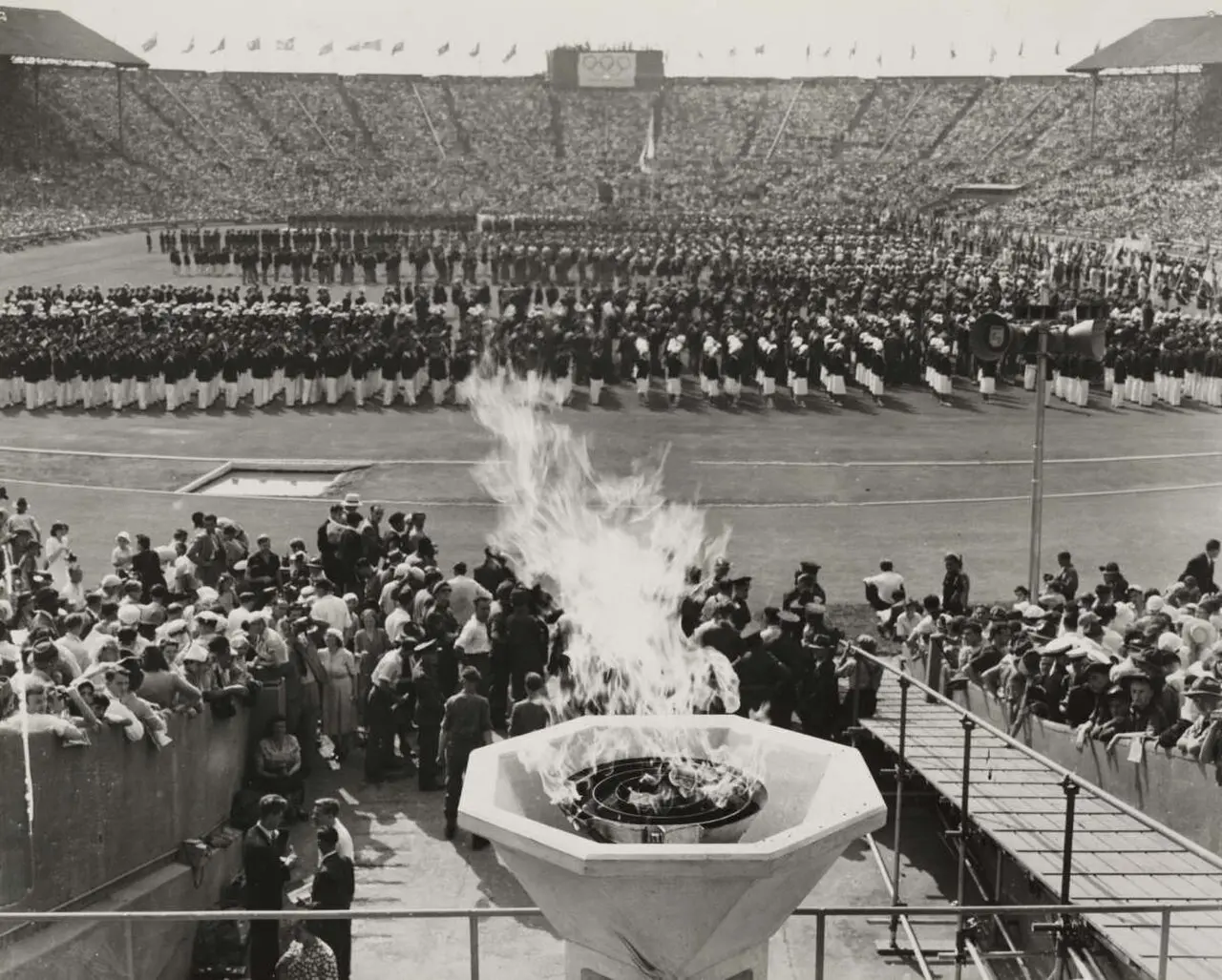
On July 29, at 4 p.m., King George VI declared the Games of the XIV Olympiad open at the Empire Stadium, Wembley. Just over 4,000 athletes from 59 nations paraded into the arena — Germany and Japan, the defeated Axis powers, were not invited. The running track was laid with cinders. The stadium was packed to the rafters.
Then came the flame. The final torch-bearer was a 22-year-old medical student named John Mark — chosen, the organizers frankly admitted, because he looked the part: the Daily Herald called him "the perfect Englishman," six feet three and blond, "like a Greek Adonis." Mark carried the heavy torch on the final leg into Wembley and lit the flame in its specially designed bowl. Thousands of pigeons were released over the stadium. (The flame would famously gutter out after about thirty hours and have to be relit — a small omen of how makeshift the whole enterprise was.)
The spirit of the day was captured by the organizing chief, Lord Burghley, who spoke of rekindling "a warm flame of hope for a better understanding in the world which has burned so low." Prime Minister Clement Attlee said the world needed "every opportunity of spreading more widely friendships between men and women of different nations."
The star of the Games embodied that hope. Fanny Blankers-Koen, a 30-year-old Dutch mother of two, won four gold medals on the cinder track at Wembley — the "Flying Housewife," as the press dubbed her, outrunning women half her age and becoming the most celebrated athlete of the Games.
When it was over, the accountants delivered the final surprise: the Austerity Games had turned a profit of £29,000. But the real profit was larger. London 1948 proved the Olympics could survive a world war and return as a force for reconciliation — that the Games didn't need grandeur, only goodwill. Every underdog Olympics since has been measured against the summer Britain did it on rations.
The image shows the Olympic flame burning in its bowl at Wembley Stadium during the opening ceremony of the 1948 Games. Photograph from the Daily Herald Archive at the National Media Museum; no known copyright restrictions.