The Arch That Took Thirty Years — and Opened in Fear
On July 29, 1836, Paris finally unveiled Napoleon's triumphal arch — thirty years after he ordered it, before a small crowd, while the king feared assassins too much to celebrate.
Thirty years. That is how long Paris waited for its most famous monument — and when the day finally came, on July 29, 1836, the king was too frightened of assassins to throw a proper party.
It had begun with an emperor's boast. In 1806, fresh from his crushing victory at Austerlitz, Napoleon Bonaparte ordered a triumphal arch worthy of ancient Rome, to honor the armies that had made him master of Europe. The architect Jean-François Chalgrin drew up a neoclassical giant — 50 meters of stone at the top of the Champs-Élysées. Laying the foundations alone took more than two years. In 1810, with the arch still a stump, Napoleon had a full-size wooden replica built so he and his young bride Marie-Louise could parade beneath it on their wedding day.
Neither Napoleon nor Chalgrin lived to see the real thing finished. Chalgrin died in 1811. Napoleon abdicated in 1814, and the returning kings had no interest in completing a monument to the usurper's glory — work slowed to a crawl. It was Louis XVIII who resumed construction in 1823, and finally Louis-Philippe, the "citizen king" who took the throne after the 1830 revolution, who ordered Chalgrin's original design completed in 1832 as a gesture of national reconciliation.
So on July 29, 1836, the Arc de Triomphe was dedicated — but before only a small gathering of dignitaries, with no grand public celebration. The reason was fear. Exactly one year earlier, on July 28, 1835, an assassin named Giuseppe Fieschi had fired his "infernal machine" — twenty gun barrels rigged to fire at once — at Louis-Philippe as he rode down the Boulevard du Temple. The king survived, but eighteen people were killed, among them a marshal of France. Nobody in the government wanted to give another assassin a crowd.
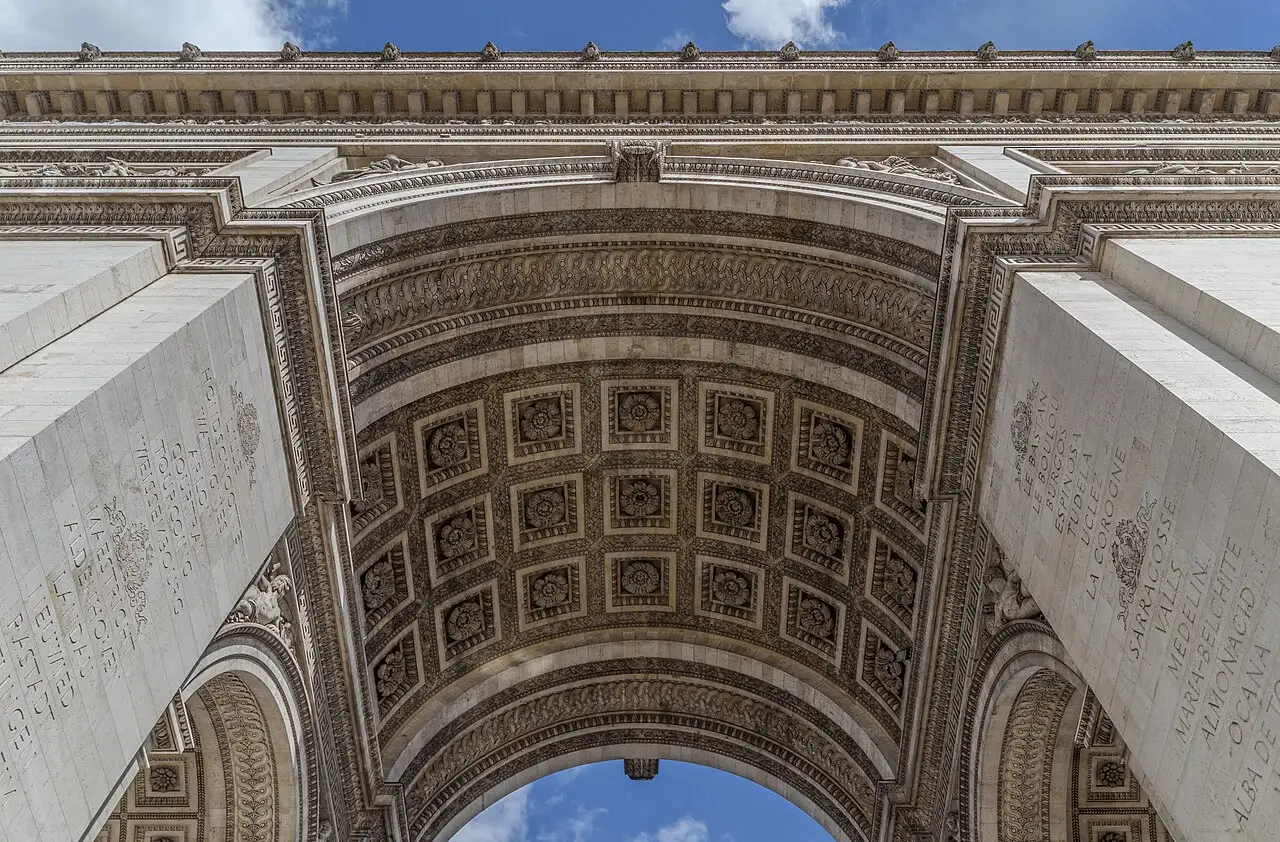
What the arch honored, in the end, was bigger than any one ruler. Its stones were dedicated to the armies of the French Revolution and the Empire — their victories and their generals carved into the vaults and pillars for all time. Look up through the arch today and you can still read the battle names overhead: Rivoli, Austerlitz, Saragossa, Valls. Its great sculptures tell the story in stone: François Rude's furious Departure of the Volunteers of 1792, known as La Marseillaise, alongside scenes of Napoleon's triumph, of resistance, and of peace.
It became the symbolic heart of France. In 1840, Napoleon's body passed beneath the arch on its way to Les Invalides — the emperor finally getting his parade, nineteen years late. Victor Hugo's funeral procession went under it in 1885. In 1921, the Unknown Soldier of the First World War was buried beneath its vault, where the eternal flame still burns. Charles de Gaulle walked under it at the Liberation of Paris in 1944. Twelve avenues radiate from its star-shaped square; the Tour de France finishes and Bastille Day parades march toward it.
Thirty years of emperors, kings, and revolutions went into building it — and it outlasted them all.
The image shows the view looking up through the arch's great vault, where the names of Napoleonic battlefields are carved into the stone. Photograph by Julian Lupyan, released into the public domain.