
The Signature That Launched NASA
On July 29, 1958, President Eisenhower signed the National Aeronautics and Space Act, creating a civilian space agency that would reach the Moon within eleven years.
On October 4, 1957, the Soviet Union put a beeping metal sphere called Sputnik into orbit, and America panicked. A nation that had assumed its technological supremacy suddenly pictured Soviet satellites — and the missiles that could carry them — passing overhead. "Everybody became absolutely terrified," recalled Eilene Galloway, the defense analyst Congress tapped to make sense of the threat.
The panic exposed an embarrassing truth: the United States had no space program, only scattered ones. The Navy had its Vanguard rocket, the Army had Wernher von Braun's Jupiter missiles, the Air Force had its own projects — and none of them talked to each other. President Dwight D. Eisenhower decided the country needed a single, civilian space agency, devoted by law to peaceful purposes.
In April 1958 he sent Congress a bill to create it. Congress passed the measure, reworded, on July 16 — and on July 29, 1958, Eisenhower signed the National Aeronautics and Space Act into law, establishing the National Aeronautics and Space Administration.
NASA began operations on October 1, 1958, absorbing the 43-year-old National Advisory Committee for Aeronautics whole: 8,000 employees, a $100 million budget, and three major research laboratories. Eisenhower named T. Keith Glennan its first administrator and Hugh Dryden his deputy. By December, NASA had also taken over the Jet Propulsion Laboratory in California, and Wernher von Braun's Army rocket team would soon follow.
The new agency wasted no time. On April 9, 1959, it introduced the Mercury 7 — America's first astronauts. Within eleven years of that July signing, NASA astronauts would walk on the Moon.
The decision to make the agency civilian mattered as much as the rockets. In the middle of the Cold War, Eisenhower insisted that space exploration serve "peaceful and scientific purposes" — a principle written into the Act itself. That choice shaped everything NASA became: the weather satellites, the space telescopes, the robotic explorers, and the international partnerships that followed. A single signature on a summer day in 1958 turned a moment of national fear into an institution built for the long, patient work of discovery.
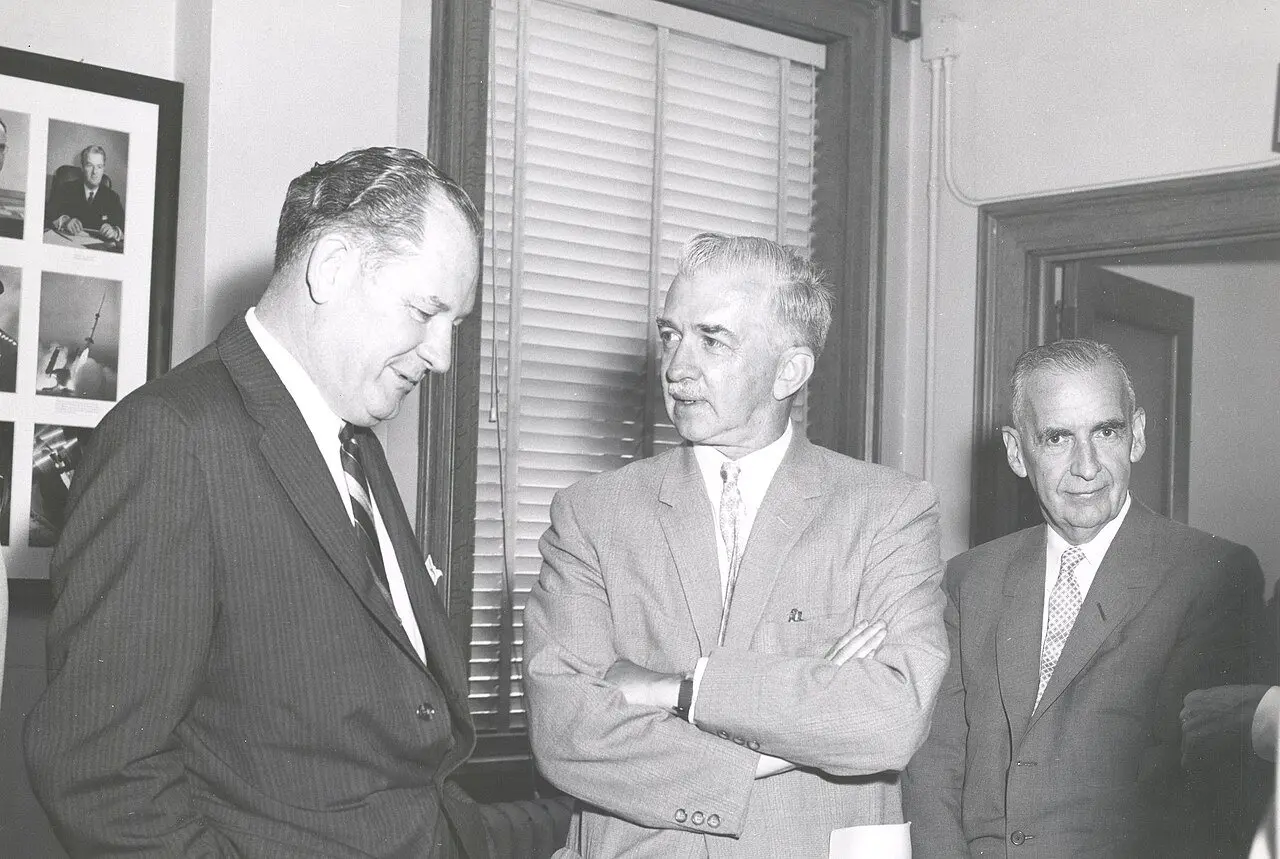
Photo: NASA, public domain (via Wikimedia Commons). This photograph shows officials at the final meeting of the National Advisory Committee for Aeronautics on August 21, 1958 — three weeks after the Space Act was signed; NACA was absorbed into NASA that October, so the image is illustrative of the transition rather than the signing itself.