The Soldier Nobody Knew: America's Unknown of 1921
On November 11, 1921, an unidentified American soldier from World War I was buried at Arlington National Cemetery in a state funeral led by President Harding.
The coffin held a hero. Nobody knew his name.
On November 11, 1921 — three years to the day after the guns of World War I fell silent — the United States buried a soldier it could not identify, and buried him with honors no living American had ever received. He was chosen to stand for all the others: the nearly 2,000 American dead of the Great War whose names were never learned, and the families who never got an answer.
The idea came from Congressman Hamilton Fish Jr., himself a decorated veteran. In December 1920 he proposed bringing home "the body of an unknown American warrior who in himself represents no section, creed, or race in the late war and who typifies, moreover, the soul of America and the supreme sacrifice of her heroic dead." Congress agreed, and in March 1921 the plan became law.
That October, four unidentified American dead were exhumed from four battlefield cemeteries in France — Aisne-Marne, Meuse-Argonne, St. Mihiel, and the Somme — and carried to the city hall at Châlons. There, Army Sergeant Edward F. Younger, a twice-wounded, highly decorated combat veteran, was given an honor no soldier would envy: he had to choose one.
Younger entered the chapel alone. He circled the four identical caskets three times. Then, as he later said, it was "as though something had pulled me" — he stopped, laid a spray of white roses on one lid, drew himself to attention, and saluted. The chosen Unknown was placed in a black casket inscribed "An Unknown American who gave his life in the World War." The other three were buried in the Meuse-Argonne cemetery in France.
The voyage home was a state occasion in itself. The casket sailed aboard the cruiser USS Olympia, Admiral George Dewey's old flagship from the Spanish-American War, under a continuous Marine guard. When the Olympia reached the Washington Navy Yard on November 9, the nation's highest military leaders were waiting on the pier.
On November 10 the casket lay in state in the Capitol Rotunda, on the same catafalque that had borne Lincoln, Garfield, and McKinley. More than 90,000 mourners filed past — so many that the Rotunda stayed open until midnight.
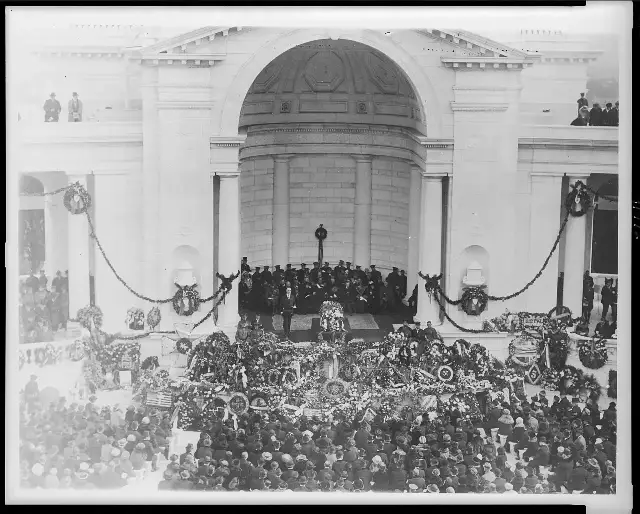
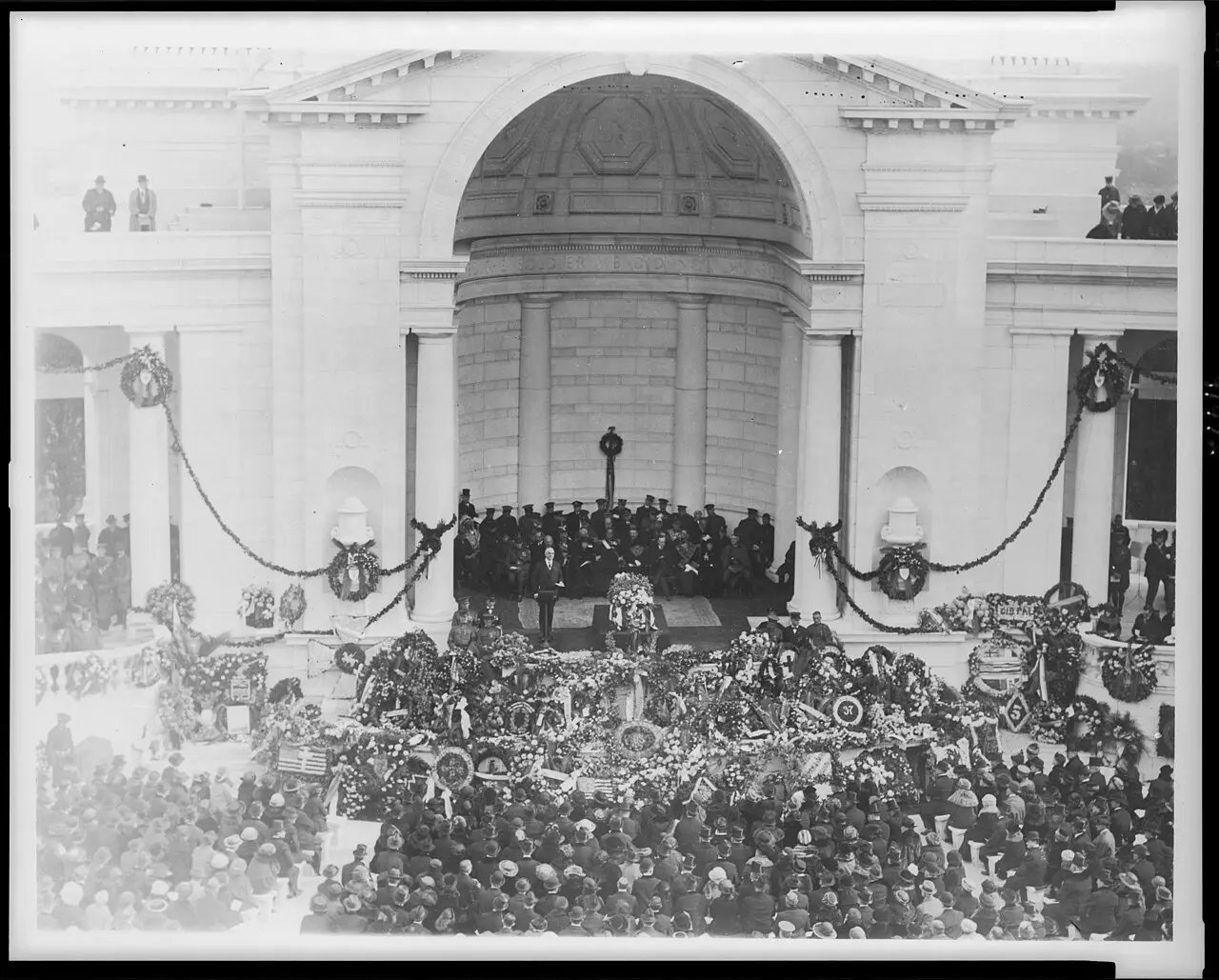
Then came Armistice Day itself. A horse-drawn caisson carried the flag-draped casket in a great procession through Washington and across the Potomac to Arlington National Cemetery. Eight highly decorated veterans, handpicked by General Pershing — including two Medal of Honor recipients — served as body bearers. At the new Memorial Amphitheater, President Warren G. Harding spoke over the casket and placed the Medal of Honor, the nation's highest decoration, and the Distinguished Service Cross upon it. Dignitaries from the Allied nations followed with their own highest honors, including Britain's Victoria Cross, presented by Admiral Lord Beatty on behalf of King George V. Across America, the nation stood silent for two minutes. Then, to the sounding of Taps and a 21-gun salute, the Unknown was lowered into his grave.
A plain marble slab first marked the spot, carved with the words now known around the world: "Here Rests in Honored Glory a Comrade in Arms Known but to God." The great white sarcophagus visitors see today was dedicated in 1932. Soldiers began standing guard at the Tomb in 1926, and since 1937 the watch has never stopped — kept now by the 3rd U.S. Infantry Regiment, "The Old Guard," through every hour of every day.
Later wars added their own unknowns beside him — from World War II and Korea in 1958, and from Vietnam in 1984. The Vietnam unknown was identified by DNA testing in 1998 and returned to his family; that crypt now honors all missing service members of that war.
The Tomb of the Unknown Soldier endures because it belongs to everyone. It is the grave of a man with no name and no family plot — and therefore the grave of every family's unanswered question, honored by a nation that refused to let him be forgotten.
Photo: National Photo Company Collection, Library of Congress, public domain (via Wikimedia Commons).