The Moon Found in a Smudge of Light
On June 22, 1978, astronomer James Christy spotted a tiny bulge in Pluto's image — a moon he named Charon, for his wife and mythology's ferryman of the dead.
Pluto was little more than a blob of light, even through the largest telescopes on Earth. More than three billion miles from the Sun, it showed up on photographic plates as a fuzzy dot — nothing more. Until June 22, 1978, when astronomer James W. Christy looked a little closer at that dot and saw that something was wrong with it.
Christy was working at the U.S. Naval Observatory's station in Flagstaff, Arizona, studying Pluto with the observatory's 1.5-meter telescope. On plates taken that spring, the image of Pluto looked stretched — a slight bulge, or elongation, on one side. At first it seemed like a flaw in the plates. But the next day Christy dug out older plates from 1965 and 1970 and found the same elongation there too, previously dismissed as defective. The bulge was real, and it moved.
Working with fellow astronomer Robert S. Harrington, Christy estimated the unseen companion's orbital period at about 6.4 days — matching Pluto's own rotation, which suggested the two were locked together in a synchronous dance. The Naval Observatory announced the discovery in July 1978, designating the new moon S/1978 P1. It would not be until 1994 that the Hubble Space Telescope captured the first image showing clear space between Pluto and its moon.
Then came the delightful problem of naming it. Christy's colleagues suggested Persephone, wife of Hades. But Christy wanted to honor his wife, Charlene, whose nickname was "Char." Then he spotted a reference to Charon, the boatman who ferried the dead across the River Styx to Hades — the Greek underworld ruled by Pluto's namesake. Char-on: it fit his wife's nickname and the mythology at once. The International Astronomical Union accepted the name in January 1986.
Charon's discovery did more than add a moon to the catalog. Before 1978, Pluto's mass could only be guessed — a 1968 study had suggested it might be 18 percent of Earth's. But knowing Charon's orbital period let astronomers calculate the masses of both bodies properly, using Newton's laws. The answer was startling: Pluto weighed in at just 0.2 percent of Earth's mass, far smaller and lighter than anyone had imagined. An entire planet had been demoted by a smudge.
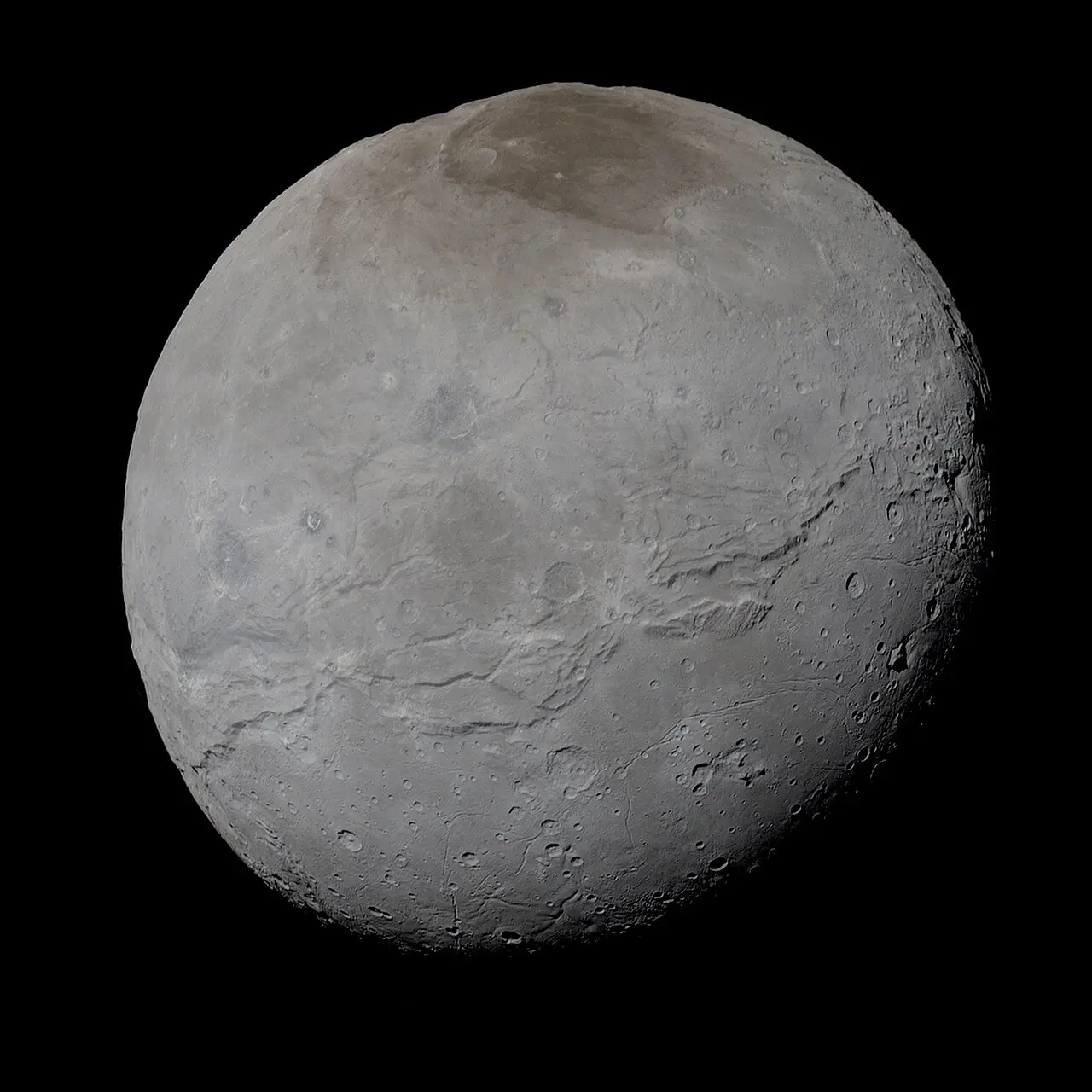
Decades later, NASA's New Horizons spacecraft flew past the Pluto system in 2015 and showed Charon in stunning detail: a gray, cratered world about half Pluto's size, with a dark reddish stain spread across its north pole — the very face you see in the image above. The two bodies, each keeping one face turned eternally toward the other, are the closest thing to a double planet we know.
It all began with an astronomer who refused to dismiss a blurry plate as a defect. On June 22, 1978, James Christy looked at a smudge of light and found a world.
Photo: NASA / Johns Hopkins University Applied Physics Laboratory / Southwest Research Institute / Alex Parker, public domain (via Wikimedia Commons).