Napoleon's Second Abdication: The Emperor Gives Up for Good
Four days after Waterloo, Napoleon Bonaparte abdicated the French throne for the second time, ending his return to power and his reign forever.
He had escaped exile once, raised another army, and marched back into Paris to reclaim an empire. But on June 22, 1815, Napoleon Bonaparte finally ran out of comebacks.
Four days earlier, on June 18, his army had been shattered at Waterloo by the Duke of Wellington and the Prussian forces of Gebhard von Blücher. Napoleon fled back to Paris, hoping to rally France once more. Instead he found the capital in no mood for another miracle. The Chamber of Representatives, the legislature of his own making, demanded that he step aside. The empire he had rebuilt in a matter of weeks was collapsing around him.
On June 22, 1815, Napoleon signed his second abdication. The first, in 1814, had sent him to the Mediterranean island of Elba — from which he had escaped to launch the adventure known as the Hundred Days. This time there would be no island in the Mediterranean and no return. He abdicated in favor of his young son, Napoleon II, a gesture the victorious allies had no intention of honoring.
What followed was a frantic, almost pitiful flight. Napoleon made for the Atlantic coast, hoping to sail for America. At Rochefort he found British warships waiting. With no way out, he surrendered to Captain Frederick Maitland of HMS Bellerophon. The most feared commander of his age gave himself up to the captain of a single ship.
The British government had learned its lesson from Elba. There would be no nearby island this time. Napoleon was transferred to HMS Northumberland and carried across the equator to Saint Helena, a speck of volcanic rock in the South Atlantic, thousands of miles from Europe. He would spend his final years there, dictating his memoirs and shaping the legend of his own life.
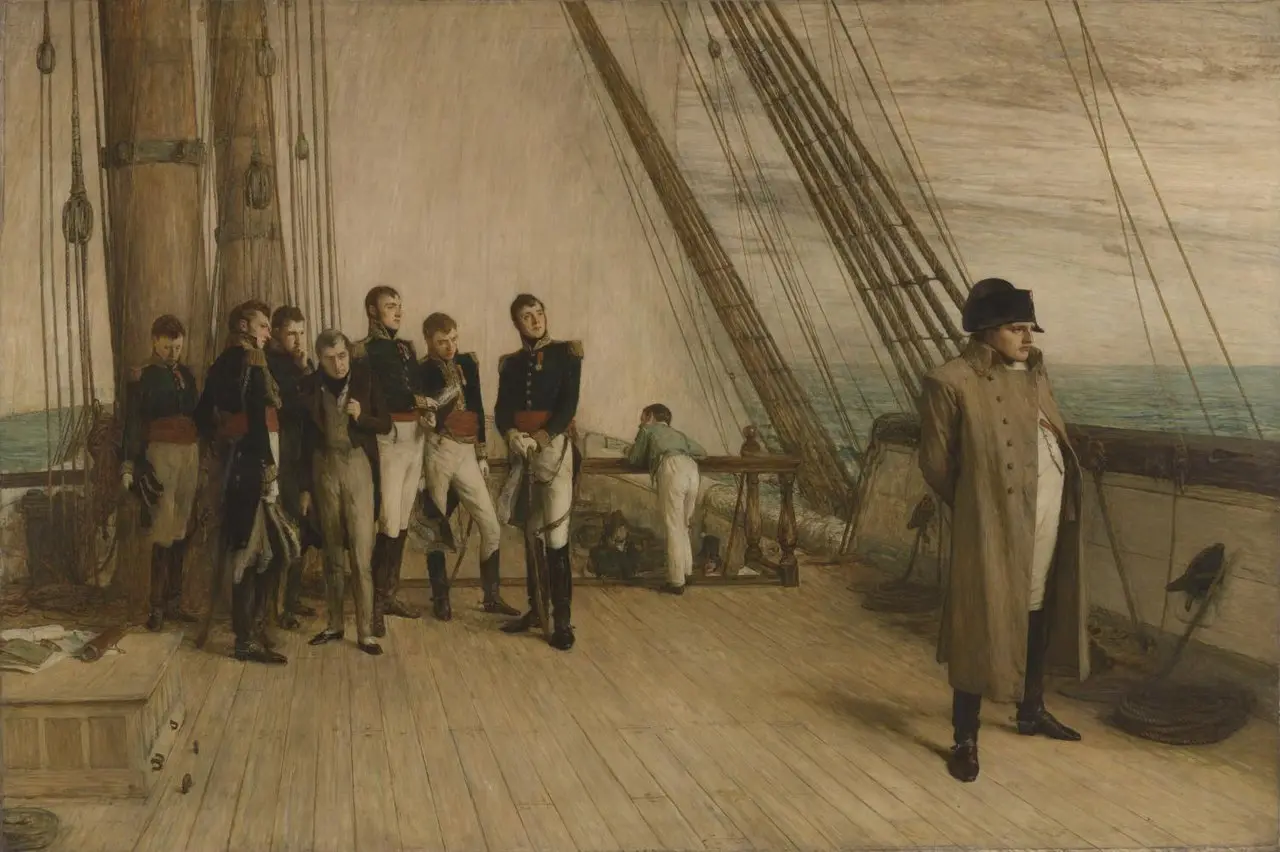
The painting that accompanies this story, made in 1880 by Sir William Quiller Orchardson and now held by Tate Britain, imagines that strange interlude aboard the Bellerophon: the fallen emperor standing apart at the ship's rail in his famous bicorne hat and greatcoat, while the British officers who captured him keep a respectful distance. It is a portrait of power in the exact moment it becomes history.
Why does a signature on June 22 matter? Because it closed the book on more than a man. Napoleon's wars had redrawn the map of Europe, spread — and then discredited — revolutionary ideals across a continent, and left a legal and administrative legacy, the Napoleonic Code, that still shapes law in dozens of countries. The diplomats gathering at the Congress of Vienna were already carving up the peace as he signed. Europe would not see a conqueror like him again.
Napoleon abdicated twice. The first time, Europe held its breath. The second time, on June 22, 1815, it simply moved on.
Photo: Painting by Sir William Quiller Orchardson (1880), Tate Britain, public domain (via Wikimedia Commons).