The Doctor's Terrible Marvel: The Gatling Gun Is Patented
On November 4, 1862, Richard Gatling received U.S. Patent No. 36,836 for his hand-cranked 'revolving battery gun' — the ancestor of the modern machine gun.
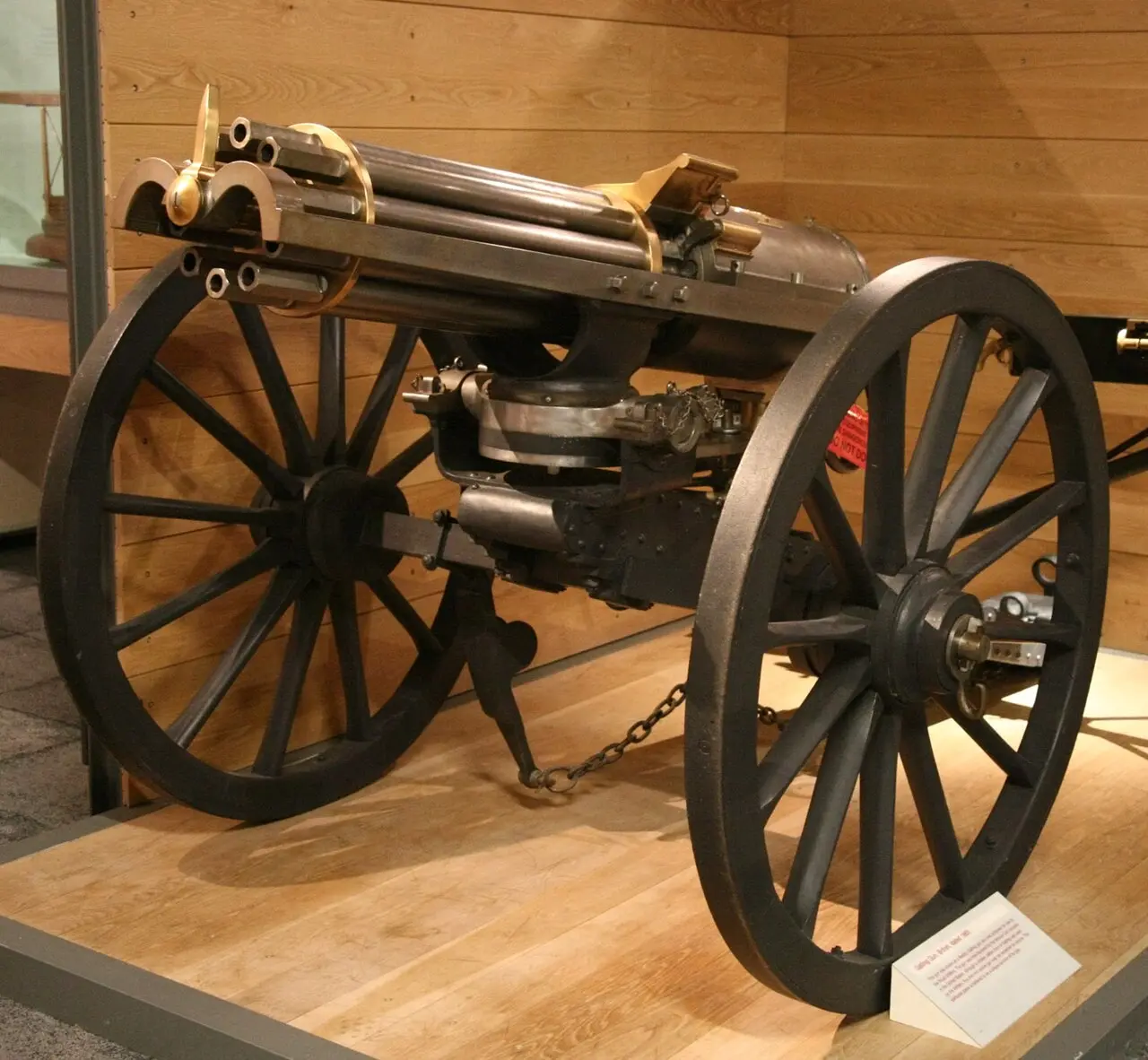
On November 4, 1862, the United States Patent Office issued Patent No. 36,836 to Richard Jordan Gatling of Indianapolis, Indiana, for an "improvement in revolving battery guns." The device it described — a cluster of barrels spun by a hand crank, firing hundreds of rounds a minute — was the world's first practical machine gun, and its descendants are still in service today.
Gatling was a trained physician who had drifted into invention, with farm machinery and a steam plow already to his name. The Civil War changed his focus. In the summer of 1861, just months after Fort Sumter, he conceived a weapon that could multiply a single soldier's firepower; by the spring of 1862 he had a working prototype, and that November the patent made it official.
The mechanism was elegantly brutal. Six rifled barrels revolved around a central axis as the gunner turned a crank, each barrel loading, firing, and ejecting in sequence. Early models could fire roughly 200 rounds a minute — many times the rate of a muzzle-loading rifle — fed from a hopper of paper cartridges. It was aimed like artillery, mounted on a carriage, and operated by a small crew.
Here is the strange paradox of the Gatling gun: its inventor built it hoping to make war less deadly. Gatling reasoned that if one man could do the battle duty of a hundred, great armies would become unnecessary — and if war became terrible enough, nations might abandon it altogether. In words later quoted in his Scientific American obituary, he believed that a weapon allowing one soldier to replace a hundred on the battlefield would mean "the need for large armies would disappear," and with it much of war's slaughter.
History declined the bargain. The gun saw only limited use in the Civil War, but in the decades that followed, armies around the world adopted it — and used it exactly as its inventor had feared, to mow down enemies in colonial wars on four continents. Gatling lived to see his paradox play out: the machine meant to end war instead helped industrialize it.
Still, the patent of November 4, 1862, marks a genuine turning point. Every rotary-barrel cannon on a modern warship or attack helicopter — the spiritual heirs of Gatling's crank — traces its lineage to that Indianapolis workshop. One man's humane miscalculation became the blueprint for a century of firepower.
Photo: Max Smith (Megapixie), public domain (via Wikimedia Commons).