Sixty-Seven Words That Redrew the Middle East
On November 2, 1917, Britain's Balfour Declaration promised a 'national home for the Jewish people' in Palestine — 67 words that echoed for a century.
It was barely a page long, and it changed the map of the world. On November 2, 1917, Britain's foreign secretary, Arthur Balfour, signed a short letter to Lord Rothschild, a leader of Britain's Jewish community — and set in motion a century of consequence.
The letter's key passage, all of 67 words, read: "His Majesty's government view with favour the establishment in Palestine of a national home for the Jewish people, and will use their best endeavours to facilitate the achievement of this object, it being clearly understood that nothing shall be done which may prejudice the civil and religious rights of existing non-Jewish communities in Palestine, or the rights and political status enjoyed by Jews in any other country."
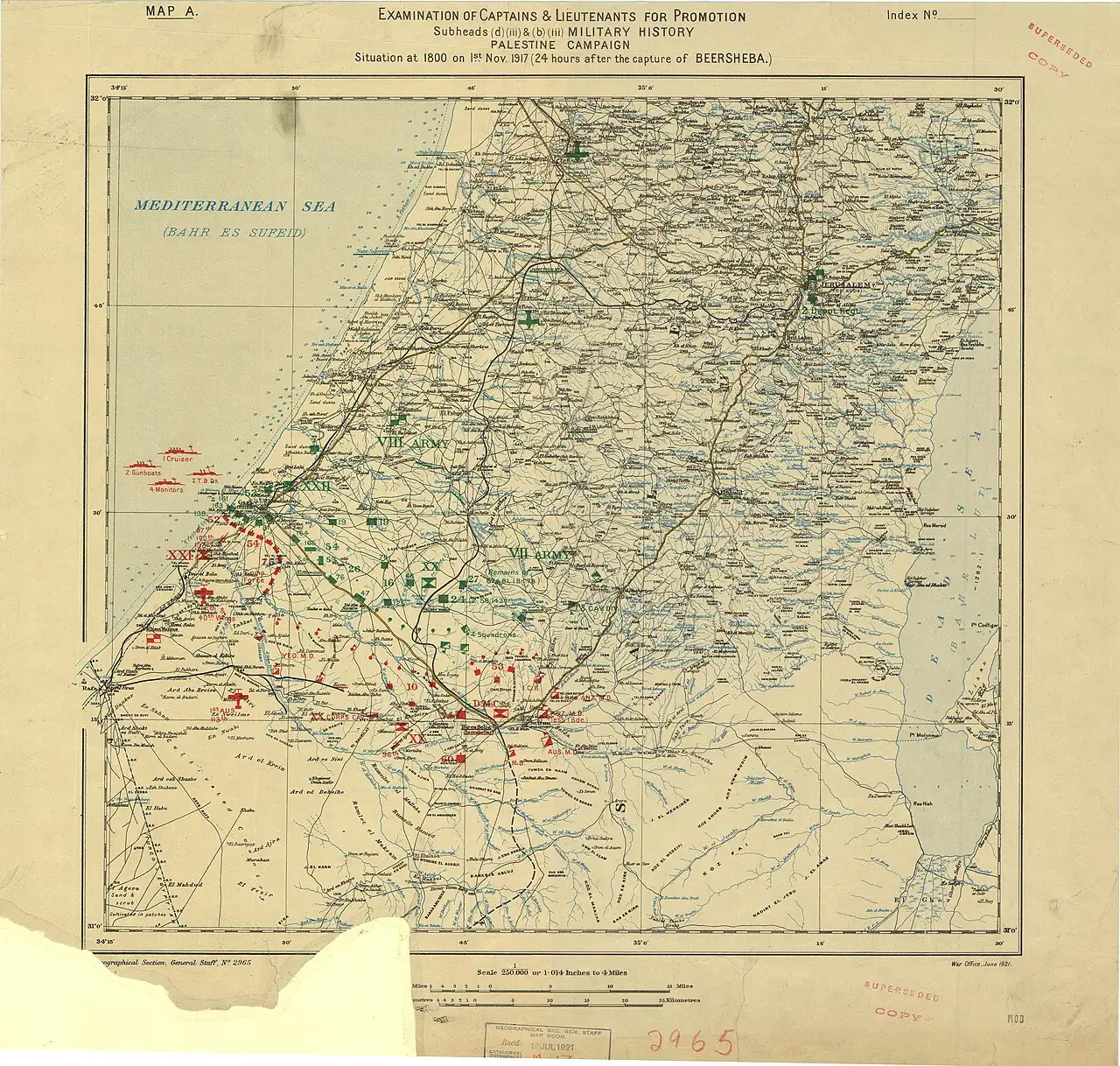
The timing was no accident. Britain was deep in the First World War, and its armies — as the map above shows — were advancing through Palestine against the Ottoman Empire. British leaders had several motives at once: sympathy for the Zionist movement, whose chief diplomat Chaim Weizmann had impressed London's elite; a desire to rally Jewish support for the Allied cause; and a strategic interest in a friendly presence near the Suez Canal, the lifeline of the British Empire.
The map above, drawn by the British War Office, captures the military moment: Allenby's forces had just taken Beersheba the day before, and Jerusalem would fall within weeks.
The declaration was a statement of intent, not a law — Britain did not yet even control Palestine. But after the war, the League of Nations wrote the declaration into the British Mandate for Palestine in 1922, giving it the force of international law. Jewish immigration grew, tensions with the Arab majority deepened, and after the Second World War and the Holocaust, the United Nations voted in 1947 to partition Palestine. In 1948, the state of Israel was proclaimed.
Few documents of such brevity have cast such a long shadow. To supporters of Israel, the declaration was the first great-power recognition of the Jewish people's right to a homeland. To Palestinians and their supporters, it was a promise made about their land without their consent — the "existing non-Jewish communities" whose rights the letter pledged to protect. Historians still debate what Britain intended, what it promised to whom, and whether its authors understood what they were setting in motion.
What is not debated is the document's place in history: a one-page letter, written in wartime London, that helped redraw the Middle East.
Photo: UK Government, public domain (via Wikimedia Commons).