
Twelve Minutes Outside the Spaceship: The First Spacewalk
On March 18, 1965, Soviet cosmonaut Alexei Leonov spent 12 minutes outside his Voskhod 2 capsule — the first spacewalk in history.
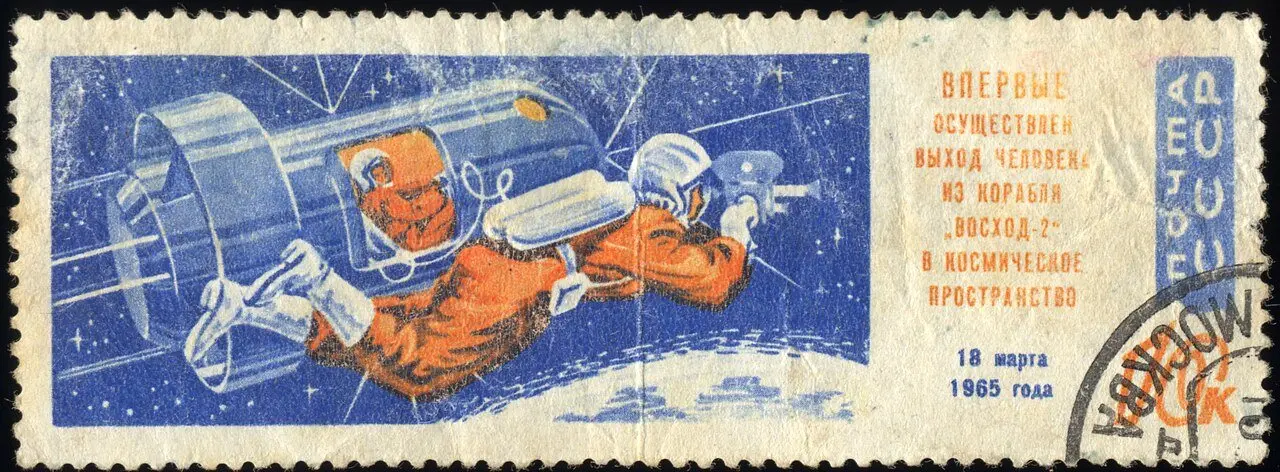
On March 18, 1965, a hatch opened high above the Earth, and Alexei Leonov floated out into nothing. Tethered to his Voskhod 2 capsule by a 16-foot cord, the Soviet cosmonaut became the first human being to walk in space — and almost didn't make it back.
The mission had launched that morning from Baikonur with Leonov and commander Pavel Belyayev aboard. The plan sounded simple: depressurize the airlock, open the hatch, step outside, float for a while, come back in. For 12 minutes and 9 seconds, it worked. Leonov drifted free of the spacecraft, the first person ever to do so, with the Earth turning below him.
Then his spacesuit betrayed him. In the vacuum of space, the suit ballooned and stiffened until Leonov could barely move — and could not fit back through the airlock hatch. With his body temperature soaring and his air supply limited, he made a decision that violated every safety rule he had been taught: he opened a valve on his suit and bled air out of it, dropping the pressure until the suit softened enough for him to squeeze through the hatch. He made it inside, drenched in sweat, having risked decompression sickness to save his own life.
The Soviet Union announced a triumph, and it was one — the Fédération Aéronautique Internationale ratified the 12-minute, 9-second spacewalk as a world record. But the full story of how close it came to disaster stayed quiet for years. Less than three months later, on June 3, 1965, American astronaut Ed White made the first U.S. spacewalk from Gemini IV, and the space race had a new arena.
Leonov was more than a daredevil. Trained as an artist, he had carried colored pencils aboard Voskhod 2 and sketched an orbital sunrise during the flight — the first work of art ever made in outer space. He went on to command the Soviet half of the Apollo–Soyuz mission in 1975, the first international crewed spaceflight, and he died in 2019 at the age of 85, remembered as a pioneer and a peacemaker.
Every spacewalk since — the assembly of the International Space Station, the repairs to the Hubble telescope — descends from those twelve minutes. Leonov proved that a human being could not only survive outside a spacecraft, but work there. He proved it the hard way, with a swelling spacesuit and no margin for error, and lived to tell the tale.
Photo: 1965 Soviet 10-kopek postage stamp commemorating the first spacewalk, public domain (via Wikimedia Commons).