Three Hours, Three States: America's Deadliest Tornado
On March 18, 1925, a monster tornado cut a 219-mile scar through Missouri, Illinois, and Indiana, killing 695 people — still the deadliest tornado in U.S. history.
There was no warning. In 1925, there were no tornado sirens, no weather radios, no Doppler radar — the word 'tornado' was even banned from U.S. Weather Bureau forecasts, for fear of causing panic. So when the sky turned an eerie green over southeast Missouri on the afternoon of March 18, 1925, the people below had no idea what was coming.
Around 12:40 p.m., a massive funnel touched down northwest of Ellington, Missouri, and began racing northeast at highway speed. More than a mile wide in places, with winds estimated above 300 miles per hour, it was as powerful as tornadoes get — what experts today call an F5. It flattened 90 percent of Annapolis, Missouri, then crossed the Mississippi River into Illinois, where it did its worst work.
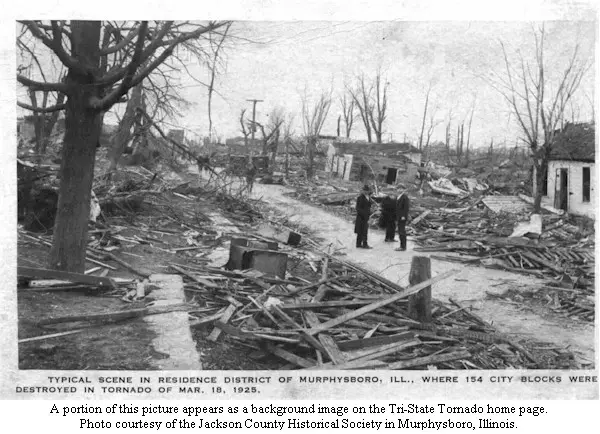
In the tiny town of Gorham, nearly every building was damaged or destroyed and 37 residents were killed — more than half the town's population. It reached Murphysboro, Illinois, around 2:35 p.m., moving at about 73 miles per hour. There, 234 people died, the largest single-community tornado death toll in American history. Forty percent of the city's buildings were damaged or destroyed; the First Baptist Church collapsed during a funeral service. In nearby De Soto, the tornado struck a school, killing 41 residents including 33 schoolchildren. In West Frankfort, at least 148 people died. Whole towns — Parrish, Illinois, and Griffin, Indiana — were essentially wiped off the map; Parrish was never rebuilt.
By the time the twister dissipated near Princeton, Indiana, around 4:30 p.m., it had been on the ground for more than three hours and traveled 219 miles — the longest tornado track ever recorded. The final toll: 695 dead and 2,027 injured, across three states, with some 15,000 homes destroyed and $16.5 million in damage. A 2013 study combining photographs, interviews, and news accounts confirmed at least 151 miles of continuous track, though whether it was one unbroken tornado or a family of twisters is still debated.
The Tri-State Tornado remains the deadliest tornado in American history and the second-deadliest ever recorded worldwide. Though the Fujita scale did not exist in 1925, meteorologists who have studied the damage — including renowned tornado experts Ted Fujita and Thomas Grazulis — agree it would have been rated an F5, the maximum. Its legacy is written into modern meteorology: the disaster helped end the ban on the word 'tornado' in forecasts and pushed the country toward the sirens, spotter networks, and radar warnings we rely on today — because on March 18, 1925, nobody saw it coming.
Photo: Jackson County Historical Society, Murphysboro, Illinois, public domain.