The Ten Days That Never Happened
On October 4, 1582, the last day of the Julian calendar, Pope Gregory XIII's reform deleted ten days overnight — the next morning was Friday, October 15.
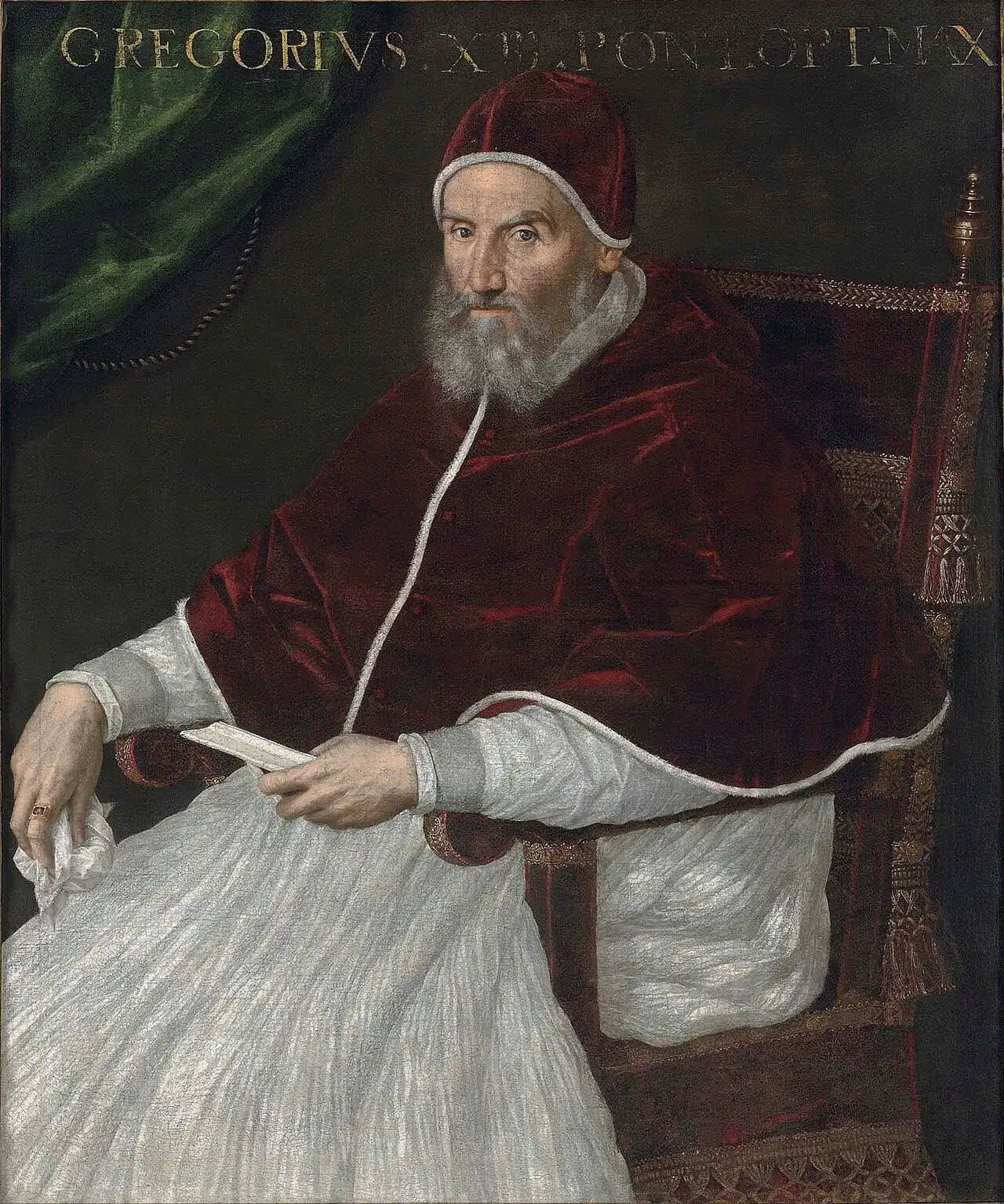
On the night of October 4, 1582, people across Italy, Spain, Portugal, and the Polish-Lithuanian Commonwealth went to bed on a Thursday — and woke up on Friday, October 15. Ten days had vanished from their lives. Birthdays, debts, saints' feast days: all skipped, by order of the Pope.
The culprit was a calendar that had been quietly lying for more than sixteen centuries. In 45 BC, Julius Caesar had set the year's length at 365 and a quarter days, with a leap day every four years. It was a fine approximation — but the true solar year is about eleven minutes shorter. Eleven minutes a year sounds like nothing. Over thirteen centuries, it added up to ten days. By the 1500s the calendar had drifted so far that the spring equinox — the anchor for calculating Easter, fixed at March 21 by the Council of Nicaea in AD 325 — was falling around March 10 or 12 instead.
Enter Pope Gregory XIII. In February 1582 he issued the papal bull Inter gravissimas, ordering a fix designed largely by the Jesuit astronomer Christopher Clavius and building on the work of the physician-astronomer Aloysius Lilius. The plan was bracingly simple: cut the ten phantom days out of October 1582, and stop the drift from recurring by dropping three leap days every four centuries — century years would be leap years only when divisible by 400. So 1600 and 2000 stayed leap years; 1700, 1800, and 1900 did not.
The cut itself was the dramatic part. Thursday, October 4, 1582, was declared the last day of the old Julian calendar. The next day was not Friday the 5th — it was Friday, October 15, the first day of the new Gregorian calendar. Four Catholic realms made the jump together. France followed two months later. But the Pope's bull carried no civil authority on its own; each nation's rulers had to adopt the reform themselves, and in Protestant Europe suspicion ran deep. A calendar invented by the Pope, in the middle of the Counter-Reformation, looked to many like a plot to drag them back to Rome. Some ordinary people, the records say, feared landlords would use the missing days to cheat them out of rent.
So the world split in two. Catholic countries marched to the new rhythm while Protestant ones clung to the old. Britain and its colonies — including the American seaboard — refused to budge for another 170 years, finally switching in September 1752 and skipping eleven days, the drift having grown by then. For a century and a half, a letter posted in London and received in Paris had to be dated twice.
Today the Gregorian calendar is the closest thing humanity has to a universal timepiece — the calendar on your phone, your wall, and the space station is the one Gregory XIII signed into being. And it is astonishingly accurate: even with the refined leap-year rule, the average calendar year runs only about 26 seconds long, a discrepancy that would take more than three thousand years to grow into a single day. Ten days were deleted once, so that no day would ever be lost again.
Photo: Portrait of Pope Gregory XIII by Lavinia Fontana, public domain, via Wikimedia Commons.