The Day They Started Carving a Mountain
On October 4, 1927, sculptor Gutzon Borglum began blasting four presidents' faces into South Dakota's Mount Rushmore — a 14-year project built on sacred, contested land.
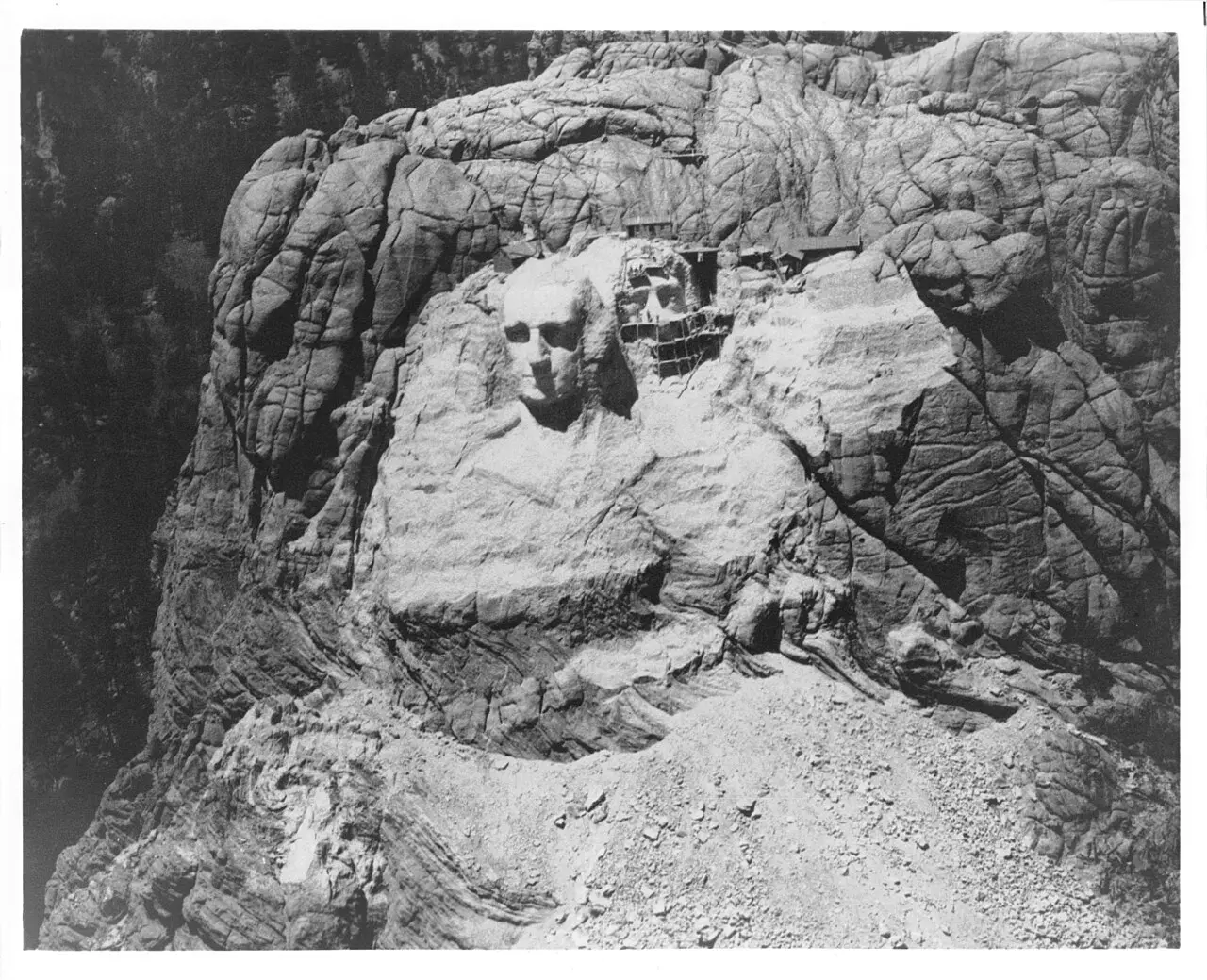
On October 4, 1927, a 60-year-old sculptor stood in the Black Hills of South Dakota, looked up at a granite cliff, and lit the first fuse. Gutzon Borglum was about to carve four 60-foot faces into the side of a mountain — with dynamite. It would take fourteen years, some 400 workers, and 450,000 tons of blasted rock. Nobody had ever attempted anything like it.
The idea hadn't been Borglum's. South Dakota's state historian, Doane Robinson, had dreamed it up a few years earlier as a tourism scheme: carve the region's cliffs into a monument and lure travelers to the Black Hills. Robinson imagined frontier heroes. Borglum, a showman with national ambitions, insisted on bigger subjects — presidents who embodied the nation's story: George Washington for its founding, Thomas Jefferson for its territorial expansion, Theodore Roosevelt for its economic development, and Abraham Lincoln for its preservation through civil war.
The work was as dangerous as it sounds. Men dangled hundreds of feet above the forest floor in leather bosun chairs, lowered by hand-cranked winches, drilling into solid granite. "Powdermen" set the dynamite charges, which were detonated when the crews were off the mountain — about 90 percent of the rock was removed by explosives. Then drillers honeycombed the stone, boring grids of shallow holes so carvers could knock the granite away by hand, finishing with pneumatic hammers. Young "callboys" relayed shouted instructions between the dangling workers and the winch operators. Remarkably, across fourteen years of explosives and hundred-foot drops, not a single worker was killed.
There was another side to the mountain. To the Lakota and other Indigenous peoples of the region, it was the Six Grandfathers, a sacred place in the Black Hills — land guaranteed to them by the 1868 Treaty of Fort Laramie and seized by the United States after gold was discovered there. Borglum began his carving over the vehement objections of Native Americans, and that history shadows the monument to this day. The chief carver who gave the faces their lifelike finish was himself an immigrant: Luigi Del Bianco, a stonemason from Friuli, Italy, chosen for his feel for sculptural expression.
Borglum never saw it finished. He died in March 1941; his son Lincoln oversaw the final months, and the work was declared complete on October 31, 1941. The grander plans — presidents carved to the waist, a great Hall of Records behind the faces — were abandoned for lack of money. What remains draws more than two million visitors a year, one of America's most recognizable landmarks.
Mount Rushmore endures as both an engineering marvel and a contested symbol — a testament to what human ambition can blast out of a mountainside, and a reminder of whose mountain it was first. On October 4, 1927, a sculptor lit a fuse. The explosion is still echoing, in arguments about history, land, and who gets carved into stone.
Photo: National Park Service, public domain, via Wikimedia Commons.