The Beep Heard Around the World
On October 4, 1957, the Soviet Union launched Sputnik 1, a 184-pound metal sphere whose simple radio beep stunned America and ignited the Space Race.
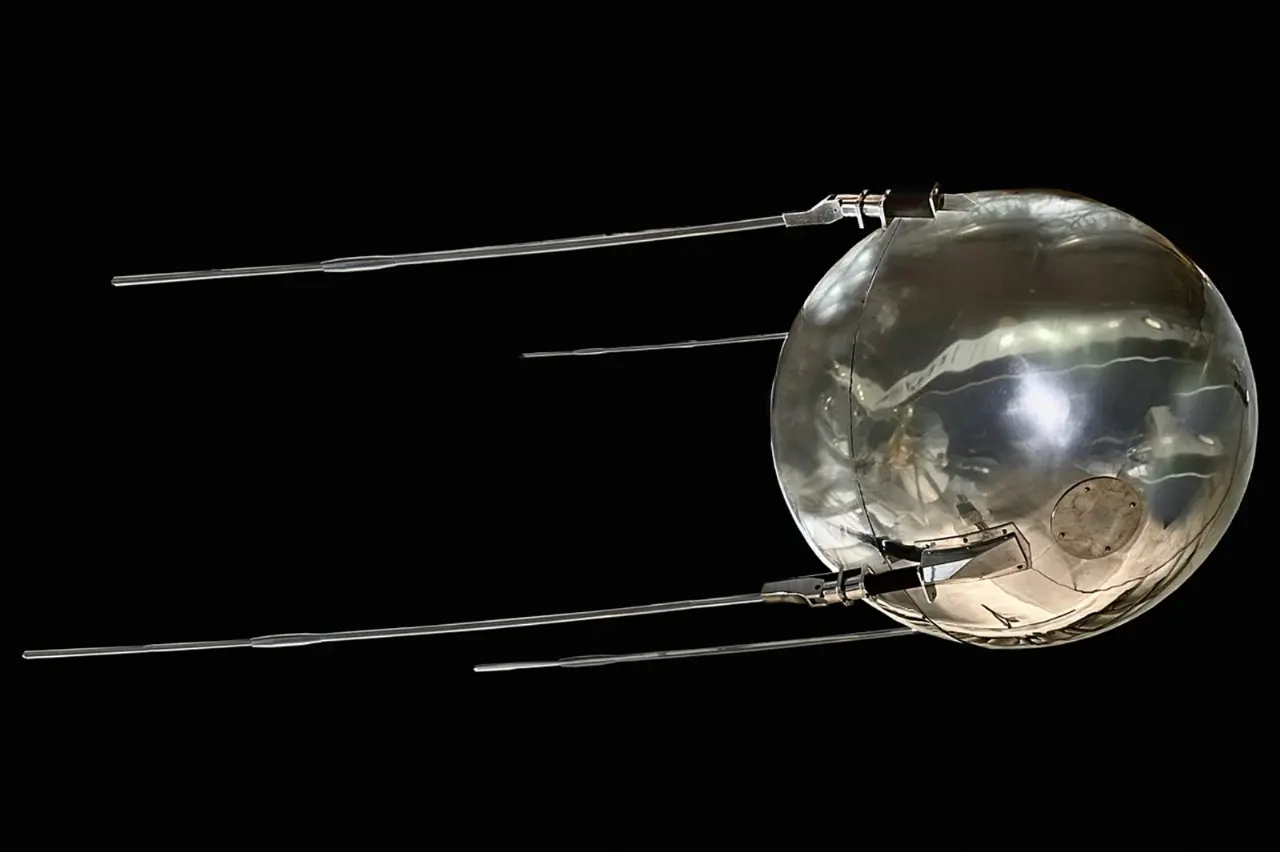
On the evening of October 4, 1957, radio operators around the world heard something no human had ever heard before: a steady, confident beep... beep... beep drifting down from the sky. It was coming from outer space — from a polished metal sphere the size of a beach ball, circling the Earth roughly every 96 minutes. The Space Age had begun. And America had not started it.
The sphere was Sputnik 1, and it was Soviet. At 19:28 UTC that evening, a modified R-7 rocket — the world's first intercontinental ballistic missile — lifted off from a secret launch site on the Kazakh steppe, the place the world would come to know as the Baikonur Cosmodrome. Riding atop the rocket was the satellite itself: two aluminum hemispheres bolted together into a sphere 58 centimeters across, weighing 83.6 kilograms, with four spindly antennas angled out behind it.
The man behind the launch was Sergei Korolev, the Soviet Union's chief rocket designer — though almost no one outside the Soviet space program knew his name. Moscow kept his identity a state secret until after his death in 1966. Under his direction, Soviet engineers had made a ruthless decision: their original satellite design, a heavy scientific laboratory, was running behind schedule, and the Americans were talking openly about launching their own satellite. So Korolev's team shelved the ambitious version and built the simplest thing that could possibly fly — a shiny ball with a radio transmitter inside.
Simple was enough. Seconds after the rocket's engines cut out, the little sphere began pulsing its signal on two shortwave frequencies, and the beep was picked up by tracking stations — and by amateur ham-radio operators — all over the planet. Soviet news media announced the triumph to the world, and the world believed it, because anyone with a radio could hear the proof passing overhead.
In the United States, the reaction was shock bordering on panic. American leaders had assumed their country led the world in science and technology. Now a rival had placed the first artificial object into orbit — and the same rocket that carried it could, in principle, carry a warhead across an ocean. The American satellite program, Vanguard, was still sitting on its launch pad; when it finally attempted flight that December, it exploded seconds after liftoff on live television.
Washington moved quickly. Within a year, the United States had created a civilian space agency — NASA — and Congress passed the National Defense Education Act, pouring money into science education to train a generation of engineers. The Space Race was on. It would run for more than a decade, through the first human in space, the first spacewalks, and finally the Moon landing in 1969.
Sputnik 1 itself did not last. Its batteries fell silent after about three weeks of beeping, and the dead sphere kept circling, spiraling gradually downward until it burned up in the atmosphere on January 4, 1958 — 92 days after launch, after more than 1,400 trips around the planet.
But its echo never faded. In Russian, sputnik means "fellow traveler," a companion on a journey. That first fellow traveler proved that space was within reach, and everything humanity has put up there since — weather satellites, GPS, space stations, great observatories — follows the trail it blazed. On October 4, 1957, the human race became a spacefaring species. All it took was a beep.
Photo: Steve Jurvetson, CC BY, via Wikimedia Commons.