The Shoe Heard Round the World: Khrushchev at the UN, 1960
On October 12, 1960, Nikita Khrushchev reportedly pounded his shoe on his desk at the UN General Assembly — the Cold War's most famous, and most disputed, diplomatic outburst.
The most famous shoe in Cold War history may never have been banged at all — or it may have been banged exactly as the newspapers said. Sixty-plus years later, historians still argue about it. But on October 12, 1960, something happened at the United Nations that turned a Soviet leader's temper into a legend.
It was the 902nd plenary meeting of the UN General Assembly in New York, and the session was already electric. The Soviet premier, Nikita Khrushchev, had been in town for weeks, giving marathon speeches denouncing Western colonialism. The year 1960 was the height of decolonization — seventeen new African nations had just joined the UN — and the Congo crisis was raging. The General Assembly hall was the Cold War's great stage.
That afternoon, the Philippine delegate, Lorenzo Sumulong, took the floor and said the unsayable: that the peoples of Eastern Europe had been "deprived of the free exercise of their civil and political rights" and "swallowed up, so to speak, by the Soviet Union" — in other words, that the USSR was itself a colonial empire. Khrushchev erupted. He stormed to the rostrum, theatrically brushed past Sumulong, and denounced him as, in the words reporters recorded, "a jerk, a stooge, and a lackey" and "a toady of American imperialism." The assembly president, Frederick Boland of Ireland, ordered Khrushchev back to his seat.
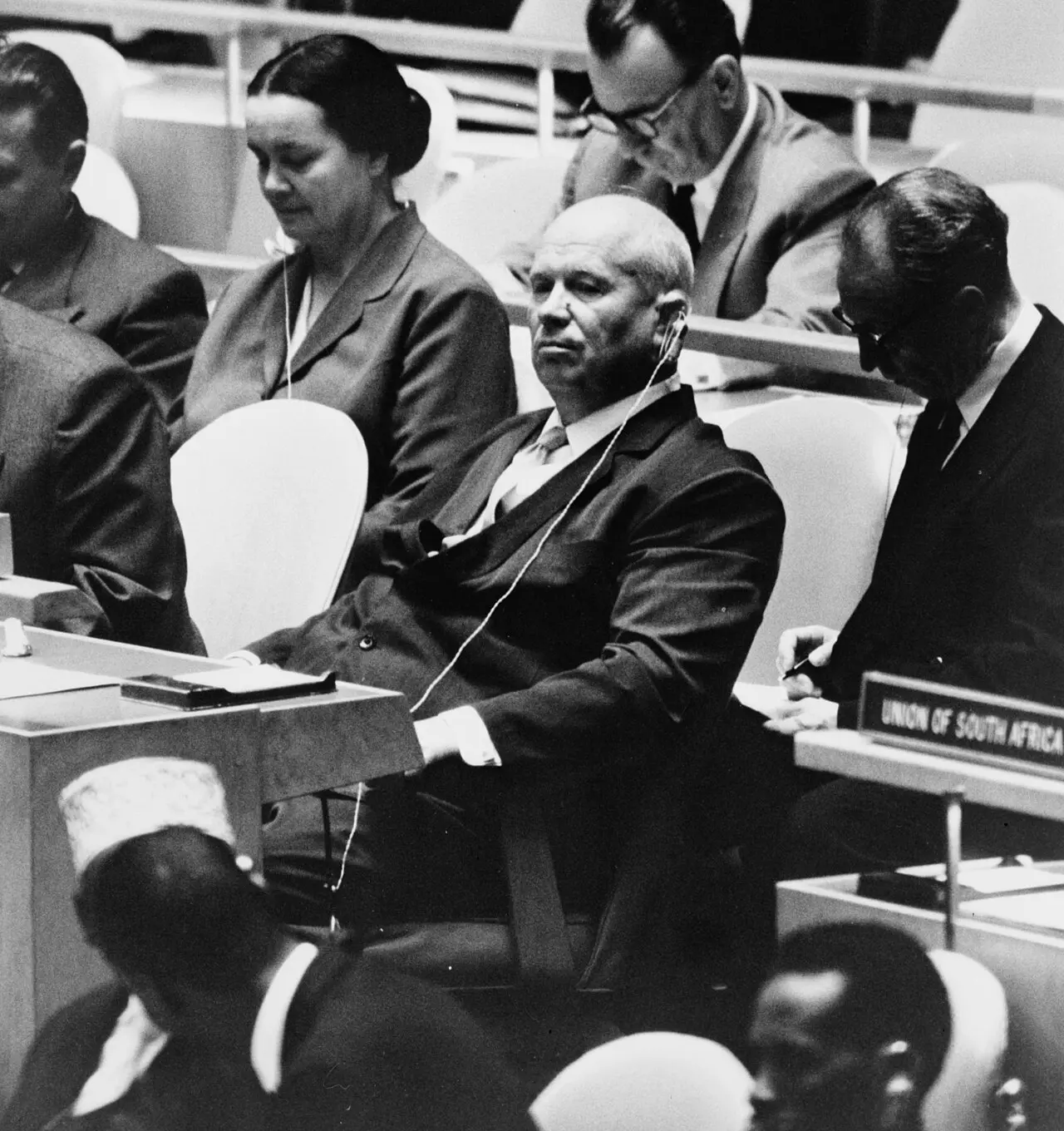
And then came the shoe. According to reporters in the hall — the New York Times among them — Khrushchev removed his shoe and pounded it on his delegate's desk in fury as the debate continued. The image flashed around the world: the leader of a superpower, banging his shoe like a cobbler at the parliament of nations. "Shoe-banging diplomacy" entered the language.
But here is where the story gets strange. The UN's own official record contains no mention of any shoe. No photograph or film of the moment has ever surfaced — and at least one famous "photo" of Khrushchev waving a shoe turned out to be a doctored fake, a shoe pasted into an unrelated picture. When the historian William Taubman interviewed eyewitnesses for his biography of Khrushchev, some remembered him merely brandishing the shoe, not banging it. Taubman himself concluded the banging did happen — but the debate has never fully died.
What isn't disputed is the scene's meaning. Khrushchev was a peasant's son who had risen to rule a superpower, and his raw, theatrical style was both his weapon and his weakness. At the UN in 1960 he was performing for the newly independent nations of Africa and Asia, casting the Soviet Union as their champion against empire — even as Sumulong's barb exposed the awkward truth that Moscow held its own subject peoples. The shoe, real or exaggerated, became the perfect symbol of an era when global politics could turn on a gesture: crude, memorable, and impossible to ignore.
October 12, 1960, matters not because a shoe was banged, but because of what the story became. It is a reminder that the most vivid moments in history are sometimes the least documented — and that in diplomacy, as in theater, the performance can matter as much as the policy.
Photo: public domain photograph of Nikita Khrushchev at a United Nations General Assembly meeting, September 1960 (via Wikimedia Commons).