The Senate's 69–11 Vote That Changed the Court
On August 30, 1967, the Senate confirmed Thurgood Marshall 69–11, making him the first Black justice in Supreme Court history.
On June 13, 1967, President Lyndon Johnson stood before the cameras and announced a nomination he knew would make history. Thurgood Marshall, he said, was "best qualified by training and by very valuable service to the country. … I believe it is the right thing to do, the right time to do it, the right man and the right place."
Marshall's qualifications were, quite literally, unmatched. As the NAACP's chief counsel for a quarter century, he had argued 32 cases before the Supreme Court and won 29 of them — dismantling, case by case, the legal architecture of segregation. His crowning victory was Brown v. Board of Education in 1954, in which the Court declared that segregated public schools were unconstitutional. "This Court should make it clear that that is not what our Constitution stands for," he had argued — and the Court agreed. A man whose great-grandfather had been enslaved had become the most successful Supreme Court advocate in American history. Along the way he had also become the first Black federal appeals judge, in 1961, and the first Black solicitor general, in 1965.
But the confirmation was a fight. Southern senators, defenders of segregation, dragged the process out. In the Judiciary Committee, Senator Strom Thurmond subjected Marshall to what Time magazine called a "Yahoo-type hazing" — more than sixty questions on obscure corners of constitutional history, designed to trip him up. He didn't trip. The committee voted 11–5 to recommend him.
On August 30, after six hours of Senate debate, the full chamber voted 69 to 11 to confirm. Thurgood Marshall took the constitutional oath on October 2, 1967, becoming the first African American — the first non-white justice of any background — to sit on the Supreme Court.
He would serve for nearly twenty-four years. On the liberal Warren Court he was usually in the majority; on the more conservative Burger Court that followed, his most consequential writing came in dissent, defending the civil-rights principles he had spent his life establishing. His closest ally on the bench was Justice William Brennan — the two agreed so often that their clerks jokingly merged them into a single justice, "Brennanmarshall."
Marshall retired in 1991 and died two years later, but the deeper story of that August vote is the arc it completed: a lawyer who had spent a quarter century arguing before the Supreme Court took a seat on it — and the highest court in the land finally looked, at least a little, like the country it judged.
The cases Marshall won read like a map of American civil rights law. In 1944's Smith v. Allwright, he persuaded the Court to strike down the whites-only primary elections that had locked Black voters out of Southern politics. In 1948's Shelley v. Kraemer, he killed the judicial enforcement of racially restrictive housing covenants. In 1950, Sweatt v. Painter and McLaurin v. Oklahoma State Regents cracked the doctrine of "separate but equal" in graduate and professional education — the direct stepping stones to Brown.
His confirmation hearings revealed the opposition's real objection. The Judiciary Committee's majority praised his "thoughtfulness, care, moderation, reasonableness, a judicial temperament, and a balanced approach to controversial and complicated national problems." The minority could not quite say what it was about him that worried them — though his liberal record on civil rights was no secret to anyone in the room.
On the Court, Marshall called Chief Justice Earl Warren "probably the greatest Chief Justice who ever lived," and he served nearly twenty-four years, retiring in 1991. He died two years later, in 1993. By then the Court he joined had been transformed — and so had the country.
The Congressional Record's tribute after his death quoted the Washington Afro-American: "We make movies about Malcolm X, we get a holiday to honor Dr. Martin Luther King, but every day we live the legacy of Justice Thurgood Marshall." On August 30, 1967, the Senate made that legacy permanent with a single roll call: 69 in favor, 11 opposed, and one seat on the highest court changed forever.
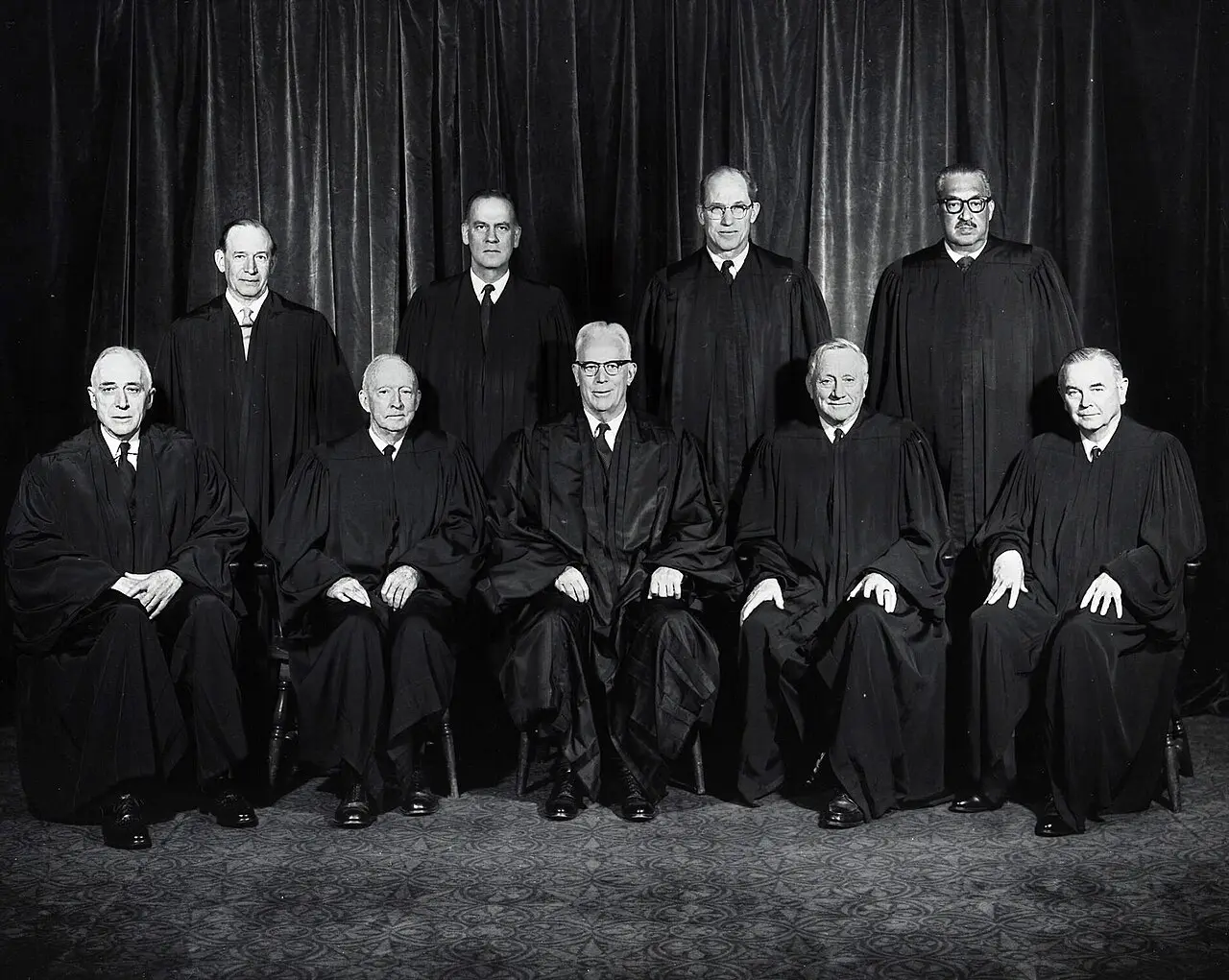
Photo: U.S. Supreme Court, public domain (via Wikimedia Commons).