
The Night Challenger Carried History
On August 30, 1983, Guion 'Guy' Bluford launched aboard Challenger's STS-8 mission, becoming the first African American in space.
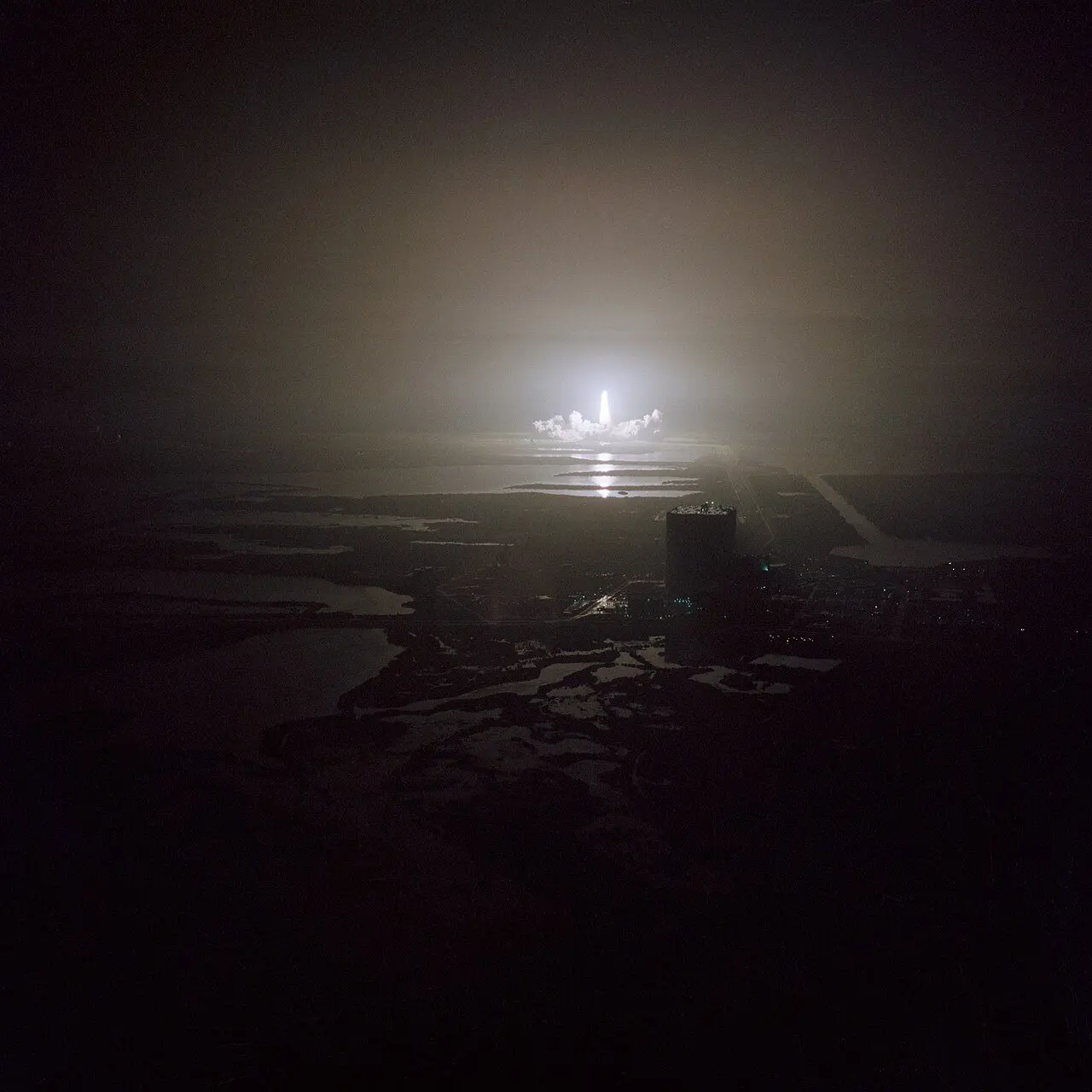
Just after 2:30 on the morning of August 30, 1983, the sky over Florida's Kennedy Space Center tore open with light. Space Shuttle Challenger rose on a pillar of fire in the first night launch in the history of the shuttle program — a sight so bright it turned midnight to noon across the marshes. Riding in the crew cabin was mission specialist Guion 'Guy' Bluford. When Challenger reached orbit, he became the first African American in space.
Challenger was still practically new. STS-8 was only the orbiter's third flight — and almost every aspect of this one was a first. NASA had originally planned to fly a communications relay satellite, but when the upper stage that carried the first one malfunctioned on the previous mission, managers swapped it for test work with the Canadian robotic arm. The orbit needed for INSAT-1B's deployment dictated a night launch and a night landing — both unprecedented for the shuttle.
Bluford had never set out to be a pioneer. 'My desire was to make a contribution to the program,' he said. An Air Force fighter pilot who flew 144 combat missions in Vietnam and then earned a doctorate in aerospace engineering, he was selected in 1978 as one of NASA's 'Thirty-Five New Guys' — the first astronaut class to include African Americans, women (including Sally Ride), and an Asian American. He later admitted he would have preferred being the second Black astronaut — 'being the No. 2 guy would probably be a lot more fun' — but he embraced the role: 'I wanted to set the standard, do the best job possible so that other people would be comfortable with African-Americans flying in space.'
STS-8 was a working mission, not a joyride. Bluford helped deploy INSAT-1B, a communications and weather satellite for India; tested the shuttle's Canadian-built robotic arm with an 8,500-pound test article; and ran biomedical experiments. After 98 orbits, the crew made the shuttle program's first night landing at Edwards Air Force Base in California on September 5.
The crew was a mix of veteran and rookies. Commander Richard Truly had piloted STS-2 in 1981; pilot Daniel Brandenstein and mission specialists Dale Gardner and Bluford were flying for the first time. Physician William Thornton was added eight months before launch to study space motion sickness — at 54, he became the oldest person in space up to that time. Bluford deployed the Indian satellite, Truly and Gardner put the robotic arm through its paces with the 8,500-pound test article, and Thornton ran the medical experiments.
The satellite Bluford released was INSAT-1B, built by Ford Aerospace and managed by India's space agency. It beamed television, telephone, and weather-forecasting services across India — including to remote villages reached by some 35,000 receiving terminals — and provided disaster warnings. It served for seven years, commissioning the INSAT system that grew into one of the largest domestic satellite networks in the Asia-Pacific region.
Bluford flew three more shuttle missions, logging more than 688 hours in orbit. But the night of August 30, 1983, remains the milestone: two decades after the first American reached space, the astronaut corps finally looked a little more like America — and millions of kids watching that pillar of fire could see themselves in it.
Bluford left NASA in July 1993 and retired from the Air Force with the rank of colonel. He went on to run engineering divisions at NYMA, the Federal Data Corporation, and Northrop Grumman — where he led the industry team that built two experiment facilities for the International Space Station — before founding his own aerospace consulting firm in Cleveland. He was inducted into the International Space Hall of Fame in 1997 and the U.S. Astronaut Hall of Fame in 2010. The pioneer who laughed all the way to orbit kept reaching for it on the ground.
Photo: NASA, public domain (via Wikimedia Commons).