The Night the Moon Got Its First Driver
On November 17, 1970, the Soviet Union landed Lunokhod 1 in the Sea of Rains — the first rover ever driven on another world.
The eight-wheeled robot touched down in darkness, unfolded its ramps, and rolled onto the Moon. No human had driven anything beyond Earth before — and no human has driven on the Moon without a crew since.
The Soviet Luna 17 spacecraft had launched from Baikonur on November 10, 1970, and after a week in space it settled into the Sea of Rains at 3:47 a.m. UTC on November 17. Three hours later, at 6:28, the 756-kilogram rover called Lunokhod 1 — "Moonwalker" — crept down the lander's ramps and onto the lunar surface. NASA later called it plainly: the first roving remote-controlled robot on the Moon, and the first to move freely across the surface of another world.
Driving it was stranger than anything on Earth. A five-person team at a control center near Moscow steered the rover in near-real time, coping with a five-second signal delay — every command had to be thought through before it was sent. Lunokhod's top speed was about 100 meters per hour, and its eight wheels could each be controlled independently.
It was designed to survive three lunar days, about 90 Earth days. Instead it operated for eleven lunar days — 321 days — and traveled 10.54 kilometers across the Sea of Rains. Along the way it returned more than 20,000 television images and 206 high-resolution panoramas, analyzed the soil 25 times with its RIFMA X-ray spectrometer, probed the ground in 500 places with its penetrometer, and carried a French-built laser reflector that still works. For perspective on that distance: the Mars rover Opportunity needed about six years to cover the same ground that Lunokhod 1 did in under a year.
The mission was nearly stillborn — an earlier attempt, Lunokhod 0, had been destroyed in a launch failure in February 1969, its secrets kept hidden for years. Its successor had no crew, no flag, and no fanfare, just a workmanlike crawl across gray dust that outlasted every expectation.
The last signal came on September 14, 1971. Lunokhod 1 was forgotten for decades until NASA's Lunar Reconnaissance Orbiter photographed its resting place in 2010. Scientists then aimed laser pulses at its reflector — and got them back. Forty years later, the little robot was still doing science: bouncing light back to Earth to measure the Moon's orbit to the millimeter.
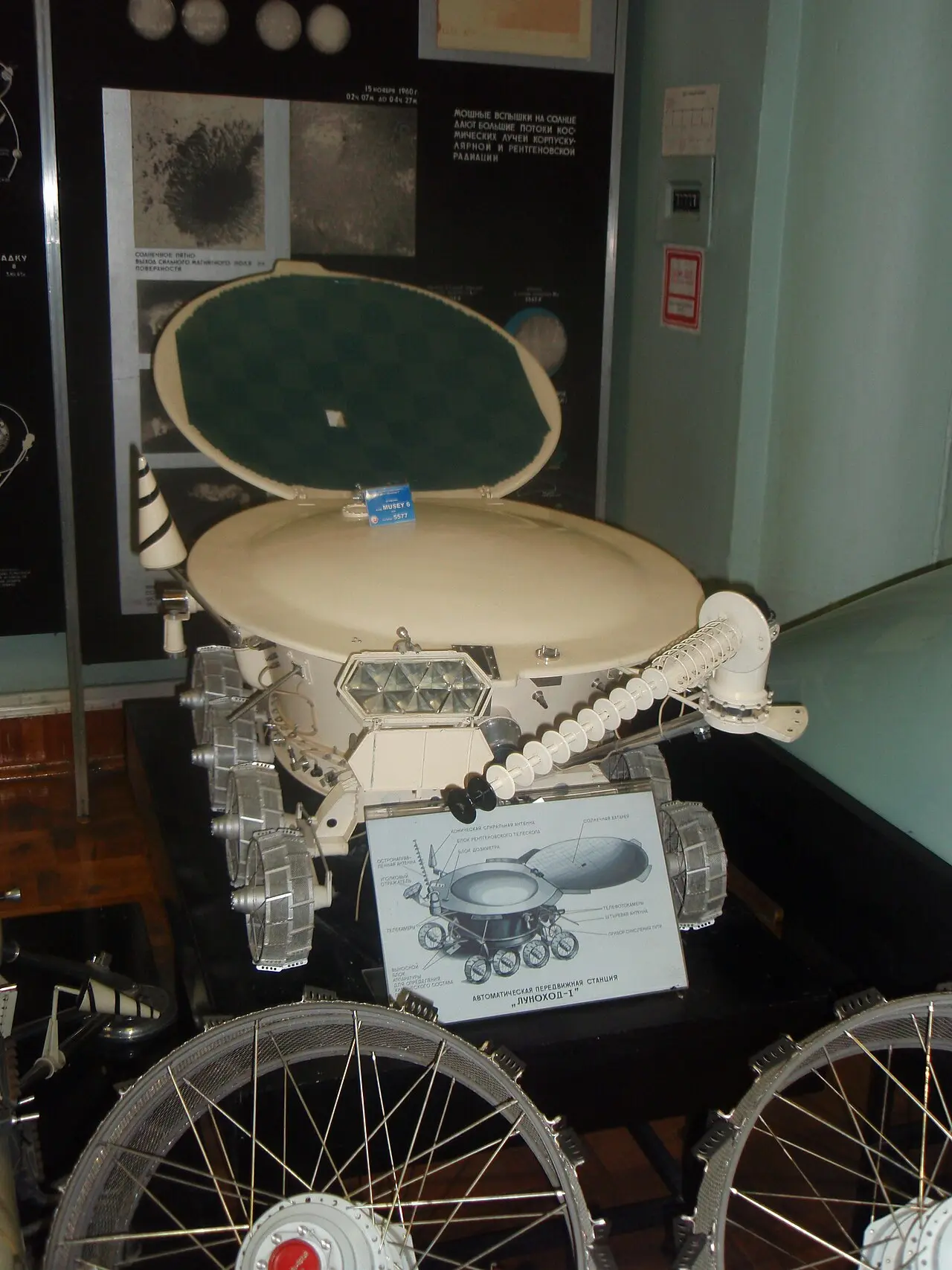
The model above, kept in a Moscow museum, shows the famous bathtub-shaped body with its hinged solar lid. The real one is parked in the Sea of Rains, waiting for the next visitor.
Photo: Vladimir Petrovich Galin, public domain (via Wikimedia Commons).