Voyager 1's Date with Saturn: November 12, 1980
On November 12, 1980, Voyager 1 flew within 78,000 miles of Saturn, revealing braided rings, new moons, and Titan's thick nitrogen atmosphere.
On November 12, 1980, a spacecraft running on less electricity than a refrigerator light bulb swept past Saturn — and sent back a planet nobody had ever seen.
Voyager 1 had left Earth on September 5, 1977, one half of NASA's audacious Grand Tour of the outer planets. It had already dazzled at Jupiter in 1979, discovering volcanic eruptions on the moon Io. Now, after three years and more than a billion miles, Saturn filled its cameras. The spacecraft began full-time observations on August 22, from 68 million miles out — and what it found over the next few months rewrote the textbooks.
The encounter's first prize was Titan, Saturn's giant moon, visited about eighteen hours before the closest approach. Voyager 1 skimmed within roughly 4,000 miles of it and confirmed what astronomers had only suspected: Titan wears a thick, smoggy atmosphere of mostly nitrogen, with an orange hydrocarbon haze hiding the surface, surface pressure about 1.6 times Earth's, and temperatures near minus 290 degrees Fahrenheit. It was the only moon known with a substantial atmosphere — a world, scientists realized, where liquid hydrocarbons might pool on the surface.
Then came the main event. On November 12, at about 3:45 p.m. Pacific time, Voyager 1 passed roughly 78,000 miles above Saturn's cloud tops — the closest it would ever come to another planet. In the hours around that moment, its cameras and instruments drank in the ringed giant.
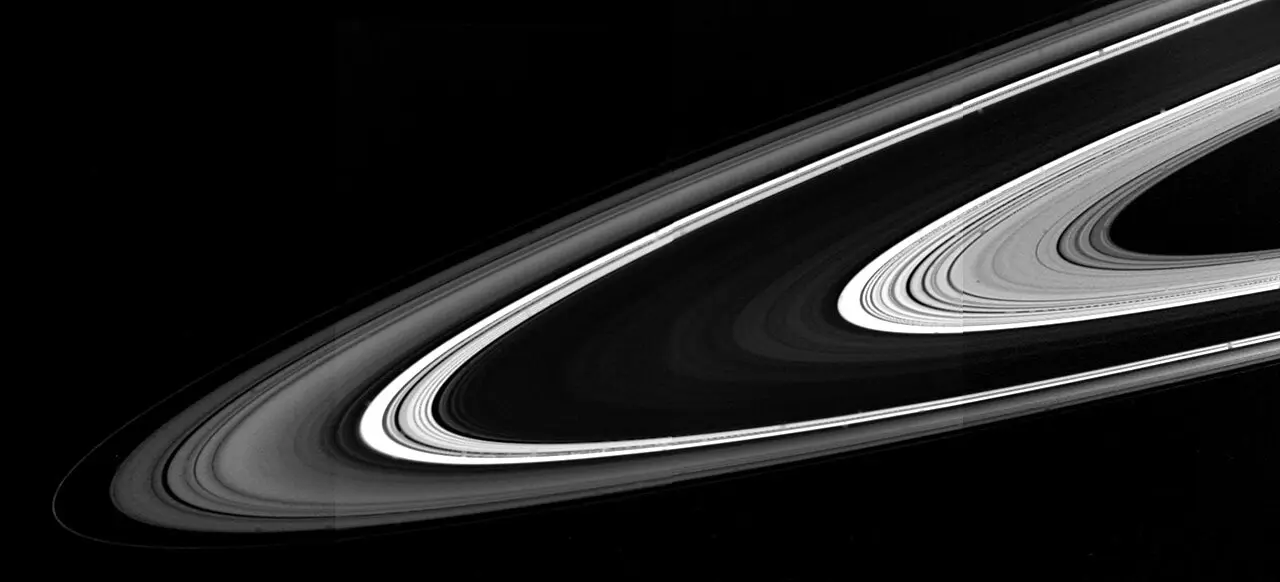
The rings, seen up close for the first time, were nothing like the smooth bands in telescopes. Voyager resolved them into thousands of fine ringlets, like the grooves of a phonograph record. It found the thin F ring braided into kinks and knots, herded by two tiny "shepherd moons," Prometheus and Pandora. It discovered new moons outright — Atlas among them — and a new ring, the G ring. It clocked Saturn's jet-stream winds at up to 500 meters per second and measured an atmosphere mostly hydrogen with about 7 percent helium. In all, the encounter returned some 16,000 photographs.
There was a price. To make that close Titan flyby, mission planners had aimed Voyager 1 on a trajectory that Saturn's gravity bent sharply upward, out of the plane of the planets. The maneuver gave the spacecraft the kick it needed to eventually escape the solar system entirely — but it ended Voyager 1's planetary tour on the spot. There would be no Uranus, no Neptune for Voyager 1; its twin, Voyager 2, would carry the Grand Tour onward to both.
It was a trade worth making. Voyager 1 is now the most distant human-made object in existence, still radioing home from interstellar space nearly half a century after launch. And every image of Saturn's impossible rings — every mission since, including Cassini's thirteen-year tour — traces back to that November day in 1980, when a small probe threaded the ring plane and showed humanity what the lord of the rings really looks like.
Photo: NASA/JPL, public domain (via Wikimedia Commons).