Seven Hours to a Comet: Philae's Bouncy Landing
On November 12, 2014, ESA's Philae lander bounced twice across comet 67P before settling at Abydos, achieving the first-ever soft landing on a comet.
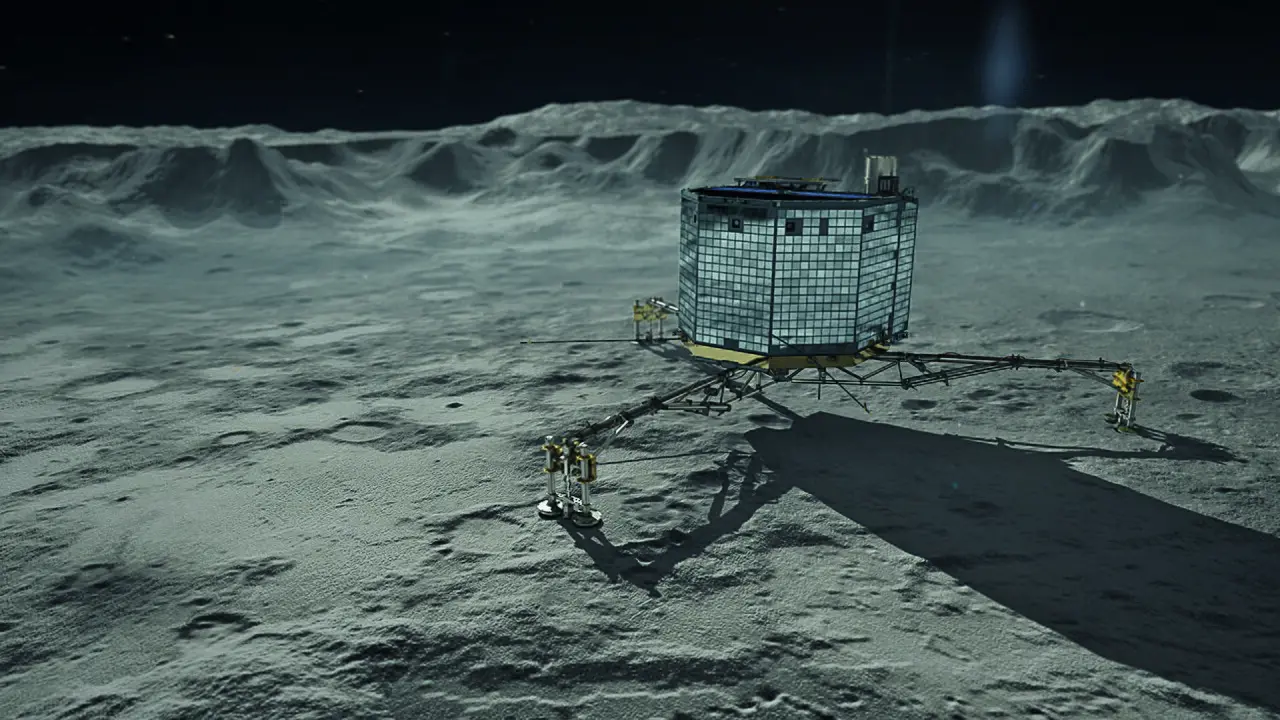
On November 12, 2014, a robot the size of a washing machine fell for seven hours toward a four-kilometer lump of ice and dust — and bounced.
The robot was Philae, and its target was Comet 67P/Churyumov–Gerasimenko, a rubber-duck-shaped mountain tumbling through space some 300 million miles from Earth. Its mother ship, the European Space Agency's Rosetta, had launched back in March 2004 and spent ten years chasing the comet down across 6.5 billion kilometers of solar system. That August, Rosetta had become the first spacecraft ever to orbit a comet. Now came the hard part: putting a lander on it.
At 08:35 GMT on November 12, Philae detached from Rosetta and began the long fall. There was no way to steer it — the little lander simply dropped, at about walking pace, toward a landing zone scientists had named Agilkia. Seven hours later, it touched down. The confirmation signal reached Earth at 16:03 GMT, and mission control erupted.
Then the telemetry told an alarming story. Almost everything designed to hold Philae down had failed. The anchoring harpoons never fired. The cold-gas thruster meant to press it onto the surface never activated. The ice screws in its feet couldn't bite into ground harder than expected. In the comet's feeble gravity, Philae rebounded — bouncing twice, soaring as high as a kilometer, tumbling for some two hours — before finally settling about a kilometer from its target, in a shadowed cleft called Abydos, tilted on its side.
It should have been a total loss. It wasn't. Running on its primary battery, Philae worked for about 64 hours, and eight of its ten instruments operated. It sent back the first images ever taken from the surface of a comet and made the first direct chemical analysis of cometary material — sniffing out organic molecules, the carbon-rich compounds that are among the building blocks of life. Its hammering probe found the surface at Abydos unexpectedly hard, like packed glacier snow. Then, starved of sunlight on its solar panels, the battery died on November 15 and Philae fell silent.
The story didn't quite end there. As the comet swung closer to the Sun, engineers caught a few faint, intermittent signals in June and July 2015 — Philae stirring briefly in its sleep. And in September 2016, with the Rosetta mission winding down, the orbiter's camera finally spotted the lost lander: wedged into a dark crack at Abydos, one leg jutting into space. Rosetta itself was gently set down on the comet on September 30, 2016, ending the mission where it had made history.
The names were no accident: Rosetta for the Rosetta Stone, Philae for the Nile island whose obelisk helped decipher hieroglyphs — a mission to decode the ancient history of the solar system, written in ice.
Philae's landing was the first soft landing ever achieved on a comet — bouncy, off-target, and half in shadow, yet a triumph all the same. It proved that the most audacious engineering can stumble and still change science forever: sometimes you aim for Agilkia and discover Abydos instead.
Photo: DLR German Aerospace Center, CC BY 3.0 (via Wikimedia Commons).