The Night the Stars Fell: The Meteor Storm of 1833
On the night of November 12-13, 1833, a colossal Leonid meteor storm terrified North America and gave Yale's Denison Olmsted the data to found meteor science.
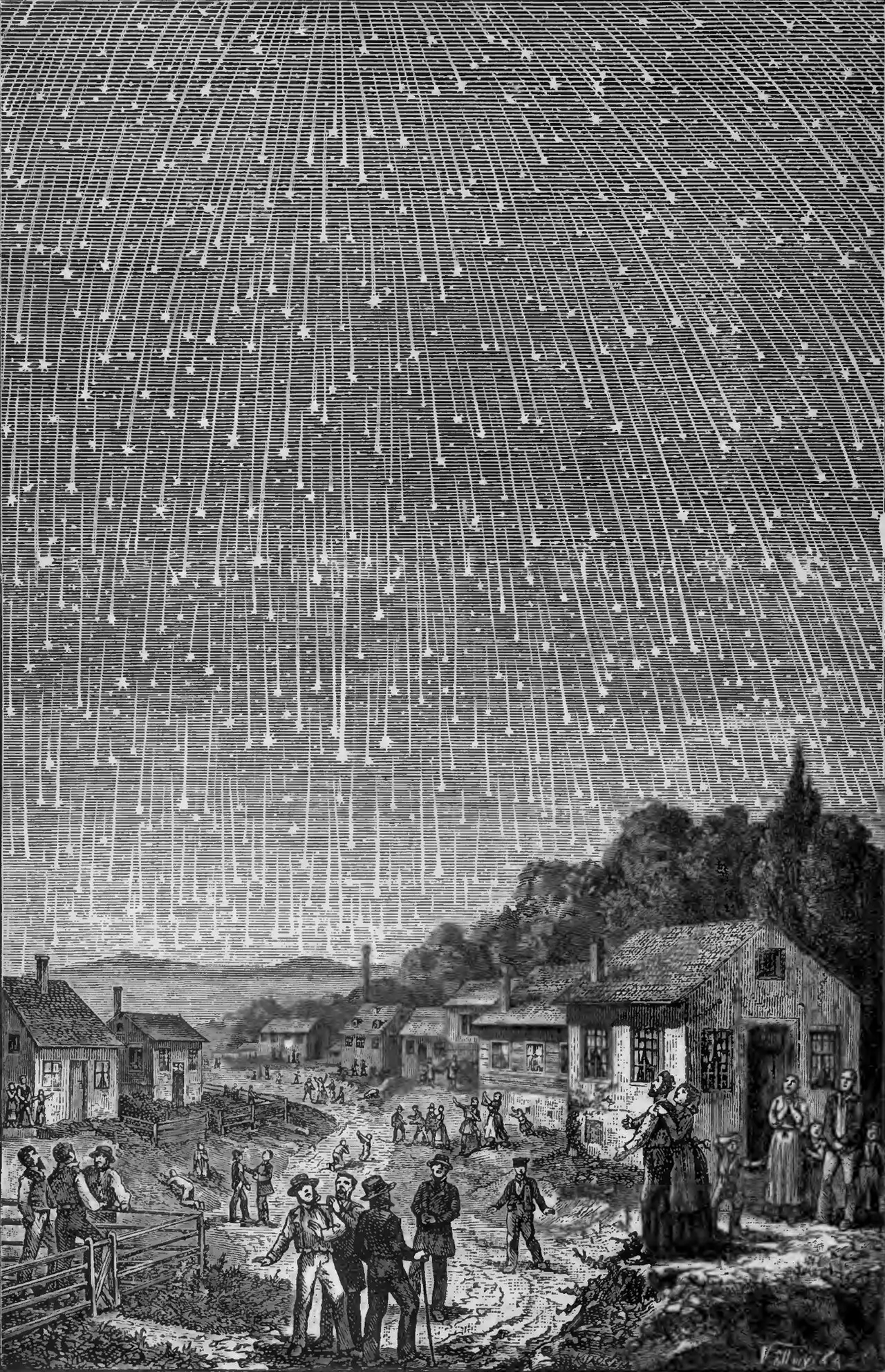
Shortly before dawn on November 13, 1833, the sky over North America caught fire — and thousands of people were certain the world was ending.
It began quietly. On the night of November 12, a few shooting stars streaked overhead. Then, sometime after 3 a.m., the heavens erupted. Meteors fell by the tens of thousands — estimates ran from 50,000 to 150,000 per hour, and one later reckoning put the night's total near 240,000. Across the eastern United States, rooms filled with light. People woke to neighbors shouting in the streets, convinced their houses were ablaze.
Nobody alive had ever seen anything like it. Churches filled overnight with the frightened faithful; many were sure they were witnessing biblical prophecy, the stars falling as Judgment Day dawned. Enslaved people in the South, who had few written records of their own, fixed the night in memory as simply "the year the stars fell" — a landmark they used to date the rest of their lives. A young Abraham Lincoln, then a 24-year-old in rural Illinois, reportedly watched the storm and never forgot it.
Science, in 1833, had almost nothing to say about it. Meteors — "shooting stars" — were widely assumed to be some kind of atmospheric phenomenon, like lightning. There was no science of meteors at all.
That changed because of one man who happened to be awake. Denison Olmsted, a professor at Yale, watched the storm from New Haven — and as the meteors faded with the sunrise, he did something remarkable. He drafted a letter to the New Haven Daily Herald appealing to the public to send him everything they had seen: where, when, how many, in what direction. It was one of the first crowdsourced science projects in history, and the replies poured in from across the country.
From hundreds of eyewitness accounts, Olmsted pieced together the truth. The meteors, he concluded, did not come from Earth's atmosphere at all — they came from space, from a cloud of debris, and they all appeared to radiate from a single point in the constellation Leo. His findings, published in 1834 in the American Journal of Science, overturned centuries of error and founded meteor science as a new branch of astronomy. The shower took its name from that radiant point: the Leonids.
The rest of the story took decades to fill in. The debris, astronomers eventually learned, is shed by Comet Tempel–Tuttle, discovered in 1865–66; every 33 years or so, Earth plows through an especially dense trail, and the Leonids storm again — as they did in 1866, 1966, and 2001. Every November, Earth still crosses the stream, and a modest shower still falls.
The night the stars fell terrified a continent — and gave birth to a science. A Yale professor's newspaper letter turned panic into data, and data into understanding. Nearly two centuries later, whenever November meteors streak the sky, they are falling from the same ancient debris trail that set 1833 ablaze.
Photo: Adolf Vollmy, public domain (via Wikimedia Commons).