The Night Budapest Tore Down Stalin
On October 23, 1956, Hungarian students and workers rose against Soviet domination, toppling Stalin's giant bronze statue in Budapest on the revolution's first night.
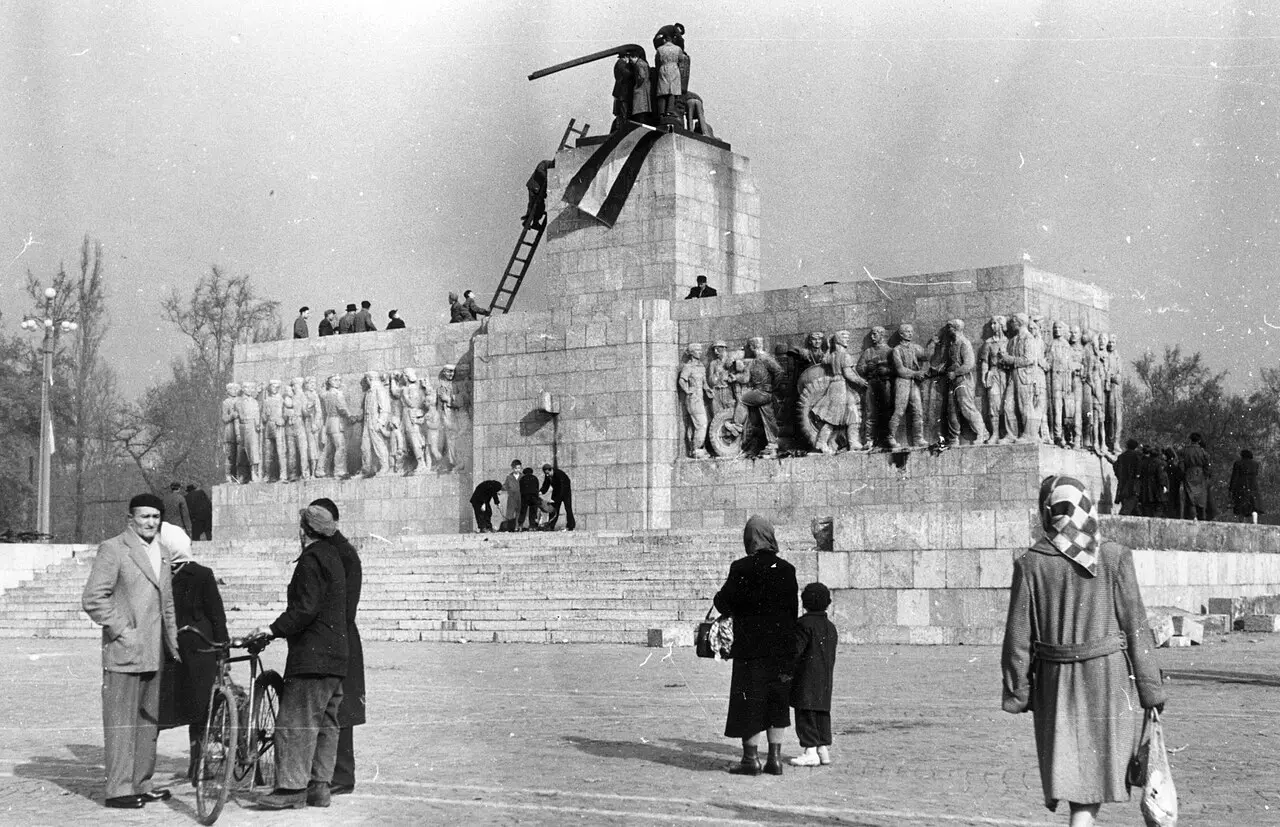
At 9:37 on the evening of October 23, 1956, the most hated statue in Budapest came down. For hours, a crowd had worked at the 25-meter monument to Joseph Stalin on Dózsa György út with winches, ropes, and blowtorches, jeered on by thousands. Finally the eight-meter bronze figure — sculpted by Sándor Mikus, who had won Hungary's highest artistic honor for it, and erected five years earlier as a 'gift' to Stalin on his seventieth birthday — was severed at the knees and hauled off its pedestal. All that remained were the dictator's bronze boots. Someone planted a Hungarian flag, its communist emblem cut out, in the wreckage. The square was renamed on the spot: Boots Square.
The day had begun with students, not wrecking crews. The night before, students at Budapest's Technical University had drafted sixteen demands — free elections, freedom of speech, the withdrawal of Soviet troops. On the afternoon of the 23rd, some 20,000 demonstrators marched to the statue of the Polish general Bem in a show of solidarity with reformers in Poland, then crossed the Danube to mass outside the Parliament building. By evening the crowd had swollen past 200,000. The reformist communist Imre Nagy appeared on a balcony at 9 p.m. — and was booed when he addressed the crowd as 'comrades.'
An hour earlier, the party's hardline boss, Ernő Gerő, had denounced the demonstrators on the radio. Enraged, part of the crowd marched to the Stalin statue to carry out one of their demands themselves: the monument had to go. Others besieged the radio building, demanding the sixteen points be broadcast. Around 10 p.m., the secret police opened fire on the unarmed crowd — the revolution's first blood. By 11, Gerő was begging Moscow to send in Soviet troops.
The uprising would hold Budapest for less than two weeks before a second, full-scale Soviet invasion crushed it in November, and Nagy himself would be arrested and, two years later, executed. But the image of that empty pedestal — the boots, the flag, the cheering crowd — traveled around the world, and it has never left the story of 1956: the night ordinary Hungarians reached up and pulled a tyrant down with their own hands. The boots stayed behind as a warning: no monument is taller than the people it was built to frighten.
Photograph: the pedestal of Stalin's toppled statue in Budapest, October 1956, with demonstrators and a Hungarian flag, by Pesti srác2, via Wikimedia Commons (CC BY-SA 3.0).