Philippi: The Battle That Buried the Roman Republic
On October 23, 42 BC, the republican army of Brutus was destroyed at Philippi in northern Greece, leaving Mark Antony and Octavian masters of Rome and sealing the Republic's fate.
On the plains outside Philippi, in northern Greece, the fate of the Roman world was decided in a single afternoon. On October 23, 42 BC, the army of Marcus Junius Brutus — the most famous of Julius Caesar's assassins — marched out to face the forces of Mark Antony and the young Octavian. By sunset, Brutus's cause was lost, his army shattered, and the Roman Republic was effectively dead. It had taken two battles; the second, on this date, finished what the first had started.
The war had begun two and a half years earlier, on the Ides of March, 44 BC, when Brutus, Cassius, and their fellow conspirators stabbed Caesar to death in the hope of saving the Republic from one-man rule. Instead, power passed to the Second Triumvirate — Antony, Octavian, and Lepidus — who hunted the assassins across the Mediterranean until the two armies met at Philippi.
The first battle, fought in early October, was a confused draw. Brutus's troops overran Octavian's camp, but Antony's veterans crushed the wing commanded by Cassius. Cassius, receiving a false report that all was lost, took his own life rather than be captured. Brutus, now alone in command, found his army demoralized and his allies deserting. Against his better judgment, he let his officers talk him into a second pitched battle.
On October 23, Antony's and Octavian's legions ground the republicans down. Ancient accounts describe a hard, close-fought struggle, but the outcome was never truly in doubt: the liberators, as Brutus's men called themselves, broke and fled. In the aftermath, Brutus took his own life rather than face capture and the humiliation of a triumphal parade through Rome.
The consequences were absolute. With the assassins dead, no organized opposition to the Triumvirate remained. Lepidus was soon pushed aside, and the partnership of Antony and Octavian itself collapsed within a decade, ending with Antony's defeat at Actium in 31 BC. In 27 BC Octavian took the name Augustus, becoming Rome's first emperor. The Republic that Brutus had killed Caesar to preserve died with him on the plain of Philippi — and the age of emperors began.
Today the battlefield's silence is kept by the ruins of ancient Philippi itself, a UNESCO World Heritage site where excavated streets, a theater, and early Christian basilicas mark the ground where legions once decided the future of the Western world.
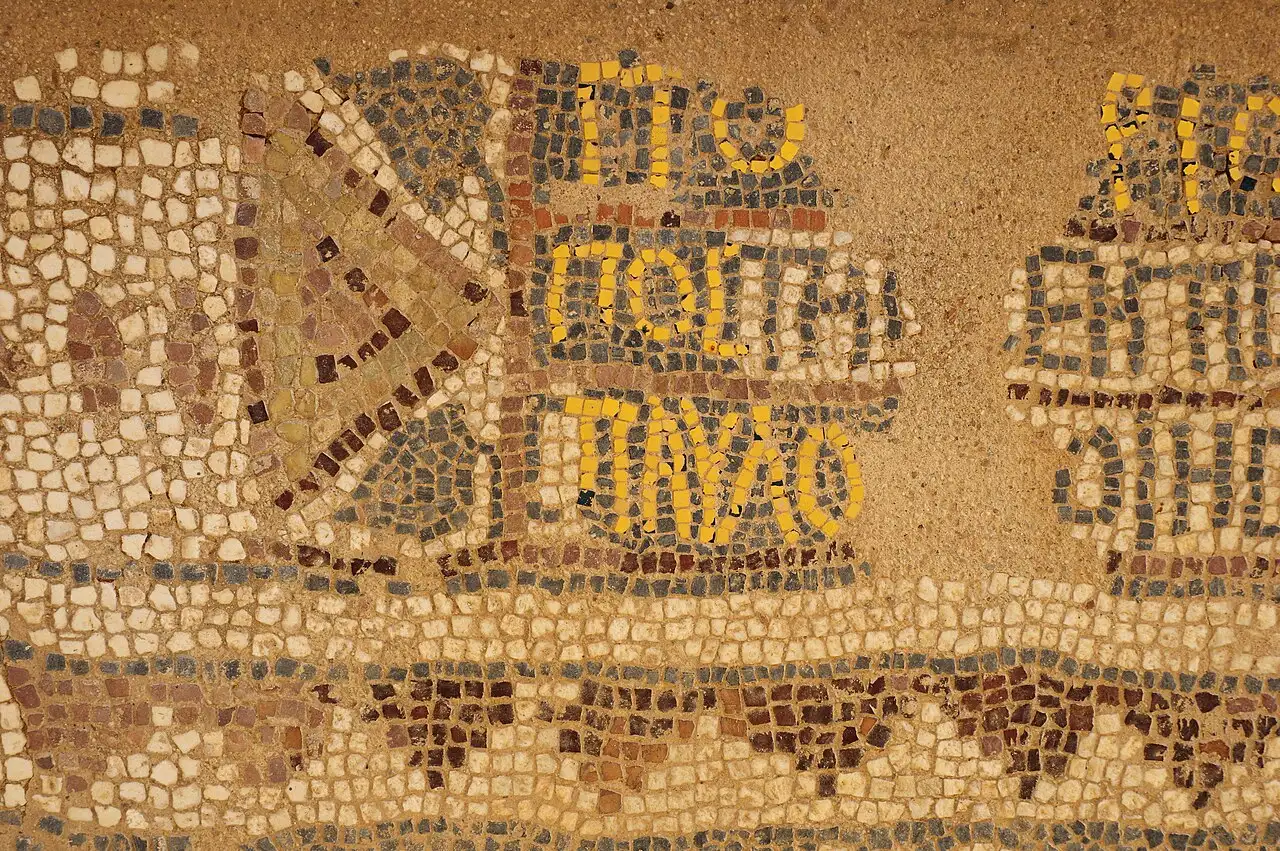
Photograph: a mosaic floor at the archaeological site of Philippi, Greece, by Berthold Werner, via Wikimedia Commons (CC BY-SA).