The Keystone Drops Into Place: St. Louis Tops Out the Gateway Arch
On October 28, 1965, workers eased a 10-ton keystone into the top of the Gateway Arch as heat, math, and 630 feet of stainless steel held their breath.
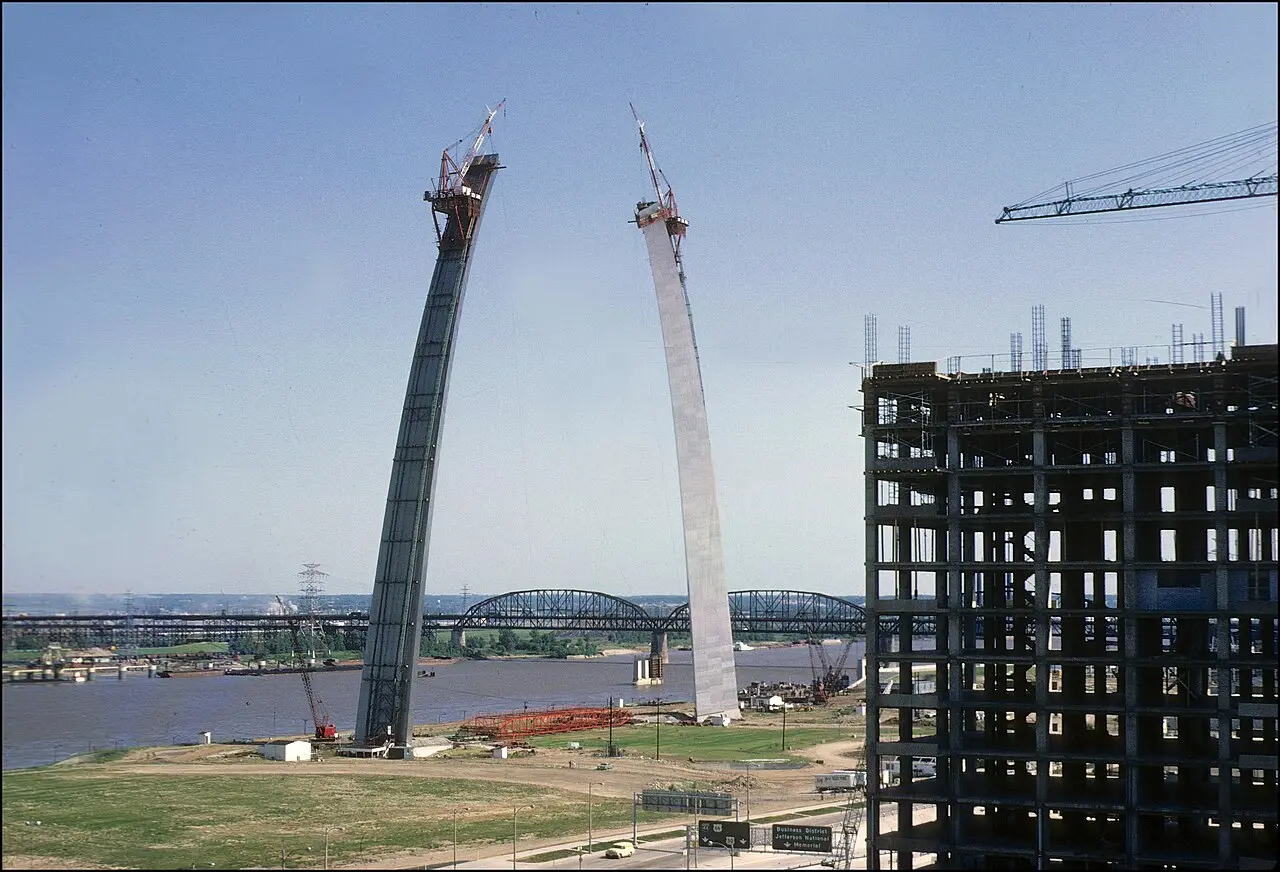
It was the kind of problem that keeps engineers awake at night. By mid-morning on October 28, 1965, the two stainless-steel legs of the Gateway Arch had risen 630 feet into the St. Louis sky — and they had stopped about eight and a half feet apart. That gap was exactly where the final piece, the keystone, was supposed to go. But the October sun had other ideas.
Steel expands in heat, and that morning the sun warmed the two legs unevenly. The gap at the top had shrunk by five inches — enough to make the ten-ton keystone, an eight-foot triangular wedge of steel, impossible to fit. So the builders did something wonderfully simple: they turned fire hoses on the south leg, spraying it with water to cool the steel and make it contract. It worked.
A little after nine-thirty — half an hour ahead of schedule — a crane began lowering the keystone into place. Sealed inside it, workers had already welded a time capsule holding the signatures of 762,000 schoolchildren. A Catholic priest and a rabbi prayed over the piece as it descended. Thirteen minutes later, with hydraulic jacks straining to hold the legs apart, the keystone slid home. By noon it was secured, and the arch was whole.
Watching from a helicopter overhead was Vice President Hubert Humphrey. Below him, a city held its breath and then exhaled: the two halves of Eero Saarinen's impossible curve had met.
The arch had been a long time coming. Saarinen, a Finnish-American architect, had won the design competition back in 1947 with a sketch of a weighted catenary curve — a shape with not a single straight line in it. Construction didn't begin until February 1963. For two years, 142 prefabricated stainless-steel sections were hoisted into place by climbing cranes, each one a slightly different shape from the last. The builders' math had to be perfect: miss by more than a few centimeters, and the legs would never meet.
Nobody died building it, which the engineers had hardly dared to hope. The final cost was $13 million.
At 630 feet tall and 630 feet wide, the Gateway Arch became the tallest arch in the world — a stainless-steel monument to the westward expansion of the United States, dedicated, in its official language, 'to the American people.' St. Louis had been the jumping-off point for Lewis and Clark and the pioneers; now it had a gateway to match the name it had always claimed: the Gateway to the West.
The arch wouldn't open to the public for another year and a half — the visitor center and its ingenious tram opened in June 1967 — and Humphrey would return to dedicate it in May 1968. But October 28, 1965 was the day the daring part ended: the day two separate towers became a single curve in the sky, joined by a ten-ton keystone and the signatures of three-quarters of a million schoolchildren.
Photo: The Gateway Arch under construction in June 1965, by Kevin William Kelly, CC BY-SA 4.0 (via Wikimedia Commons).