Out of an Empire's Ashes: Czechoslovakia Is Born
On October 28, 1918, cheering crowds filled Prague's Wenceslas Square as Czech leaders proclaimed an independent Czechoslovakia, ending centuries of Habsburg rule.
The news arrived in Prague on the morning of Monday, October 28, 1918, in the form of a diplomatic note. Austria-Hungary — the empire that had ruled the Czech lands for nearly four hundred years — had accepted American President Woodrow Wilson's terms for ending the First World War. To the people reading it in the newspapers, it looked like what it was: a surrender.
By mid-morning, the center of Prague was filling with people. They crowded into Wenceslas Square, in front of the offices of the Narodni politika newspaper, where the news had first been posted. Houses were draped with flags. And a small group of Czech politicians, the National Committee, understood that history had just handed them a once-in-centuries opening — and that they had to seize it before it closed.
The committee's leaders — Antonin Svehla, Alois Rasin, Jiri Stribrny, Frantisek Soukup, and Vavro Srobar — moved fast. They took over the military's grain institute, the office that controlled the food supply, and then walked to the governor's residence to demand that imperial authority be handed to them. Shortly after noon, Stribrny stood before the cheering crowd on Wenceslas Square and proclaimed the independent Czechoslovak state. After lunch, the committee passed the first law of the new country.
The declaration they read began with five plain words: the independent Czechoslovak state has come into being.
The man most responsible for that moment wasn't even in the country. Tomas Garrigue Masaryk, a philosophy professor turned independence campaigner, had spent the war years in exile, lobbying the Allies in Paris, London, and Washington. In May 1918, Czech and Slovak representatives in America signed the Pittsburgh Agreement calling for a joint state; on October 18, Masaryk's Czechoslovak National Council published a declaration of independence. When the news from Prague reached him, the scaffolding he'd spent four years building finally had a country to stand on. On November 14, the new National Assembly elected him the republic's first president.
Two days after Prague's proclamation, Slovak leaders issued their own Martin Declaration in favor of the joint state. The new Czechoslovakia — Czechs, Slovaks, and millions of Germans, Hungarians, and others — became one of the successor states of the collapsed Habsburg Empire, and for twenty years, one of Europe's few working democracies.
It would not last in that form: dismembered before the Second World War, swallowed by communism after it, and finally, peacefully divided into the Czech Republic and Slovakia on January 1, 1993. But every October 28, the Czechs still celebrate the day their state was born — the day a crowd in a Prague square decided that four centuries of empire were over.
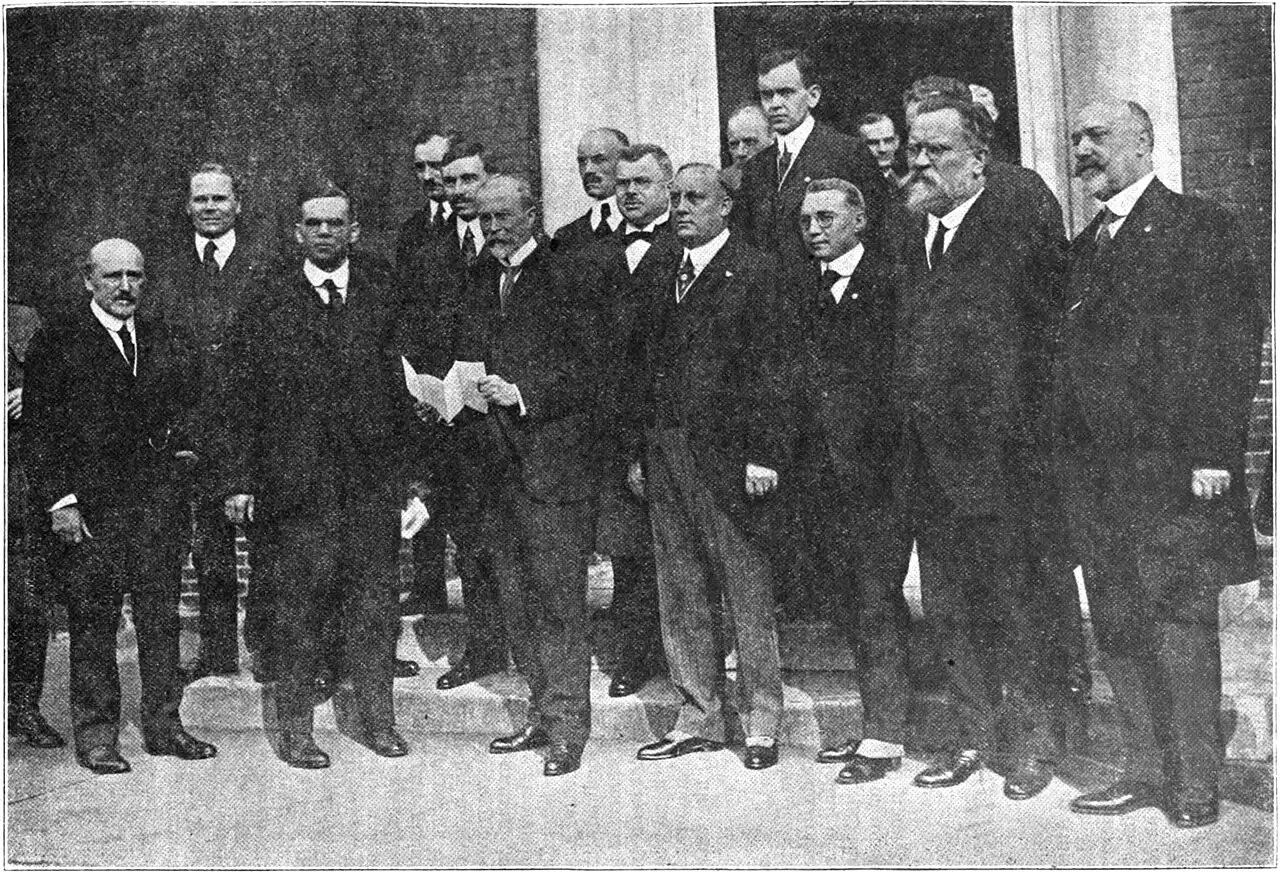
Photo: Tomas Garrigue Masaryk (center, holding a document) in Philadelphia in 1918, with Mayor Smith of Philadelphia and director Miller of the Union — photographer unknown, public domain (via Wikimedia Commons).