The Day a Line Was Drawn Across Vietnam
On July 21, 1954, the Geneva Conference closed with accords ending France's war in Indochina — and split Vietnam at the 17th parallel, a 'temporary' line that became two countries.
They had been talking for 75 days.
In a grand conference room in Geneva, Switzerland, diplomats from France, Britain, the Soviet Union, China, and the United States — along with delegations from Vietnam, Laos, and Cambodia — had spent the spring and summer of 1954 trying to end a war that had already lasted eight years. The First Indochina War, France's desperate fight to hold its colony in Southeast Asia, had turned decisively against the French in May, when the Viet Minh army overran the French fortress at Dien Bien Phu. A day after the Geneva Conference opened, the French garrison surrendered.
France's new prime minister, Pierre Mendès France, had won office on a blunt promise: he would get a ceasefire within four months, or resign. His negotiators worked through eight full sessions and twenty-three smaller meetings, haggling over maps, troop withdrawals, and the wording of every clause.
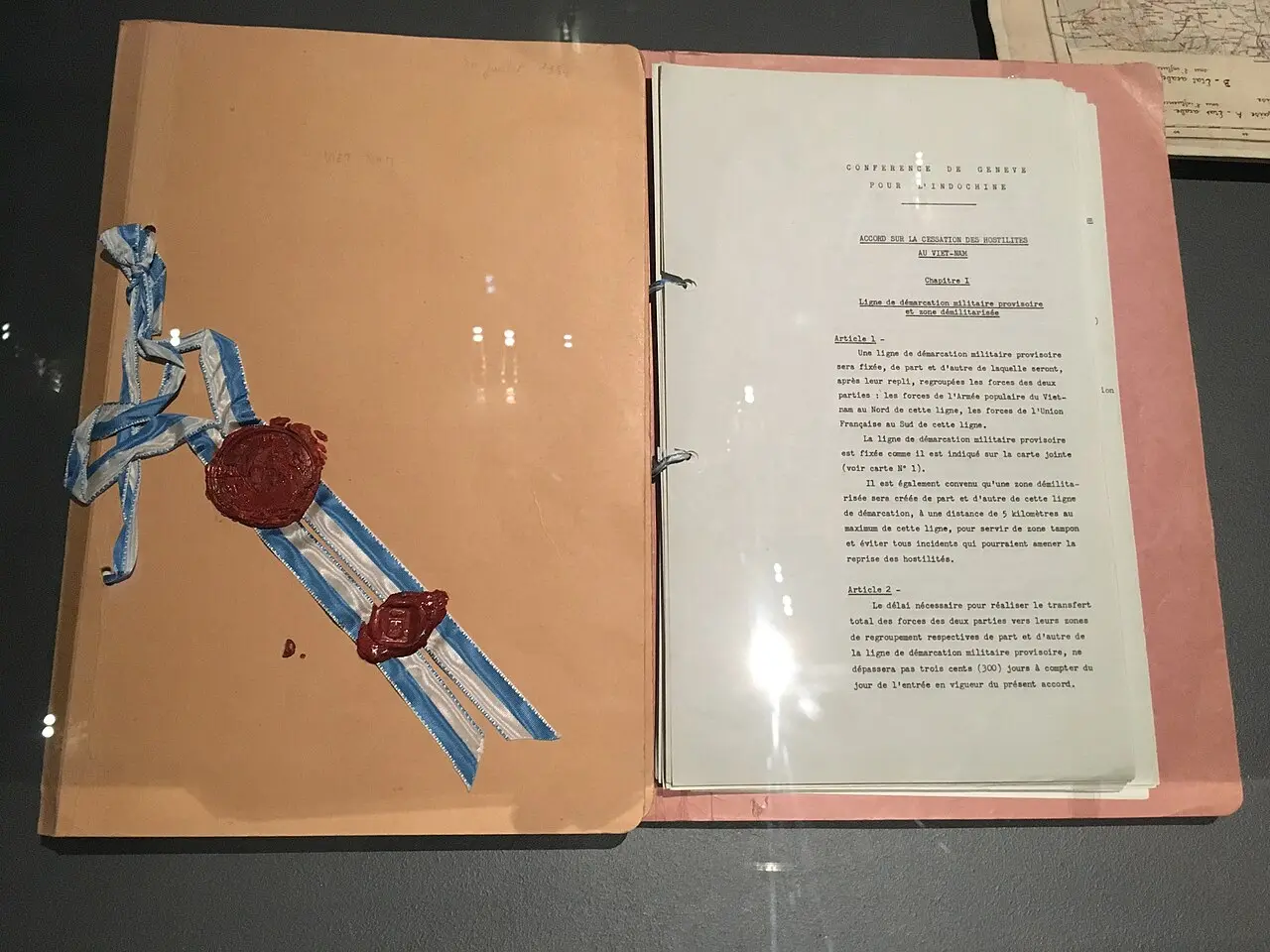
On July 21, 1954, it was over. The conference closed with a set of agreements that ended the fighting across Indochina. French forces would withdraw. The three countries of the region — Vietnam, Laos, and Cambodia — would be recognized as independent. And Vietnam itself would be divided, for now, at the 17th parallel: a "provisional military demarcation line" that split the country into a northern zone, where Viet Minh forces would regroup, and a southern zone, where French forces would gather. It was not supposed to be a border. The line was explicitly described as temporary — "provisional," the documents said, and not to be treated as a political boundary.
The accords also gave ordinary people a choice. For 300 days, civilians could move freely between the two zones to choose where they wanted to live, and hundreds of thousands of people made the journey. And within two years, the plan went, free elections would be held under international supervision to reunify the country under one government.
But not everyone signed on to every word. The United States declined to endorse the final declaration, merely "taking note" of the ceasefire. And the promised 1956 elections were never held. Instead of reuniting, the two zones hardened into two separate states — North Vietnam and South Vietnam — each backed by rival superpowers. Within a decade, the "temporary" line would become one of the most heavily contested frontiers on earth, and the country would be plunged into the Second Indochina War, known in America as the Vietnam War.
Why it matters: the Geneva Accords are a study in how peace agreements can solve one crisis while planting the seeds of another. The negotiators ended a colonial war at the table — a genuine achievement — but a line drawn as a short-term military convenience became a long-term political reality. It is a reminder that in diplomacy, words like "provisional" and "temporary" carry enormous weight, and that the map a peace deal draws can shape history for generations.
Photo: The bound text of the 1954 Geneva Accords on Indochina, sealed with wax stamps. Photograph by Marc Baronnet, licensed under CC BY-SA 4.0 via Wikimedia Commons.