
The Beach Ball That Bounced Onto the Moon
On February 3, 1966, the Soviet probe Luna 9 became the first spacecraft to land softly on the Moon — by bouncing across the lunar dust like a beach ball.
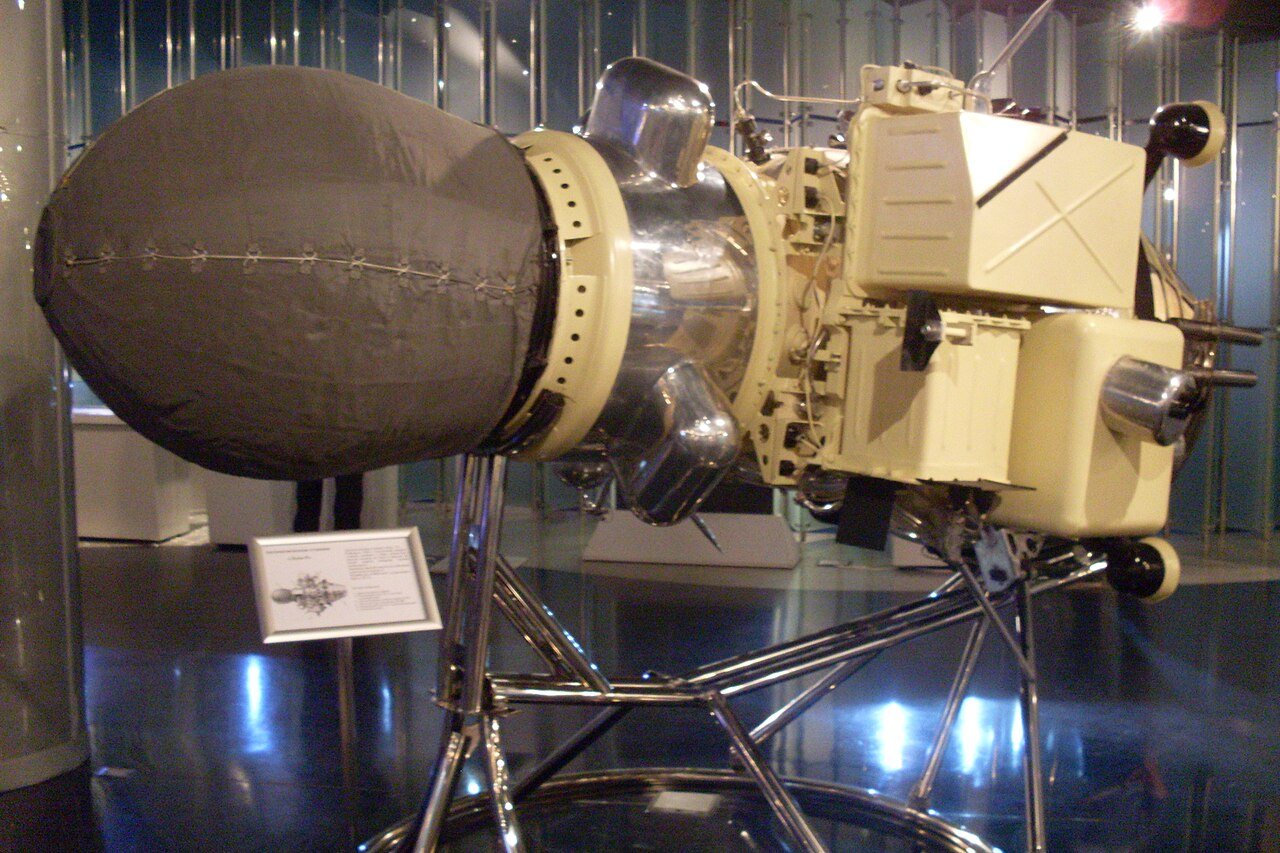
Before humans could walk on the Moon, someone had to answer a terrifyingly basic question: would a spacecraft sink?
Some scientists genuinely feared the Moon was covered in a deep ocean of fine dust — that anything landing there would vanish into the powder like a stone into quicksand. On February 3, 1966, a small Soviet spacecraft settled the argument by doing something gloriously low-tech: it bounced.
Luna 9 was the Soviet Union's twelfth attempt at a soft lunar landing. Eleven earlier probes had failed — rockets malfunctioned, boosters exploded, guidance systems went haywire. On January 31, 1966, the twelfth one lifted off from the Baikonur Cosmodrome aboard a Molniya-M rocket and headed for the Moon.
What arrived was a contraption of endearing weirdness. The descent stage carried a spherical capsule just 58 centimeters across — about two feet — weighing 99 kilograms, packed with radio gear and a television camera. As it neared the surface, a sensor rod touched the ground, and from about five meters up the capsule was ejected. Wrapped in inflatable airbags, it struck the lunar surface at roughly 22 kilometers an hour and bounced across the dust like a beach ball. When it finally stopped, the airbags deflated, the sphere rolled upright, and four spring-loaded petals unfolded to steady it. The descent stage crashed nearby. Of the ton and a half launched from Earth, only that little ball survived to do the job.
About seven hours after touchdown, in the Ocean of Storms — Oceanus Procellarum — the capsule began transmitting. The first images ever taken from the surface of another world arrived on Earth: a stark panorama of rocks and dust, a curving horizon, a black sky. They were picked up not only by the Soviets — a British observatory intercepted the radio signals and published a picture before Moscow released its official version, one of the cheekier scoops of the space race.
The pictures carried a profound message: the ground was firm. The Moon would not swallow a lander. The dust-quicksand theory was dead, and the path was clear for the missions that followed — including, four months later, America's Surveyor 1, and eventually the Apollo astronauts.
Luna 9 ran on batteries, with no solar panels, so its life was short. It transmitted three panoramic photographs and radiation measurements, and on February 6 its batteries died and contact was lost. Six days from launch to silence.
There was poignancy in the timing. The triumph came just weeks after the death of Sergei Korolev, the secret chief designer of the Soviet space program — reportedly, his colleagues wanted to dedicate the mission to him, but his identity was still a state secret, so they could not.
Why does it matter? Every giant leap needs a first small bounce. Luna 9 proved the Moon was landable, turning it from a frightening unknown into a destination. Sometimes the bravest thing a machine can do is simply touch down and send back a postcard.
Photo: Armael, CC0 (via Wikimedia Commons).