Gutenberg and the Machine That Freed the Word
Johannes Gutenberg, who introduced movable-type printing to Europe, died in Mainz on February 3, 1468, after an invention that put books within reach of ordinary people for the first time.
Nobody knows what he looked like. Nobody knows exactly when he was born. But the machine he built put books into the hands of millions — and Johannes Gutenberg died, nearly forgotten and reportedly blind, on February 3, 1468, in the German city of Mainz.
Gutenberg was born in Mainz sometime around the turn of the 15th century, the son of a patrician family. Trained as a goldsmith and gem cutter, he spent years in Strasbourg quietly experimenting with a secret project. By the late 1430s he was buying presses and printing materials, and by 1450 his invention had progressed far enough to convince the wealthy financier Johann Fust to invest 800 guilders — then another 800 two years later. Gutenberg's breakthrough was not a single device but a system: a mold for casting individual pieces of type precisely and in quantity, a durable lead-tin-antimony alloy, an oil-based ink that clung to metal type, and a screw press adapted from wine and paper presses. Together, they could produce hundreds of identical pages — something no scribe could match.
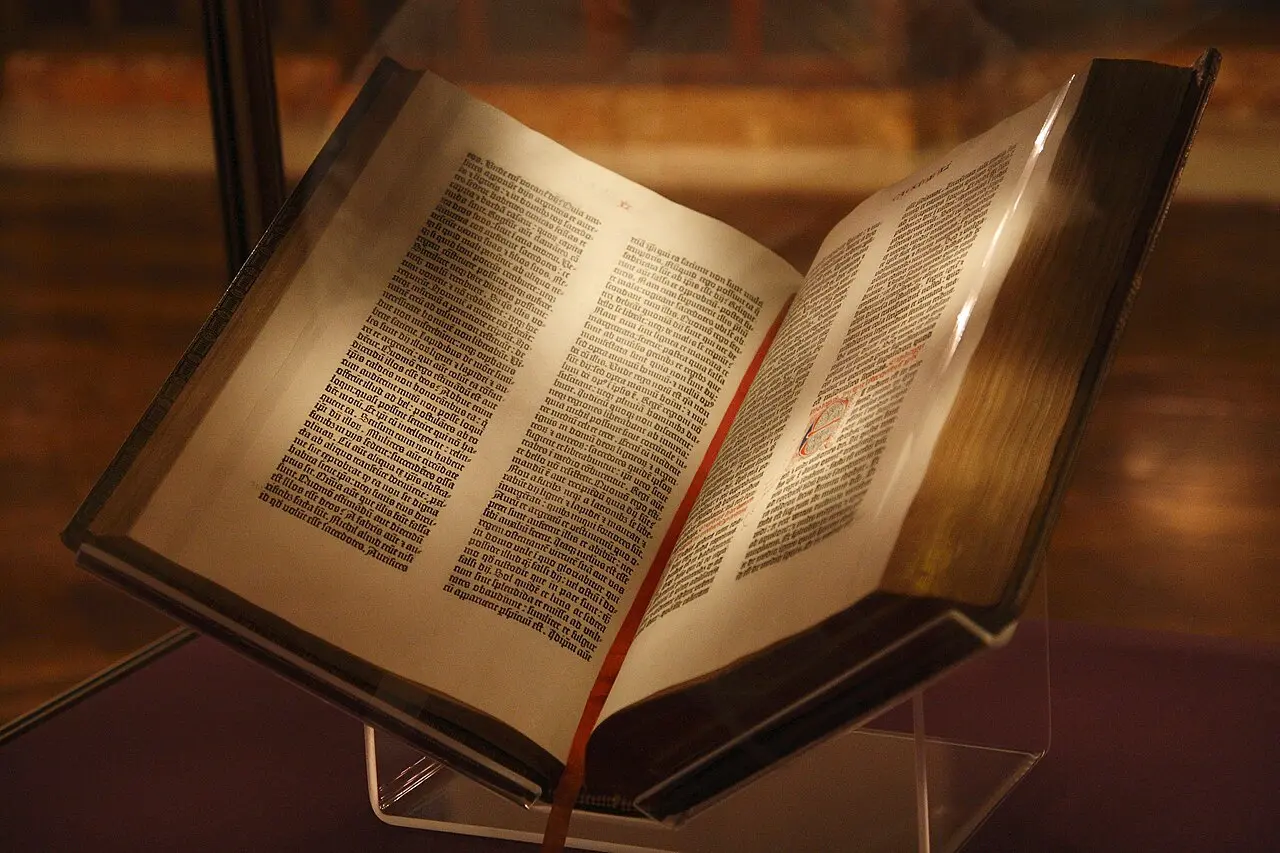
His masterpiece was the 42-line Bible, completed around 1455: the first major book printed from movable type in Europe, with about 180 copies produced on paper and vellum. But triumph curdled into ruin. Fust sued Gutenberg over the loans in 1455 and won, seizing the workshop and half the Bibles. Gutenberg started over with a small shop, and in 1462 the sack of Mainz scattered his workmen across Europe — carrying his jealously guarded secrets with them, which is how printing spread so fast. In January 1465, Archbishop Adolf of Nassau granted the aging inventor a pension of clothing, grain, and wine "for services rendered and to be rendered." He died in St. Victor's parish in Mainz and was buried in the Franciscan church. No authentic portrait of him exists; every image is an artist's guess.
Before Gutenberg, a book was a luxury copied by hand, chained to a library shelf, priced beyond any commoner's reach. Within decades of his death, presses were operating in cities across Europe, pouring out Bibles, classics, pamphlets, and news. The Reformation, the scientific revolution, and mass literacy all traveled on printed pages. He died poor and obscure; his machine made knowledge cheap. It may be the most important invention of the millennium — and its inventor never lived to see what it did.
Photo: Joshua Keller, CC BY 2.0 (via Wikimedia Commons)