Pioneer 10: The First Machine to Leave the Planets Behind
On June 13, 1983, NASA's Pioneer 10 crossed Neptune's orbit and became the first human-made object to travel beyond all the major planets.
It was built to last 21 months. Eleven years later it was still flying — and on June 13, 1983, it did something no human-made object had ever done: it left the planets behind.
Pioneer 10, launched in March 1972 from Cape Canaveral, Florida, was NASA's first mission to Jupiter. After its flyby of the giant planet in December 1973 — swooping within about 81,000 miles of its cloud tops — Jupiter's gravity slung the little craft onto a path out of the solar system. It crossed Saturn's orbit in 1976 and the orbit of Uranus in 1979, still faithfully radioing data home.
Then, on June 13, 1983, Pioneer 10 crossed the orbit of Neptune, at the time the outermost planet, and became the first human-made object to pass beyond the orbits of all the Solar System's major planets. At that historic moment it was about 2.8 billion miles from the Sun, racing outward at more than 30,000 miles an hour.
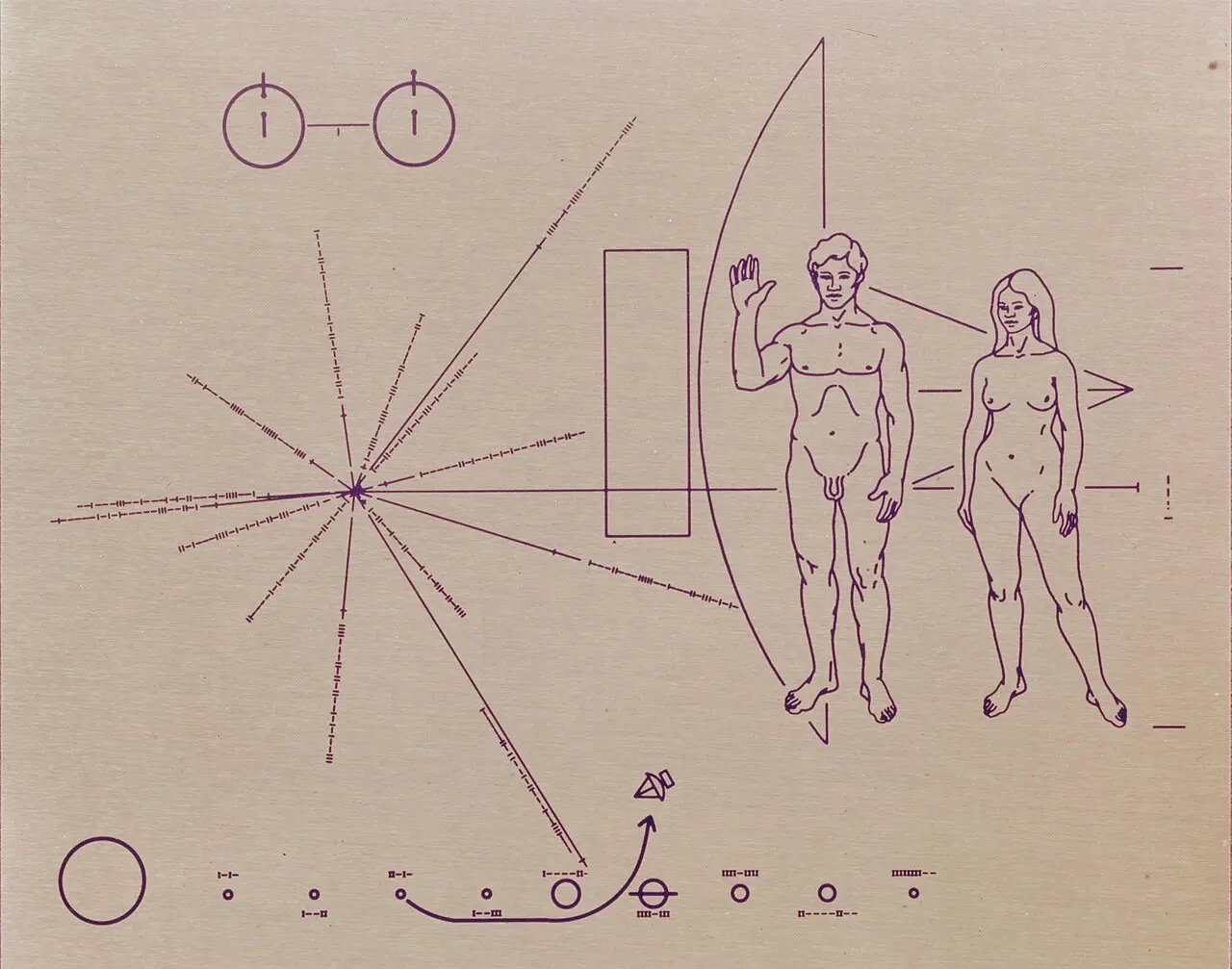
The spacecraft was modest by any measure: about 570 pounds, powered by nuclear generators, sending its data home at a trickle. But it carried a famous passenger. Bolted to its frame was a gold-anodized plaque designed by astronomers Carl Sagan and Frank Drake, with artwork by Linda Salzman Sagan — etched with drawings of a man and a woman, a map of the Sun's position among pulsars, and the story of the spacecraft's origin. It was a message in a bottle, addressed to any civilization that might one day find it.
NASA kept listening long after the mission's official end on March 31, 1997. The spacecraft's faint signal was tracked until January 23, 2003 — nearly 31 years after launch — when its nuclear power finally fell too low to run the transmitter. That last whisper took 11 hours and 20 minutes to reach Earth from some 7.6 billion miles away. Pioneer 10 is now headed in the general direction of the star Aldebaran, which it will reach in about two million years.
Pioneer 10 proved a spacecraft could survive the asteroid belt and Jupiter's brutal radiation, paving the way for the Voyagers and every outer-planet mission since. And it became humanity's first emissary to the stars — a machine built for a 21-month job, still sailing silently into interstellar space. A full-scale mockup of the craft stands in the Milestones of Flight exhibit at the Smithsonian's National Air and Space Museum in Washington, D.C.
Photo: NASA Ames Research Center, public domain (via Wikimedia Commons).