
You Have the Right to Remain Silent
On June 13, 1966, the Supreme Court ruled that police must warn suspects of their rights before questioning — the origin of the words 'you have the right to remain silent.'
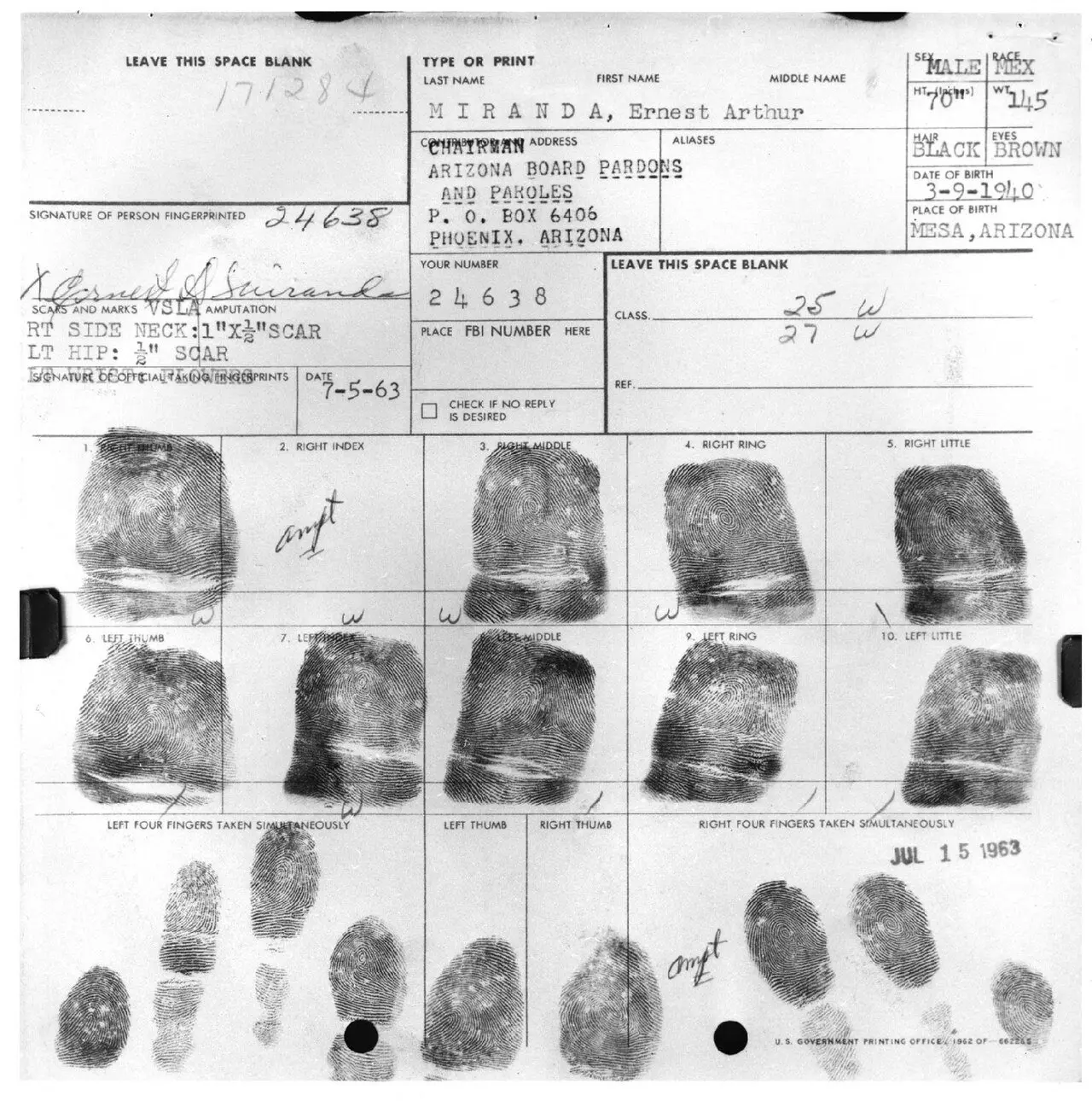
If you have ever watched a police drama, you have heard the words: “You have the right to remain silent. Anything you say can and will be used against you in a court of law. You have the right to an attorney…” Every officer, every suspect, every TV detective owes those lines to a decision handed down on June 13, 1966 — and to a man named Ernesto Miranda.
In March 1963, Phoenix police were investigating a serious crime against a young woman. Following a license-plate lead, they picked up Miranda, a 23-year-old with a thin record. The victim could not identify him in a lineup. But after hours of interrogation, officers emerged with a signed confession that Miranda soon recanted — confessing, he said, without knowing he had any right to stay silent or ask for a lawyer.
His court-appointed lawyer raised the alarm, and the American Civil Liberties Union took up his appeal. The question reached the U.S. Supreme Court: could the government lock you in a room, question you without telling you your rights, and then use your own words to convict you?
On June 13, 1966, the Court answered no, 5–4. Writing for the majority, Chief Justice Earl Warren ruled that the coercive pressure of custodial interrogation meant no confession could be used under the Fifth Amendment’s protection against self-incrimination unless the suspect had first been clearly told four things: the right to remain silent, that anything said could be used in court, the right to an attorney, and the right to a free attorney if one could not be afforded. If the suspect asked for silence or a lawyer, the questioning had to stop.
The decision was instantly controversial — critics said it would handcuff the police — but it became bedrock. Within a few years, reading suspects their rights, or “Mirandizing” them, was standard procedure in every American police department, and the warnings crossed into popular culture, repeated in a thousand films and television episodes.
The irony of the case is hard to top. Miranda’s conviction was overturned, but Arizona retried him that October without the confession and convicted him again. Released on parole in 1972, he made a small living signing autographs on printed Miranda-warning cards — until January 1976, when he was stabbed to death in a bar after a poker game. The man who won the right to remain silent died at the hands of someone who had heard those very words read to him.
Why it matters: Miranda v. Arizona drew a bright line between the power of the state and the rights of the individual. The four warnings are now the most famous sentence in American criminal law — a shield for the innocent and a reminder that justice must be fair even when the accusation is grave.
Photo: Fingerprint record card of Ernesto Miranda, the man at the center of Miranda v. Arizona (Arizona Board of Pardons and Paroles, public domain via Wikimedia Commons).