Midnight in Kampala: Uganda's Independence Day
On October 9, 1962, the Union Jack came down over Kampala and a new flag rose — Uganda was an independent nation at last.
At the stroke of midnight, in a stadium full of people who had waited generations for the moment, one flag came down and another went up.
On October 9, 1962, at the Kololo Independence Grounds in Kampala, thousands of Ugandans gathered to watch the British Union Jack lowered for the last time and the new Ugandan flag — black, yellow, and red, bearing the grey crowned crane — raised in its place. The Duke of Kent, representing Queen Elizabeth II, handed the constitutional instruments of independence to Dr. Milton Obote. After nearly seventy years as a British protectorate, Uganda was a sovereign nation.
The road to midnight had been decades long. Political consciousness had been stirring since the 1940s, when Ugandans pressed the colonial administration to admit African representatives to the Legislative Council. The Uganda National Congress formed in 1952, the Democratic Party in 1954. The 1955 Namirembe Agreement promised independence within years; the Legislative Council was expanded in 1958; self-government arrived in March 1961 under Benedicto Kiwanuka; and elections in April 1962 set the stage for the handover.
Independence night was a compromise as much as a celebration. Obote, leader of the Uganda People's Congress, became the first prime minister — but he governed through an uneasy alliance with the Kabaka Yekka party, representing the powerful Buganda kingdom. Sir Edward Mutesa II, the Kabaka himself, became the ceremonial head of state. It was an arrangement built on mutual suspicion, and it did not hold: within a few years Obote suspended the constitution, abolished the kingdoms, and drove the Kabaka into exile — and in 1971 Obote himself was overthrown by his army chief, Idi Amin, whose brutal dictatorship would stain Uganda's name for a decade.
But October 9 belongs to the beginning, not to what followed. The flag-raising at Kololo — mirrored in ceremonies across the new nation — announced that Uganda would chart its own course, for better and worse. Every year since, Ugandans have marked Independence Day with parades at Kololo, the singing of the national anthem "Oh Uganda, Land of Beauty," and the black, yellow, and red flown from rooftops: the colors of the people, the sunshine, and the brotherhood of all Africans.
The night also showed what independence ceremonies are really for: a new state telling its people, and the world, that from this midnight forward its story would be written by its own hand — even when the chapters that followed proved harder than anyone on the parade ground that night could have imagined.
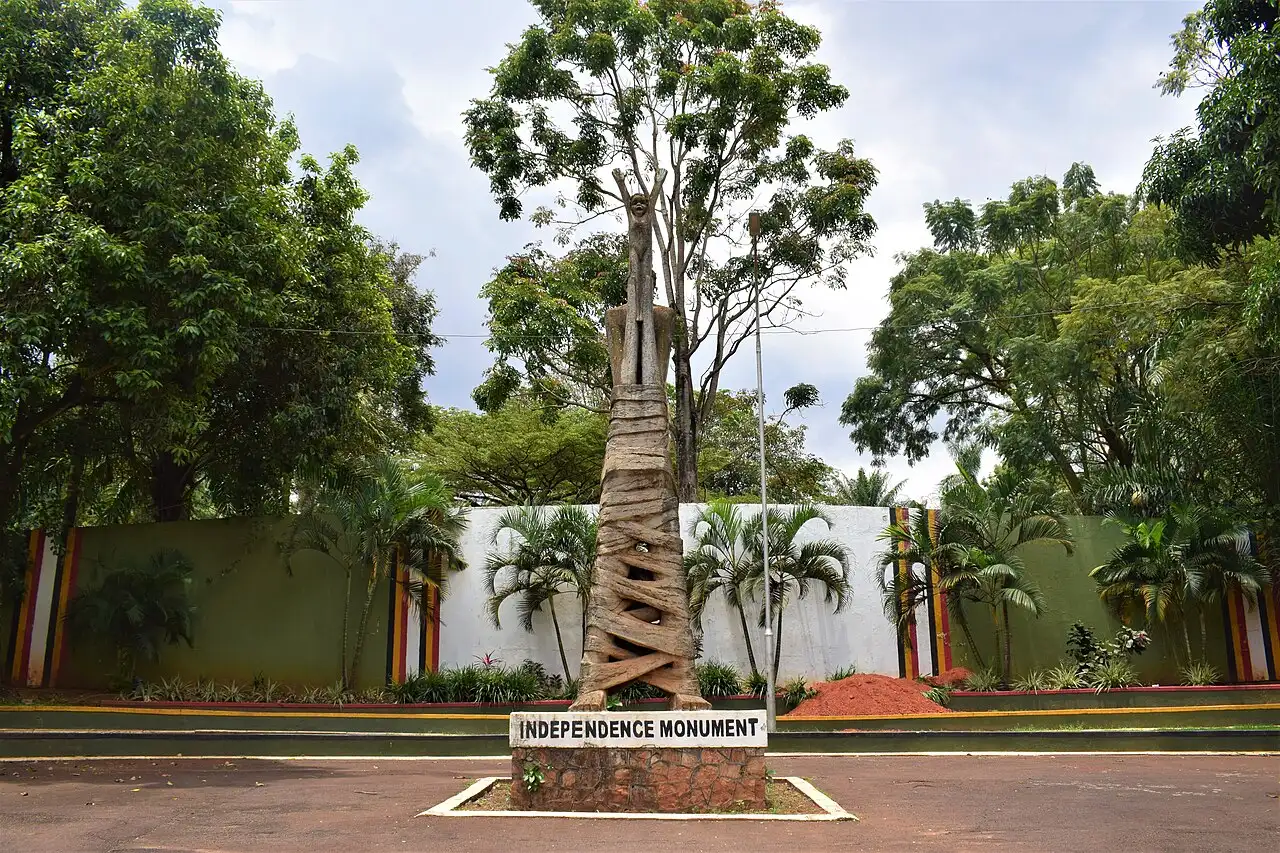
Photo: the Independence Monument in Kampala — a sculpture of an adult lifting a newborn child, commemorating Uganda's independence — photographed by Alvinategyeka, CC BY-SA 4.0 (via Wikimedia Commons).