The First North Korean Nuclear Test
On October 9, 2006, North Korea announced its first underground nuclear test — a sub-kiloton blast that reshaped global security.
At 10:35 on the morning of October 9, 2006, seismographs across Northeast Asia twitched. Deep inside a mountain in North Korea's remote northeast, something had exploded — and within hours, Pyongyang was on state media claiming a triumph: the country's first successful nuclear test.
The blast was underground, in a horizontal tunnel bored into Mt. Mantap near the village of Punggye-ri in Kilju County, North Hamgyong Province. The tremor registered about magnitude 4.3 on seismic monitors — small, by nuclear standards. For days, analysts debated whether it had even been a nuclear explosion at all. The question was settled on October 16, when the U.S. Director of National Intelligence confirmed that air samples collected five days earlier contained radioactive debris: North Korea had indeed detonated a nuclear device in the vicinity of Punggye-ri on October 9. The estimated yield was less than one kiloton — a fraction of the Hiroshima bomb's power — and much of the world wrote the test off as a partial failure, a "fizzle."
A fizzle it may have been, but the political shockwave was enormous. North Korea had withdrawn from the Nuclear Non-Proliferation Treaty in 2003 and had been inching toward a working arsenal ever since. Days after the test, the UN Security Council imposed sanctions. The test shattered years of diplomacy and announced that the world's most isolated state had crossed the nuclear threshold — joining a club of eight other nuclear-armed nations and refusing, ever since, to give up its seat.
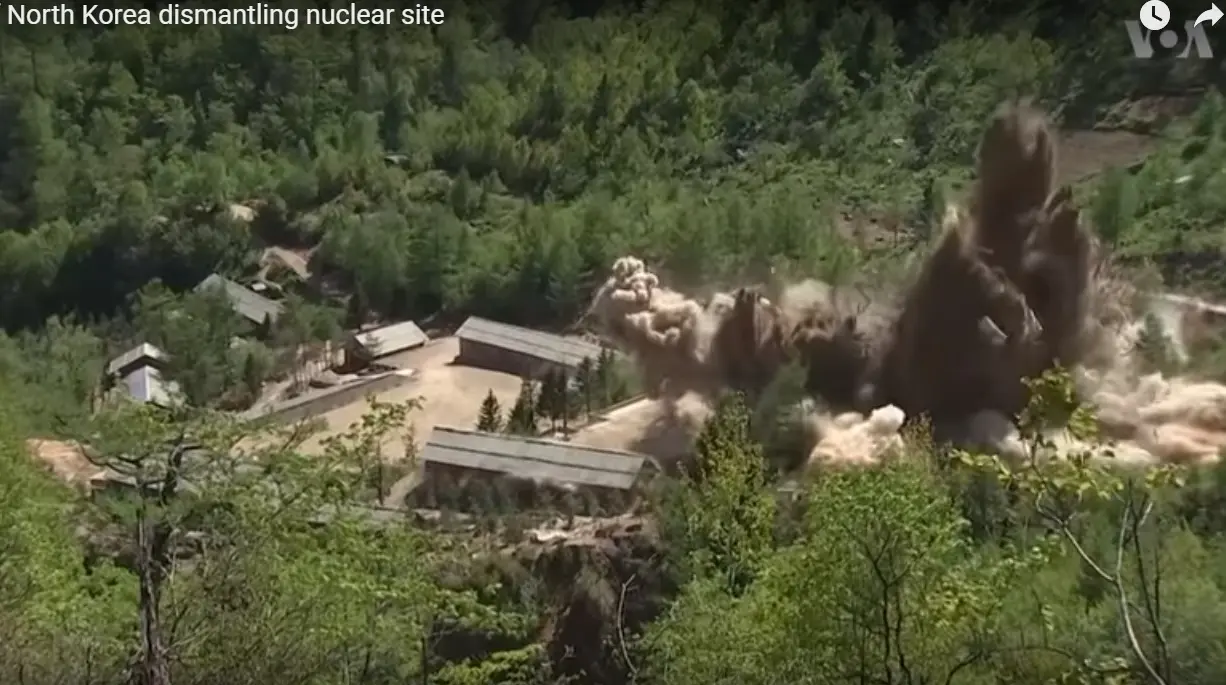
What followed was an arms program that kept accelerating. Five more tests followed at the same mountain site — in 2009, 2013, twice in 2016, and 2017 — each one bigger than the last, culminating in a blast estimated at roughly a quarter of a megaton. In May 2018, with the world watching, North Korea blew up the Punggye-ri tunnels in front of foreign journalists, a gesture of goodwill ahead of a summit with the United States — though inspectors were never allowed to verify what, exactly, had been destroyed.
The October 9 test matters because it was the moment the hypothetical became real. Every negotiation with Pyongyang since — every round of sanctions, every summit, every red line — has started from the fact established that morning under Mt. Mantap: North Korea is a nuclear-armed state, and the world has never found a way to change that.
Image: a screen capture from a Voice of America video showing the 2018 demolition of the Punggye-ri test tunnels — the same mountain where North Korea conducted its first nuclear test on October 9, 2006; public domain (via Wikimedia Commons).