America's Bloodiest Day — Twelve Hours at Antietam
On September 17, 1862, Union and Confederate armies met near Sharpsburg, Maryland, in the bloodiest single day in American military history — giving Lincoln the opening he needed to free the slaves.
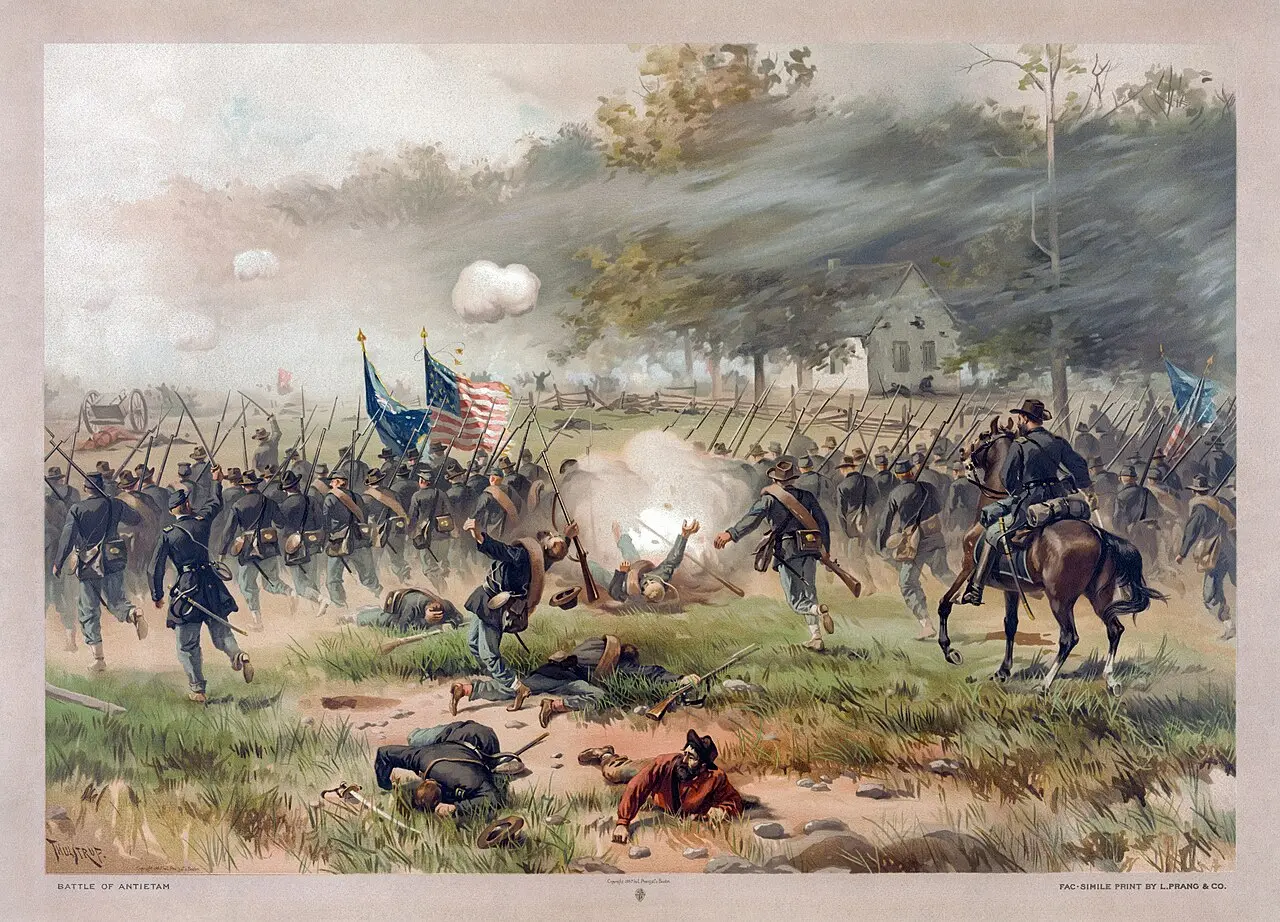
It began before dawn in a cornfield. By nightfall, the ground was covered with more dead and wounded Americans than any single day before or since.
In early September 1862, Confederate General Robert E. Lee did something audacious: he marched his Army of Northern Virginia into Maryland, hoping a victory on Northern soil would win foreign recognition for the Confederacy and shatter Northern morale. Union General George McClellan had a gift he barely used — a copy of Lee's battle plans, Special Order 191, found wrapped around three cigars by two Indiana soldiers on September 13. McClellan waited about 18 hours before moving, giving Lee time to gather his outnumbered army near the town of Sharpsburg, along Antietam Creek.
The battle opened at dawn on September 17 with Union artillery and an assault through a farmer's cornfield. For hours, the fighting surged back and forth across the Cornfield, around a small white church called the Dunker Church, and along a sunken farm road that would earn the name "Bloody Lane." Artillery shredded the cornfield, and the dead lay in rows where they had stood.
At midday, Union troops finally broke through at the Sunken Road. In the afternoon, after hours of bloody struggle, they stormed the stone bridge over Antietam Creek — now called Burnside's Bridge — at the cost of more than 600 casualties. Just as the Union seemed poised to crush Lee's army, Confederate General A.P. Hill arrived from Harpers Ferry with his division and launched a savage counterattack that saved the day for the South.
When the guns fell silent, the butcher's bill was staggering: about 22,726 dead, wounded, or missing — roughly 12,410 Union and 10,316 Confederate. It remains the bloodiest single day in American military history.
Tactically, the battle was a draw. But strategically, it was a Union victory: Lee withdrew across the Potomac the night of September 18, ending his invasion. And that was enough for President Abraham Lincoln. He had been waiting for a Union success before issuing his Emancipation Proclamation, so the announcement would not look like an act of desperation. Five days later, on September 22, he issued the preliminary proclamation declaring that enslaved people in rebellious states would be free as of January 1, 1863.
Antietam matters because it turned the Civil War from a fight to preserve the Union into a fight to end slavery — and because its cost still staggers the imagination. In a single day, on a few square miles of Maryland farmland, America paid a price in blood that helped buy its second founding.
Photo: "Battle of Antietam" by Thure de Thulstrup (1887), chromolithograph published by L. Prang & Co., Library of Congress collection, public domain, via Wikimedia Commons.