Thirty-Nine Men Sign a Piece of Parchment That Rules a Nation
On September 17, 1787, thirty-nine delegates signed the U.S. Constitution in Philadelphia — a document almost nobody loved, written by men who openly doubted it would work.
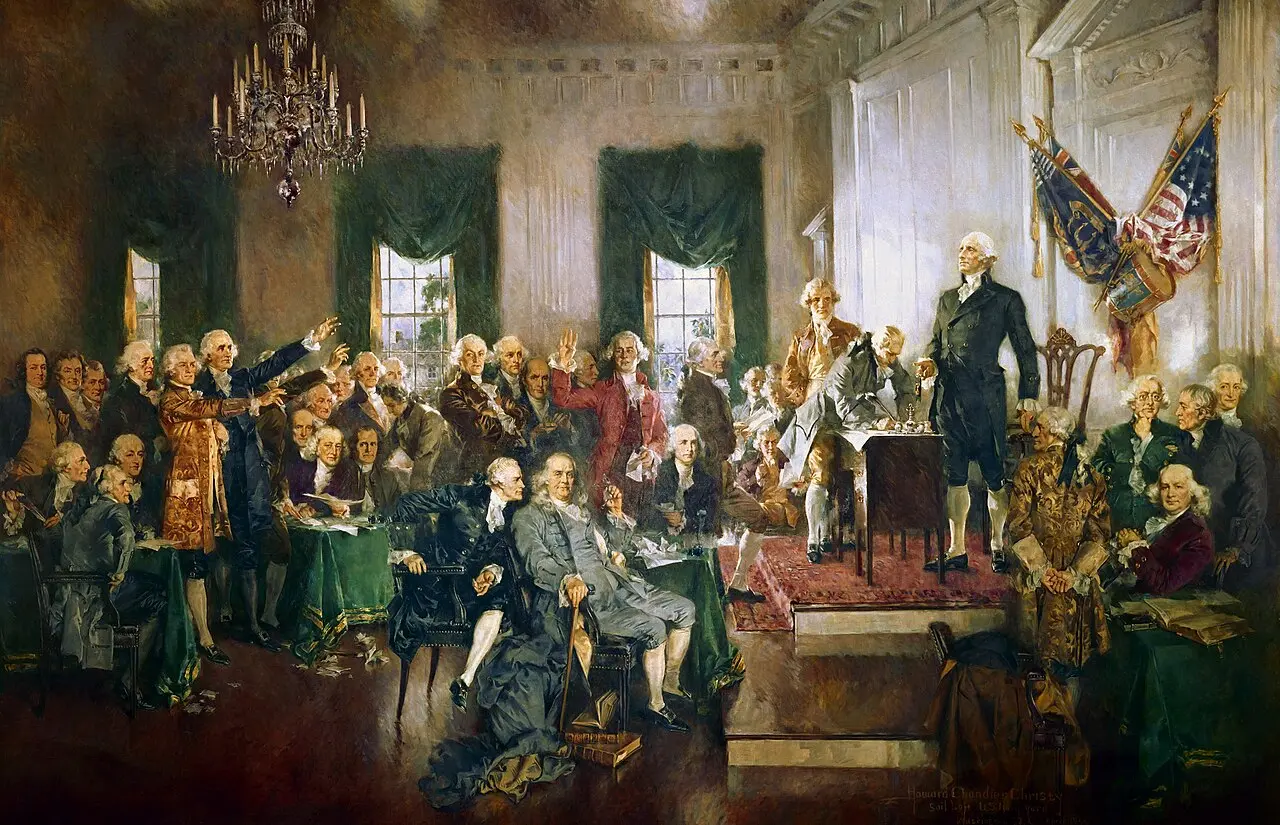
By the summer of 1787, the American experiment was failing. The Articles of Confederation had given the thirteen states a government so weak it could not pay its debts, regulate trade, or stop states from bickering like rival countries. So delegates gathered in Philadelphia — behind closed doors, in the same room where the Declaration of Independence had been signed eleven years earlier — to fix it. They ended up writing something entirely new.
The work took nearly four months of brutal, secret debate. Big states fought small states over representation. Northern delegates fought Southern delegates over slavery — a compromise that counted enslaved people as three-fifths of a person for representation haunts the document to this day. Twice the convention nearly broke apart. Benjamin Franklin, at 81 the oldest delegate, kept the peace with jokes, patience, and one famous plea for compromise.
On September 17, the engrossed Constitution — written out in a clear hand by a clerk named Jacob Shallus — was ready for signatures. Thirty-nine of the 42 delegates present signed. Three refused: Elbridge Gerry of Massachusetts and Edmund Randolph and George Mason of Virginia, who thought the document gave the federal government too much power and lacked a bill of rights. Rhode Island, the thirteenth state, had boycotted the convention entirely.
The signers were an extraordinary group. The youngest, Jonathan Dayton of New Jersey, was 26. Franklin was 81. Six of them had also signed the Declaration of Independence. About thirty had served in the military. They were lawyers, merchants, planters, and soldiers — and almost none of them was fully satisfied with what they had written.
Franklin said so himself in his closing remarks, recorded by James Madison in his notes of the convention: he confessed he did not entirely approve of the Constitution, but added that he doubted any other convention they could obtain would be able to make a better one. It was an endorsement wrapped in a shrug — and it was enough.
The signing was only the beginning. The Constitution had to be ratified by nine states, and the fight was ferocious. The promise of a Bill of Rights — the first ten amendments — was what finally won over the skeptics. By 1791, the deal was sealed.
Today, the U.S. Constitution is the oldest written national constitution still in use anywhere in the world. It has survived a civil war, two dozen amendments, and every crisis thrown at it. It matters because of what those 39 men understood on September 17, 1787: that a government built on compromise, checks, and the consent of the governed — even an imperfect one — could outlast them all. They signed a document they doubted. It turned out to be the most durable political invention in modern history.
Photo: "Scene at the Signing of the Constitution of the United States" by Howard Chandler Christy (1940), Architect of the Capitol, public domain, via Wikimedia Commons.