After Seven Years of Silence, Argentina Votes
On October 30, 1983, Argentines voted in their first free election in a decade, choosing Raul Alfonsin and ending seven years of military dictatorship.
For seven years, Argentina had been ruled by men in uniform. Then, on October 30, 1983, the uniforms stepped aside — and 85 percent of registered voters walked to the polls in the country's first free election in a decade.
What they were voting to end had been one of the darkest chapters in Argentine history. The military junta that seized power in 1976 waged a campaign of state terror against its own citizens: according to human rights groups, as many as 30,000 people were kidnapped, tortured, and murdered — the desaparecidos, the disappeared, whose children and grandchildren are still being identified today. The press was censored, the legislature shuttered, dissent criminalized.
By 1983 the junta was bankrupt in every sense. The economy was in ruins, the regime's crimes were becoming impossible to hide, and a disastrous defeat in the 1982 Falklands War had destroyed what remained of its prestige. The last military president, Reynaldo Bignone, had no choice: he called elections.
The winner, with nearly 52 percent of the vote, was Raul Alfonsin of the Radical Civic Union — a soft-spoken lawyer who had campaigned on an electrifying promise: that democracy would feed, heal, and educate, and that the crimes of the dictatorship would be investigated, not buried. His Peronist rival, Italo Luder, took about 40 percent — the first time the Peronists had ever lost a presidential election.
Alfonsin took office on December 10, 1983. One of his first acts was to create CONADEP, the National Commission on the Disappearance of Persons, which documented the junta's atrocities in a report titled 'Nunca Mas' — Never Again. The junta's leaders were put on trial, in proceedings without precedent in Latin America: never before had a democracy tried the dictators who had just left power.
The trials made Argentina a model for the world. When other countries emerging from dictatorship asked how to face the past, they looked to Buenos Aires. Alfonsin's bet — that a new democracy could afford to tell the truth about the old terror — held, and the military never again seized power in Argentina.
Democracy in Argentina has been tested many times since — by uprisings, by economic collapse, by the old temptations. But it has held. And it began on an October day when millions of Argentines, many voting for the first time in their lives, stood in long lines to take their country back.
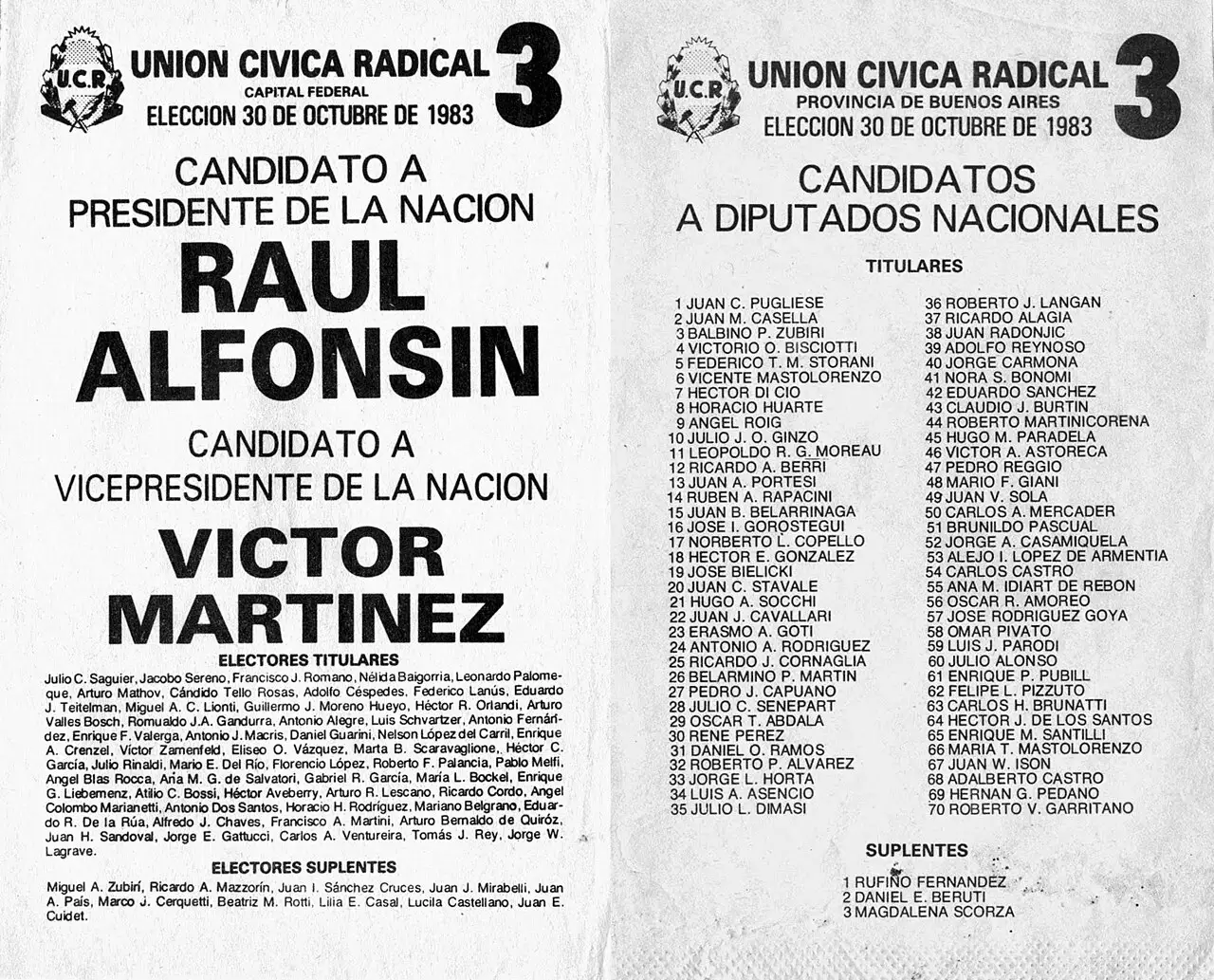
Photo: The 1983 Union Civica Radical ballot, headed by presidential candidate Raul Alfonsin and running mate Victor Martinez — public domain (via Wikimedia Commons).