
108 Minutes That Changed the World
On April 12, 1961, Soviet pilot Yuri Gagarin rode the Vostok 1 capsule once around the Earth in 108 minutes, becoming the first human being in space.
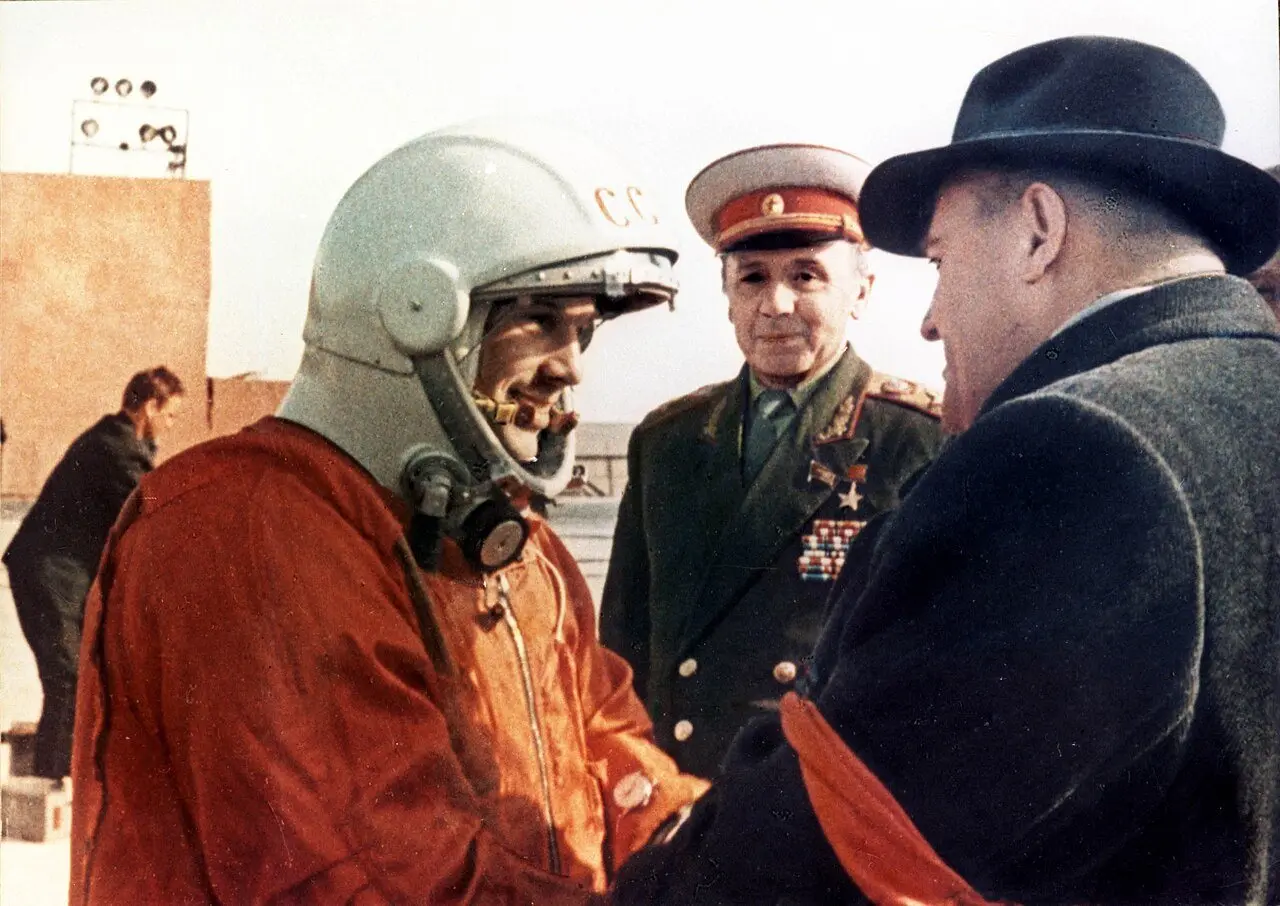
On the morning of April 12, 1961, a 27-year-old Soviet Air Force pilot climbed into a small spherical capsule perched atop a modified missile at the Baikonur Cosmodrome in Soviet Central Asia. His name was Yuri Alekseyevich Gagarin. No human being had ever left the planet before. He was about to.
At liftoff, the Vostok 1 rocket carried him beyond the sky itself. Gagarin became the first human to reach orbital velocity and circle the Earth — a single orbit lasting 108 minutes, swinging between 181 and 327 kilometers above the surface. Down below, the world had no idea it was happening; the Soviet space program operated in near-total secrecy.
Gagarin was, for most of the flight, a passenger. Engineers feared that weightlessness might scramble a pilot's judgment, so his manual controls were locked behind a combination he carried in a sealed envelope, to be opened only in an emergency. The flight ran on automatic pilot, and the one statement attributed to him from orbit was calm and workmanlike: "Flight is proceeding normally; I am well." Of the view, he reportedly said: "The sky is very dark; the Earth is bluish. Everything is seen very clearly."
The return was nearly the end of him. The service module failed to separate cleanly from the descent module, held on by a bundle of wires, and the two halves tumbled wildly through the upper atmosphere until the wires burned through. Then, exactly as planned, Gagarin ejected at about 7 kilometers and parachuted to a field — landing separately from his capsule. As the story goes, a farmer and his young daughter watched the stranger in the bright orange suit drift down; Gagarin reassured them, "Don't be afraid, I am a Soviet citizen like you, who has descended from space and I must find a telephone to call Moscow!"
The photograph above was taken that very day: Gagarin in his spacesuit and helmet, moments before the start, with officials at the launch site — history's last portrait of an anonymous pilot.
He did not stay anonymous for long. Gagarin became an instant worldwide celebrity, awarded the Order of Lenin and named a Hero of the Soviet Union, his smiling face on monuments and stamps across the globe. The triumph stunned the United States, whose first astronaut, Alan Shepard, would not fly until 23 days later — and then only on a brief suborbital hop. It would take John Glenn, in February 1962, to match Gagarin's orbit.
Gagarin never flew in space again; he died in 1968 when his MiG jet crashed on a training flight, and his ashes were interred in the Kremlin Wall. But April 12 endures. In 2011, the United Nations declared it the International Day of Human Space Flight, celebrated every year as the beginning of the space era for mankind.
Before April 12, 1961, the stars were something humans only looked at. After 108 minutes, they were somewhere a human had been — and, ever since, somewhere we keep going back to.
Photo: Ministry of Defence of the Russian Federation / RIA Novosti, CC BY 4.0 (via Wikimedia Commons). Taken on April 12, 1961, the day of the launch.