Two Worlds Meet on the Causeway
On November 8, 1519, Hernán Cortés walked the southern causeway into Tenochtitlan — a lake-city possibly larger than any in Europe — and was welcomed by Moctezuma II.
It may have been the largest city on Earth that morning. On November 8, 1519, Hernán Cortés led his small force of Spaniards — and about a thousand Tlaxcaltec allies — down the flower-covered southern causeway and into Tenochtitlan, the island capital of the Mexica people, rising from the middle of Lake Texcoco. Modern estimates put its population between 60,000 and 300,000; at the upper end, it would have been larger than every city in Europe, dwarfing Paris and Naples and towering over Seville, the city Cortés had sailed from.
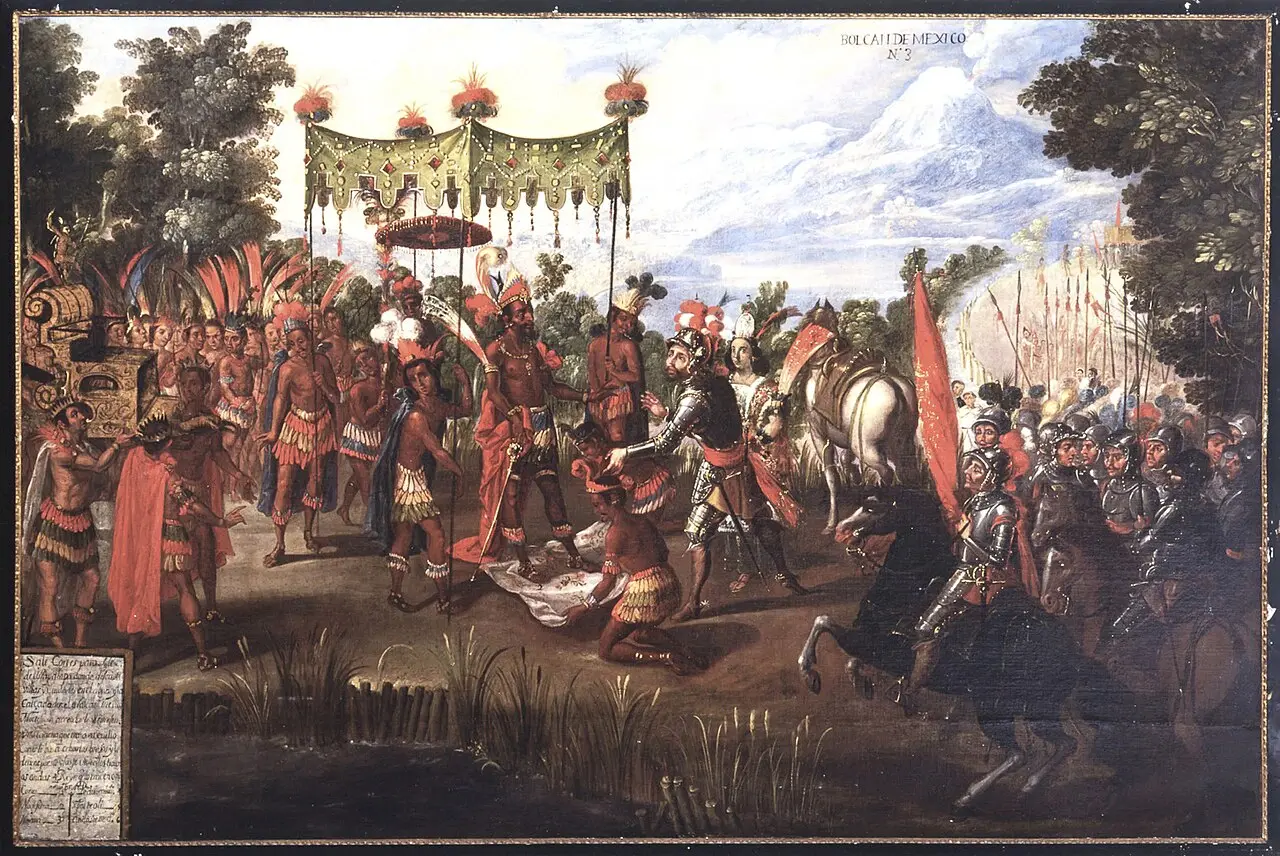
The emperor, Moctezuma II, came out to meet him on the Great Causeway with his great lords — including Cacamatzin, king of Tetzcoco, and the lords of Tlacopan and Tlatelolco — carried in a litter beneath a canopy of green feathers, while enormous crowds from the city watched the two processions approach each other. When they met, Cortés strode forward and tried to embrace Moctezuma — and was immediately restrained by the emperor's brother Cuitláhuac and nephew Cacamatzin. No one was permitted to touch the tlatoani. Moctezuma then honored his guest himself, placing a priceless feather-work flower, a golden necklace, and a garland of flowers around Cortés's neck. Cortés, for his part, declared himself the representative of Queen Juana of Castile and her son, the young emperor Charles V — and in the account recorded by the Franciscan chronicler Bernardino de Sahagún, Moctezuma answered with words of submission, reportedly telling Cortés of his "desire to serve" the Spanish crown.
The conversation ran through an extraordinary chain of interpreters: Doña Marina — the Indigenous woman the Spanish called Malinche — translated Nahuatl into Chontal Maya, and the Spaniard Gerónimo de Aguilar translated Chontal Maya into Spanish. Word by word, across two worlds, the two leaders spoke.
Cortés entered the city unopposed and was lodged with his men in the palace of Axayacatl. Remarkably, the expedition itself was a renegade venture: Cortés had defied the orders of Diego Velázquez, the governor of Cuba, and sailed without his sanction — claiming his authority instead as captain-general, directly from the crown. But the welcome was the high-water mark. Within weeks, Cortés took Moctezuma hostage in his own palace; the following year, smallpox — a disease the Americas had never known — tore through the city; and on August 13, 1521, Tenochtitlan fell. The causeway meeting of November 8 remains one of the most studied encounters in history: the moment two civilizations, each certain of its own grandeur, finally looked each other in the eye.
Painting: unknown artists, 17th century, public domain (via Wikimedia Commons).