The Library a Retired Diplomat Refused to Let Die
On November 8, 1602, Thomas Bodley reopened Oxford's ruined university library with about 2,000 books — the rebirth of the Bodleian Library.
By the 1590s, Oxford's university library was a ruin in all but name. The medieval collection built by Duke Humphrey of Gloucester had been gutted during the Reformation — under Edward VI, manuscripts deemed "superstitious" were purged, books were burned or sold off for pennies, and by 1556 the desks themselves were sold and the room handed to the medical faculty. Only three of Duke Humphrey's original books were left.
Then a retired diplomat decided to "set up my staff at the library door." Thomas Bodley, a former fellow of Merton College who had spent years on diplomatic missions for Elizabeth I across Europe, had married a wealthy widow and stepped back from public life. In 1598 he wrote to Oxford's vice chancellor offering to take on the cost of restoring the old library "to the public use of students." The university accepted, the room was refitted, Bodley donated books from his own collection, a librarian — Thomas James — was appointed, and on November 8, 1602, the library formally reopened as Bodley's Library, the Bodleian, with roughly 2,000 books and a prominently displayed register of benefactors to encourage donations.
Bodley was just getting started. The first librarian, the scholar Thomas James, had been appointed in 1600, and in 1602 the library opened with a fine register recording every benefactor — an ornate showpiece designed to shame more books out of wealthy visitors. In 1610 Bodley struck an agreement with London's Stationers' Company that a copy of every book published in England and registered at Stationers' Hall would be deposited in his library — the seed of the legal-deposit system that makes the Bodleian, four centuries later, one of Britain's great research libraries, still entitled to a copy of nearly everything published in the country. The first printed catalogue of the collection appeared in 1605, and its 1620 successor ran to 675 pages. Knighted by James I in 1604, Bodley died in 1613, childless, and left most of his fortune to Oxford.
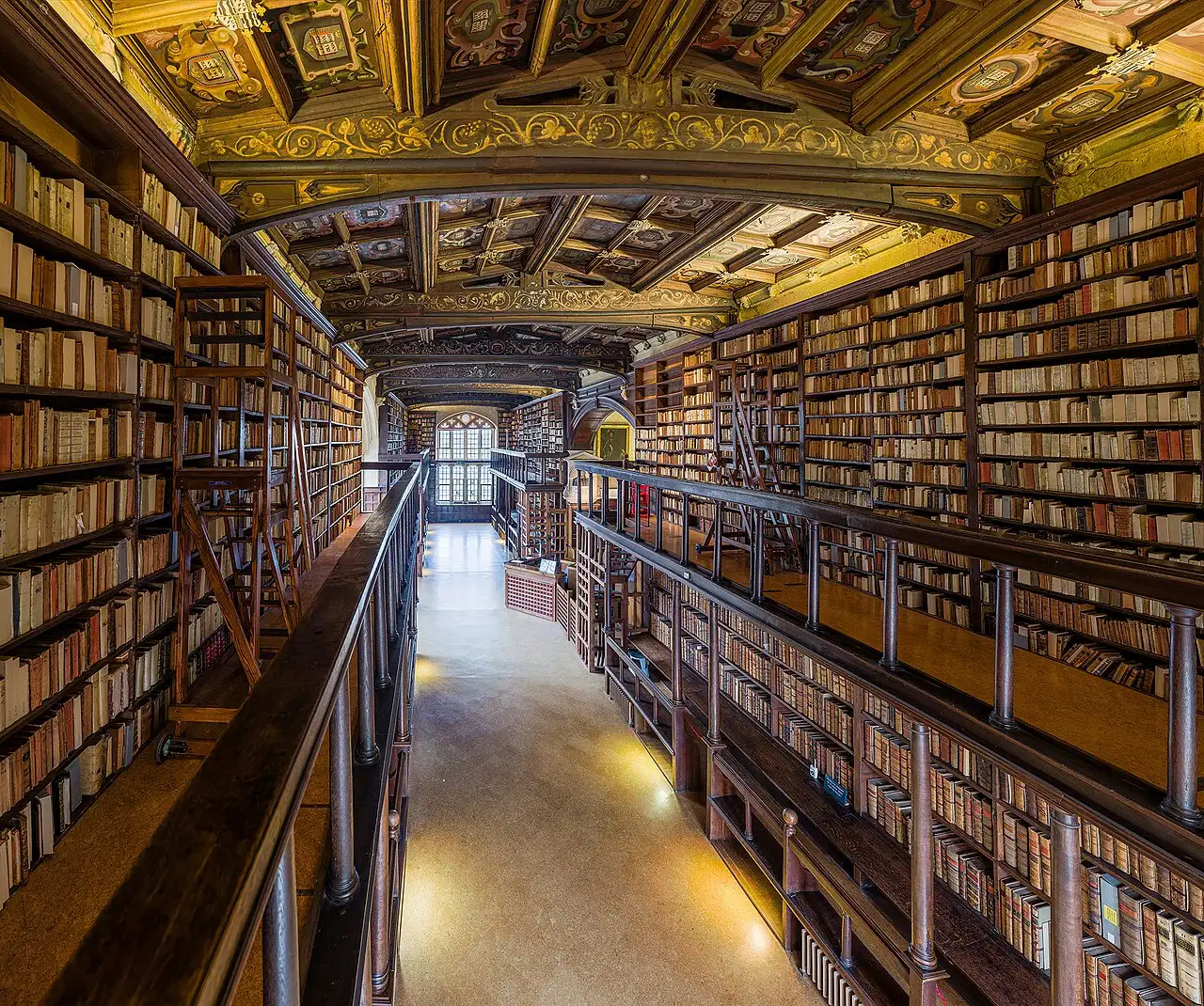
The library he saved now holds many millions of items — and it still celebrates his vision. Duke Humfrey's room that he refitted remains the library's oldest reading room. On November 8, 2002, exactly four hundred years after the reopening, the Bodleian marked its quatercentenary. One man's retirement project had become, as the occasion's historians put it, Oxford's greatest benefaction.
Photo: Diliff, CC BY-SA 3.0 (via Wikimedia Commons).