The Second Flag on Mount Suribachi
On February 23, 1945, U.S. Marines raised the American flag atop Mount Suribachi on Iwo Jima, producing one of World War II's most famous photographs.
Some photographs are taken. This one was almost missed. On February 23, 1945, Associated Press photographer Joe Rosenthal was climbing the volcanic peak of Mount Suribachi on Iwo Jima when a Marine coming down told him the flag-raising was already over. Rosenthal kept climbing anyway. At the summit, he found Marines preparing to raise a larger flag — one big enough to be seen across the island. He swung his bulky Speed Graphic camera into action, and the shutter clicked on one of the most famous images in history.
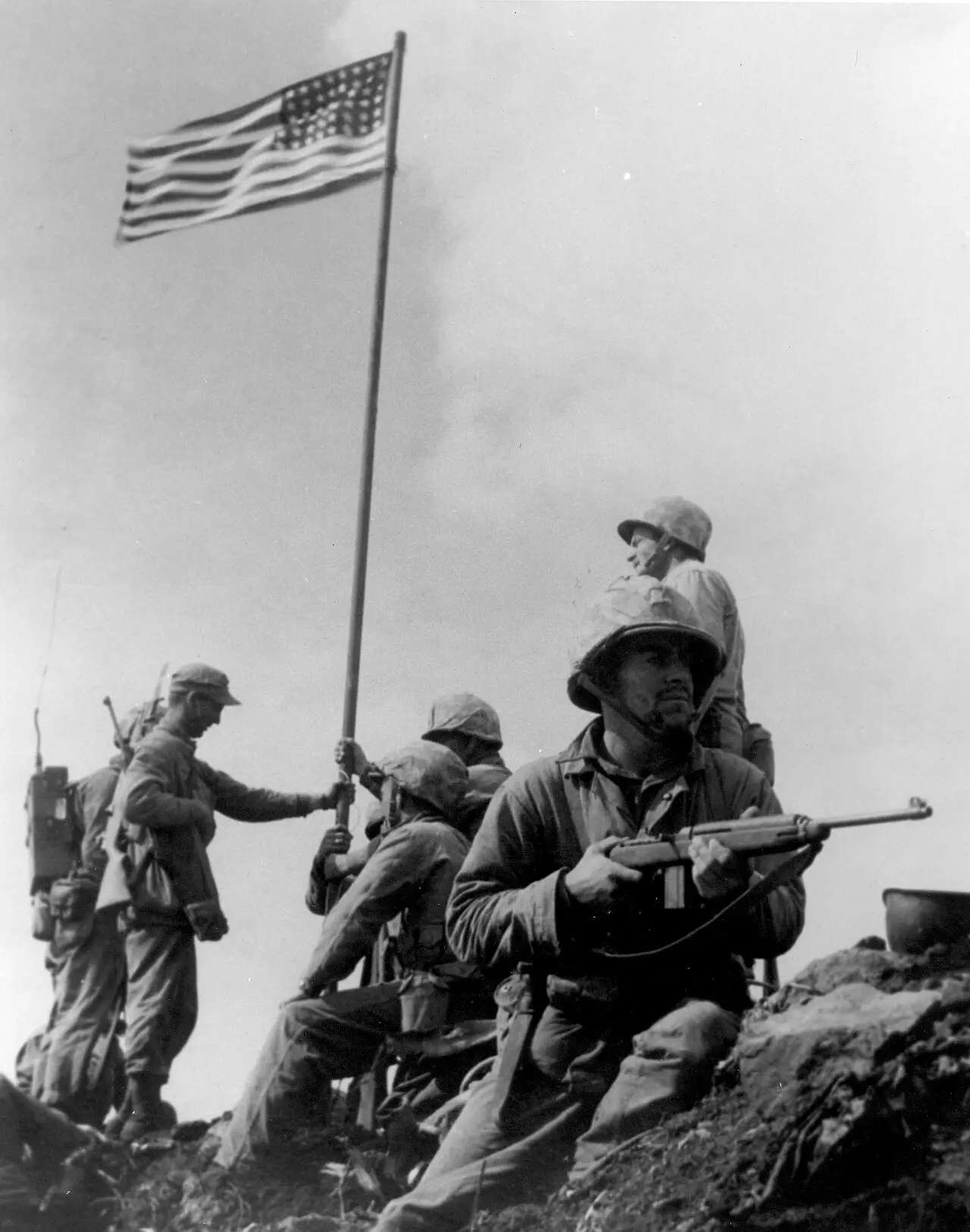
Iwo Jima was a speck of volcanic rock about 700 miles from Tokyo, and it mattered enormously: its airfields would give American bombers a base within striking distance of Japan. The invasion had begun on February 19, and the fighting was savage — Japanese defenders fought from a maze of tunnels and bunkers. The 546-foot Mount Suribachi, looming over the landing beaches at the island's southern tip, was a key early objective. On the morning of February 23, troops of the 28th Regiment, 5th Marine Division fought their way to the crater's rim. Around 10:30 a.m., a patrol under Lieutenant Harold Schrier raised a small American flag, setting off cheers and ships' whistles offshore. Marine photographer Sergeant Louis Lowery captured that first raising — the photograph illustrating this story.
Hours later came the second flag. Commanders wanted a bigger banner visible from the beaches and the fleet. Six men raised it together — and Rosenthal's photograph of the moment, published in Sunday newspapers two days later, electrified the nation. It won the 1945 Pulitzer Prize for Photography and was reprinted in thousands of publications. It was not staged, though rumors of fakery have followed it for decades; Rosenthal simply got lucky with perfect timing.
The image outlived the battle's brutality. Three of the six flag-raisers — Sergeant Michael Strank, Corporal Harlon Block, and Private First Class Franklin Sousley — were killed in the fighting that followed. The battle for Iwo Jima raged for more than a month, costing nearly 7,000 American lives and wounding more than 19,000. The photograph became a symbol of sacrifice and resolve: it anchored war-bond drives and, in 1954, was sculpted in bronze as the Marine Corps War Memorial in Arlington, Virginia, honoring every Marine who has died in service since 1775.
Lowery's photograph of the first flag — quieter, less famous — is a reminder that history's most iconic moments often had a rehearsal. The cheers that morning belonged to a small flag on a short pole. The world remembers the second one. But both were raised by young men on the same crater rim, on the same February day, in the middle of one of the Pacific war's bloodiest battles.
Photo: Staff Sergeant Louis R. Lowery, USMC, public domain (via Wikimedia Commons).