
The Night the Sky Exploded
On February 23, 1987, light from an exploding star reached Earth, giving astronomers their first close-up study of a supernova in 383 years.
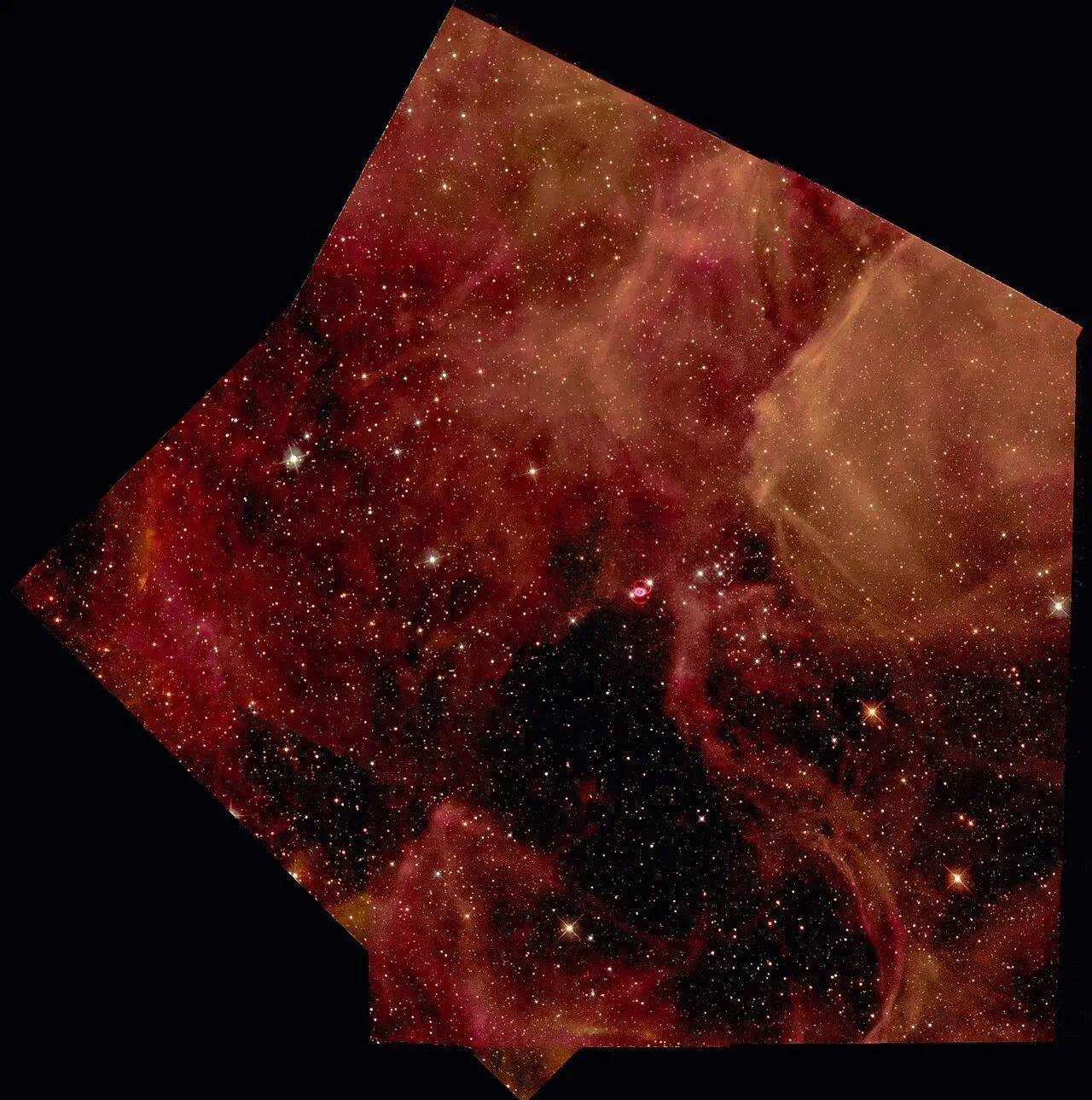
On February 23, 1987, three underground detectors on three continents felt something pass straight through the entire planet — the ghost of a star that had died 168,000 years earlier.
Deep in a Japanese mine, in an Ohio salt mine, and in the Caucasus Mountains of the Soviet Union, instruments built to catch neutrinos — subatomic particles so shy they can fly through a light-year of lead without noticing — recorded a sudden burst within seconds of one another. A neutrino burst like that means only one thing: somewhere in the universe, a massive star had just collapsed.
Hours later, high in the Chilean Andes at the Las Campanas Observatory, a 26-year-old Canadian graduate student named Ian Shelton was developing photographic plates from the night before. On one plate, in the Large Magellanic Cloud — a small satellite galaxy of our own Milky Way — a brilliant new star blazed where none had been. The blue supergiant star Sanduleak -69° 202 was gone. In its place: a supernova. Shelton stepped outside into the dark desert night and saw it with his own eyes. The telescope operator, Oscar Duhalde, saw it too. And half a world away in New Zealand, an amateur astronomer named Albert Jones spotted the new star independently that same night.
It was the first supernova visible to the naked eye since the one Johannes Kepler observed in 1604 — a gap of 383 years. Over the following weeks it kept brightening, peaking in May at magnitude 3, outshining nearly every star in its constellation.
SN 1987A, as it was named, became the most studied stellar explosion in history — and it rewrote the textbooks. It confirmed the theory of core collapse: when a giant star dies, some 99 percent of its energy escapes as neutrinos, racing ahead of the visible light — exactly what those underground detectors had caught hours before anyone saw a thing. It also delivered a surprise: the star that exploded was a blue supergiant, not the red supergiant theorists had expected, forcing astronomers to rethink how massive stars live and die.
The investigation never stopped. The Hubble Space Telescope has watched the expanding debris for decades, and in 2026 the James Webb Space Telescope found the strongest evidence yet of what the blast left behind at its core: a neutron star, a city-sized ember packing more mass than our sun.
Why it matters: every atom of iron in your blood and calcium in your bones was forged in explosions like this one. On February 23, 1987, humanity got to watch the forge in action — and we're still learning from the light.
Photo: Hubble Heritage Team (AURA/STScI/NASA/ESA), public domain (via Wikimedia Commons).