
The Paper That Rewrote Gravity Arrived on March 20, 1916
On March 20, 1916, Annalen der Physik received Einstein's "Foundation of the General Theory of Relativity," the paper that rewrote our understanding of gravity.
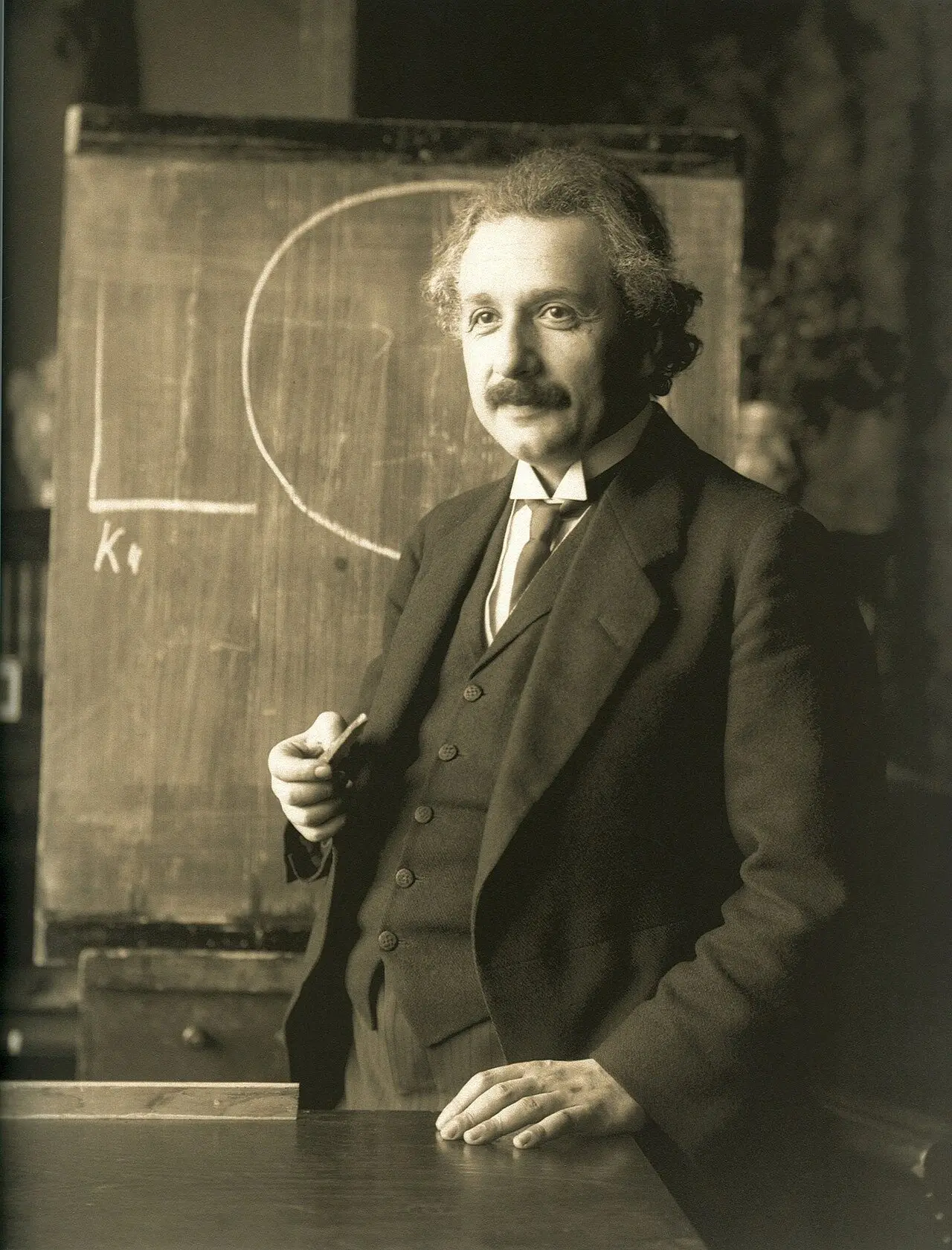
On March 20, 1916, the journal Annalen der Physik received a manuscript that would change physics forever. It was Albert Einstein's "Die Grundlage der allgemeinen Relativitätstheorie" — "The Foundation of the General Theory of Relativity" — the first complete account of his final theory of gravity, and the paper that made him Einstein.
The 37-year-old physicist, then working in Berlin, had spent years wrestling the idea into shape. The previous November he had presented the finished field equations to the Prussian Academy of Sciences in a rush of four papers, capping a frantic priority race with the mathematician David Hilbert. But those were breakthroughs delivered at speed. The March paper — published as volume 49, pages 769 to 822 — was the whole theory, laid out from first principles: gravity is not a force pulling masses together, as Newton had taught, but the curvature of spacetime itself, bent by the presence of matter and energy.
Einstein wanted the paper to be read, not just admired. In its opening pages he wrote that he had tried to set the theory out "in as simple and transparent a manner as possible, so that a special study of the mathematical literature is not required for the understanding of the present paper." He had reason for confidence: his new field equations had already explained the slow rotation of Mercury’s orbit, a puzzle Newtonian gravity could not solve.
The theory was audacious, and it made predictions Newton could not. It explained a long-standing anomaly in the orbit of Mercury, whose path around the Sun slowly rotates in a way Newtonian physics couldn't account for. And it predicted that the Sun's gravity would bend starlight passing near it — a claim that sounded like science fiction until a solar eclipse on May 29, 1919, let Arthur Eddington's expedition measure the deflection and confirm Einstein was right. When the Royal Society of London announced the result publicly, fame and recognition came suddenly — the Berlin professor became the most famous scientist alive.
A century later, the paper was still giving. In February 2016 — almost exactly a hundred years after it was received — physicists announced the first direct detection of gravitational waves, the ripples in spacetime Einstein's theory had predicted. Black holes, the expanding universe, the GPS satellites that must correct for relativity to tell you where you are: all of it flows from those pages.
"Conceivably the farthest-reaching generalization" of his earlier work, Einstein called it in the paper's opening. He was not exaggerating. On March 20, 1916, one manuscript arrived at a physics journal, and the universe got bigger.
Photo: Ferdinand Schmutzer, public domain (via Wikimedia Commons).