The Nun Who Left the Convent to Serve the Slums
On October 7, 1950, Mother Teresa's new order, the Missionaries of Charity, was officially established in Calcutta — and grew from thirteen sisters into one of the world's largest charities.
The summons came to her on a train. On September 10, 1946, Sister Teresa — a 36-year-old Loreto nun teaching geography to the daughters of Calcutta's wealthy families — was riding the overnight train to Darjeeling for her annual retreat when, as she later described it, she received a "call within a call." Christ, she said, was asking her to leave the convent classroom and serve the poorest of the poor directly. She would spend the rest of her life answering.
For nearly two years the Church tested that conviction. Then, on August 17, 1948, she walked out of the Loreto convent wearing for the first time the garment the world would come to know: a plain white sari edged with blue. After a short nursing course with the Medical Mission Sisters in Patna, she took a tiny room in Calcutta and, on December 21, went into the slums for the first time — washing children's sores, sitting with a dying old man in the road, beginning each day with Mass and a rosary in her hand. Former students began joining her, one by one.
On October 7, 1950 — the feast of Our Lady of the Rosary, a date she chose deliberately — Archbishop Ferdinand Périer of Calcutta officially established her new congregation, the Missionaries of Charity, as a diocesan religious order, with permission from the Holy See. It began with just thirteen sisters. Their mission, in Mother Teresa's own words, was to care for "the hungry, the naked, the homeless, the crippled, the blind, the lepers, all those people who feel unwanted, unloved, uncared for throughout society."
The work grew with astonishing speed. In 1952 the city of Calcutta gave her space in an abandoned Hindu temple, and she turned it into Nirmal Hriday — "Pure Heart" — the first Home for the Dying, where the destitute could die with dignity, honored according to their own faiths. In 1955 came Nirmala Shishu Bhavan, a home for orphaned and homeless children. A leprosy hospice followed. By the 1960s the sisters were opening houses across India; in 1965 five sisters sailed for Venezuela, the order's first foundation abroad, and houses soon followed in Rome, Tanzania, Austria, the United States, and eventually nearly every country on earth.
The world noticed. She received the Nobel Peace Prize in 1979 for her humanitarian work, and at her death in 1997 the Missionaries of Charity numbered more than 4,000 sisters working in hundreds of centers worldwide — homes for orphaned children, hospices, leper colonies, soup kitchens. On September 4, 2016, Pope Francis canonized her as Saint Teresa of Calcutta.
Her methods and theology have drawn criticism over the years, and she never pretended to be perfect. But the October 7 decision — to turn a private spiritual summons into a public institution — is why a nun who started with nothing but a sari and thirteen companions now has her name on charitable works on six continents. It began with one woman, one train ride, and the refusal to walk past suffering.
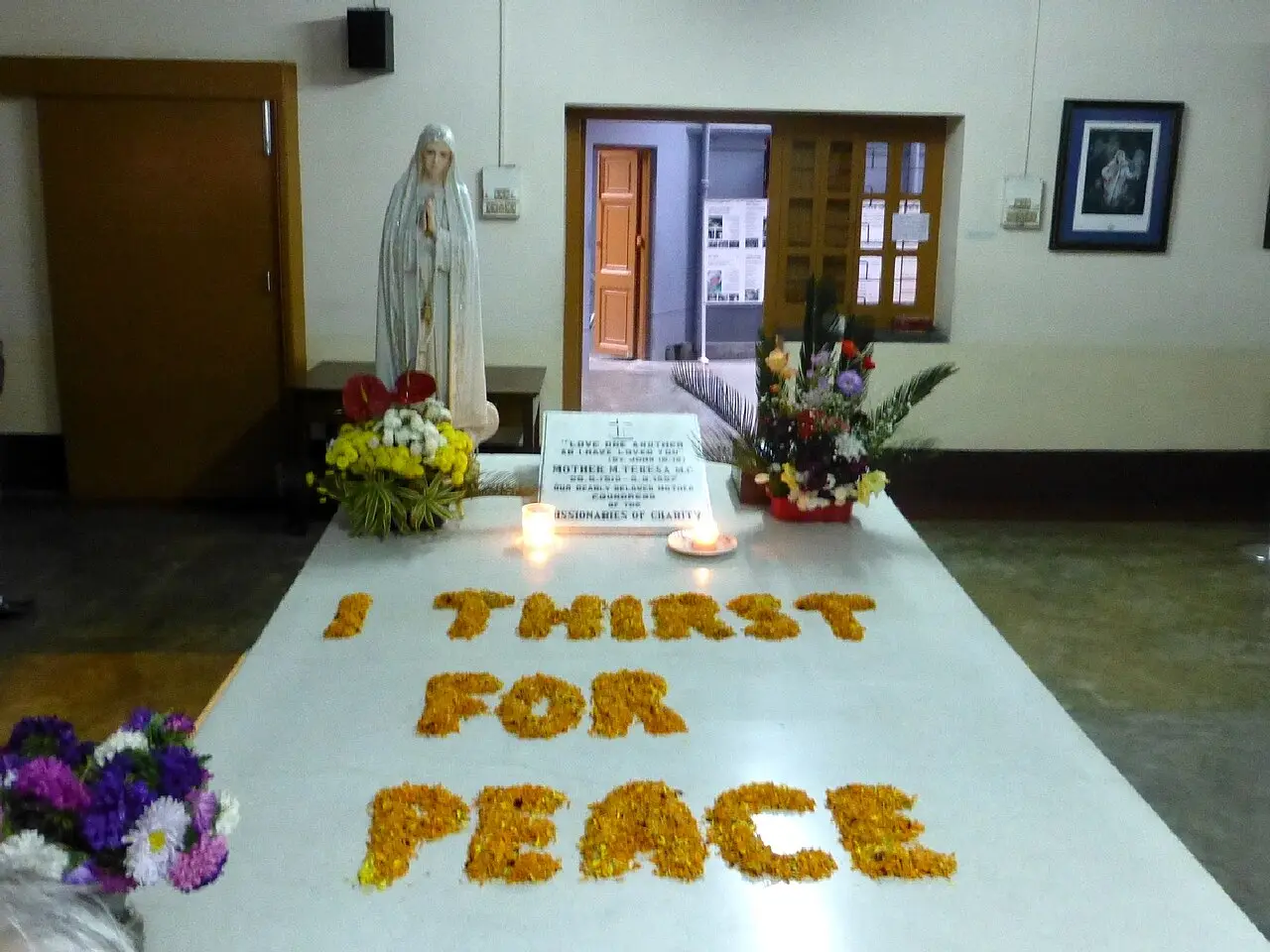
Photo: the tomb of Mother Teresa at the Mother House of the Missionaries of Charity in Kolkata, photographed by Hiroki Ogawa, CC BY 3.0 (via Wikimedia Commons).