Kennedy's Signature on the Nuclear Test Ban Treaty
On October 7, 1963, President Kennedy signed the ratification of the treaty banning nuclear tests in the atmosphere, space, and underwater — the first arms-control deal of the Cold War.
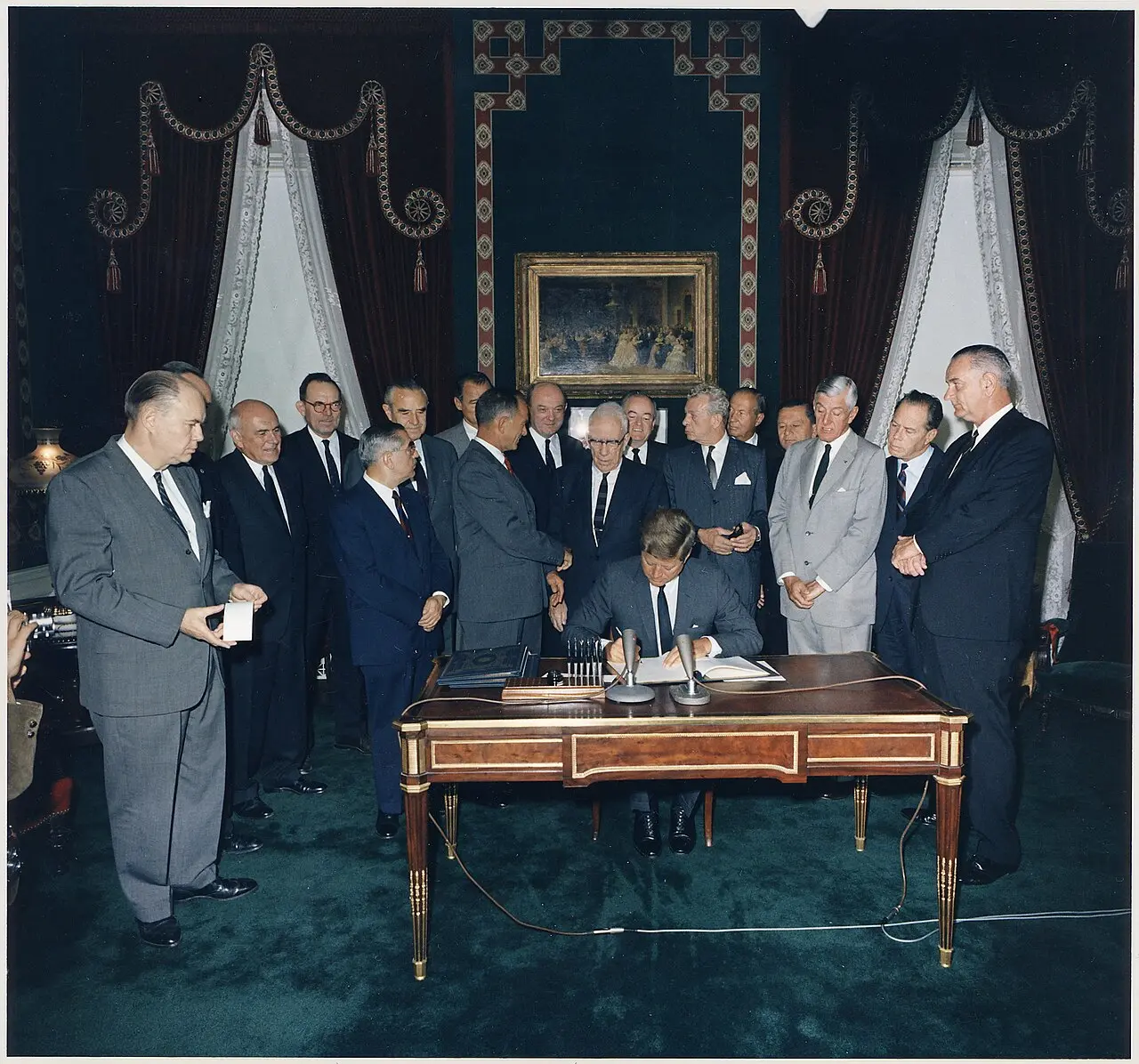
Exactly one year and twelve days after the Cuban Missile Crisis brought the world to the edge of nuclear war, the American president sat down in the Treaty Room of the White House and signed the first arms-control agreement of the atomic age.
The road to October 7, 1963, had been long and grim. Since the first Soviet atomic test in 1949, the United States and the Soviet Union had been blowing up ever-bigger bombs in the open air, and the fallout was drifting across the planet — into milk, into soil, into children's bones. Talks on a test ban had dragged on for years, foundering on the question of inspections. Then, in the summer of 1963, with the memory of the missile crisis still fresh, Soviet Premier Nikita Khrushchev signaled he would accept a ban limited to the environments both sides could monitor without intrusive inspections: the atmosphere, outer space, and underwater.
President Kennedy sent veteran diplomat Averell Harriman to Moscow. The talks opened on July 15, and within days the two sides had a deal. It was initialed on July 25 and formally signed in Moscow on August 5, 1963, by U.S. Secretary of State Dean Rusk, Soviet Foreign Minister Andrei Gromyko, and British Foreign Secretary Lord Home. But the hardest fight was at home: Kennedy spent two months selling a fearful public and a divided Senate on the pact. In late September the Senate gave its consent, 80 to 19.
On the morning of October 7, 1963, in a ceremony in the historic Treaty Room, Kennedy signed the instruments of ratification, flanked by Vice President Lyndon Johnson, Secretary Rusk, and a bipartisan row of senators. He called the treaty a beginning — the "first fruits of hope" for peace — and pledged the United States to abide by its letter and spirit. Three days later, on October 10, the three original powers deposited their instruments and the treaty entered into force.
The Limited Test Ban Treaty was, as its name admits, limited. It banned nuclear explosions in the atmosphere, in space, and underwater — but it allowed underground testing to continue, and the two superpowers went right on building arsenals. Yet it was the first time the rivals had ever agreed to restrain the arms race, and it set the template for everything that followed: the Non-Proliferation Treaty, the strategic arms talks, and eventually the Comprehensive Nuclear-Test-Ban Treaty of 1996. More than 120 nations would eventually sign on.
Kennedy would not live to see how far the idea traveled; he was assassinated six weeks later. But the signature he put on paper that October morning marked the moment the Cold War's two giants first proved they could draw a line around the apocalypse — and hold it.
Photo: President Kennedy signing the Limited Nuclear Test Ban Treaty on October 7, 1963, photographed by White House photographer Robert LeRoy Knudsen; public domain (via Wikimedia Commons).