
The Handshake That Ended Centuries of War
On January 22, 1963, Charles de Gaulle and Konrad Adenauer signed the Élysée Treaty, turning France and Germany from ancient enemies into partners.
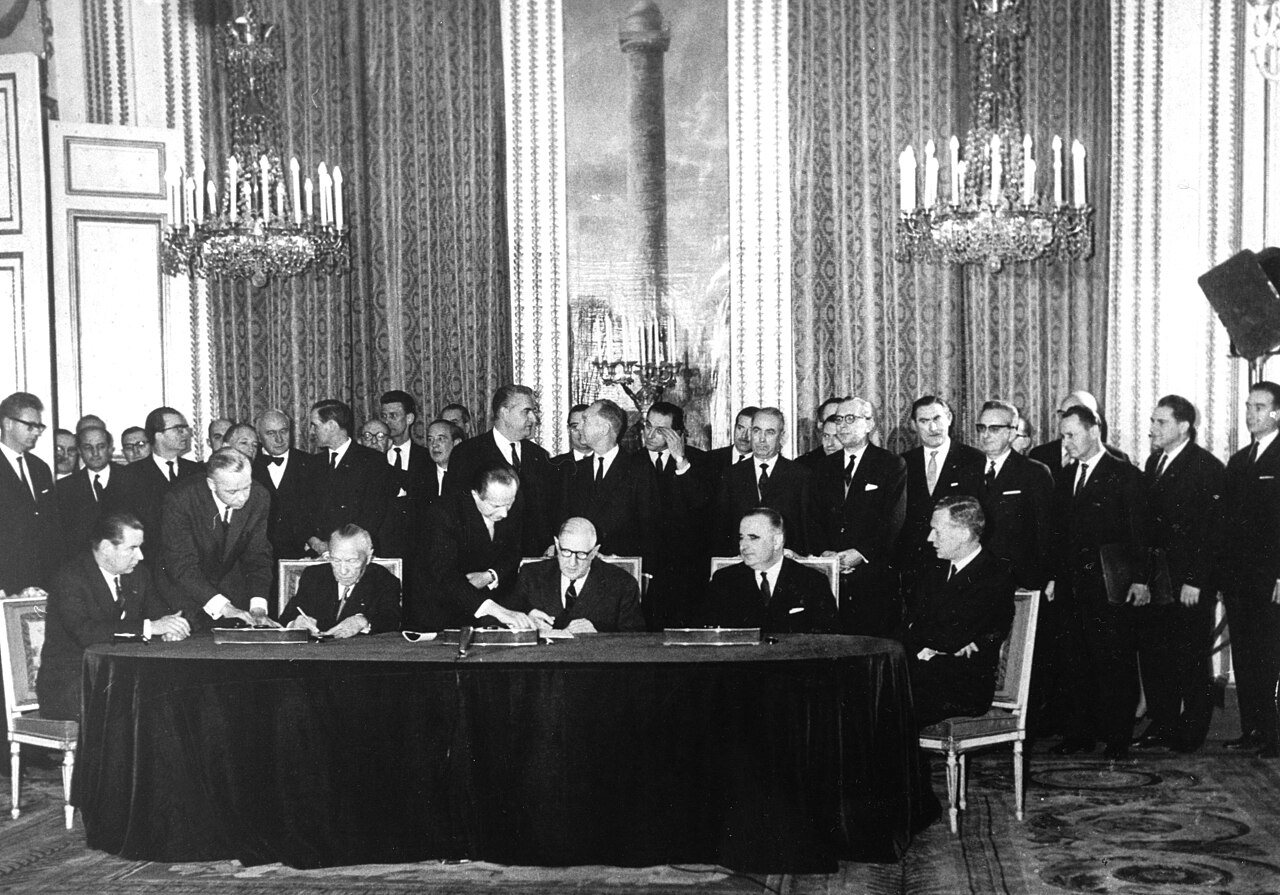
In January 1963, two old men, one 72 and the other 87, sat down at a long table in a gilded Paris palace and signed a piece of paper that ended what centuries of war could not.
The men were Charles de Gaulle, president of France, and Konrad Adenauer, chancellor of West Germany. The paper was the Élysée Treaty, a treaty of friendship between two countries that had been enemies for as long as anyone could remember. They had fought each other in the Franco-Prussian War, in the First World War, and, most brutally, in the Second World War, when Germany invaded and occupied France from 1940 to 1944. In living memory, their soldiers had killed each other by the millions.
Yet on January 22, 1963, in the Salon Murat of the Élysée Palace, surrounded by ministers and dignitaries from both nations, de Gaulle and Adenauer put their names to a solemn promise. As the treaty's own declaration said, they were "convinced that the reconciliation of the German people and the French people, bringing an end to the age-old rivalries, constitutes a historic event."
The treaty was more than a handshake. It committed the two governments to consult each other on foreign policy and defense, and it invested in the future by linking their young people, teachers, and soldiers in regular exchanges. Out of it grew the Franco-German Youth Office, which has since given millions of French and German teenagers the chance to cross the Rhine, meet each other, and learn the other language.
The road to that table had been long. Adenauer had made reconciliation a personal mission after the war. De Gaulle, the wartime leader of Free France, surprised everyone by inviting Adenauer to his country home at Colombey-les-Deux-Églises in 1958, and then toured West Germany in 1962, speaking some of his speeches in German to cheering crowds. Trust was built meeting by meeting, year by year.
Why does it matter? The Élysée Treaty turned the oldest rivalry in Europe into its closest partnership, the engine that still drives European integration today. The six-country common market of 1963 grew into today's European Union of 27 nations, and the Franco-German alliance renewed its vows in 2019 with a second treaty signed at Aachen.
It stands as proof that even the bitterest enemies can choose friendship, and that peace is not just the absence of war but something leaders have to build, signature by signature, student exchange by student exchange.
Photo: Bundesarchiv, CC BY-SA 3.0 de (via Wikimedia Commons).