150 Against 4,000: The Night They Held Rorke's Drift
On January 22, 1879, about 150 British soldiers held a mission station in South Africa against some 4,000 Zulu warriors through a night of hand-to-hand fighting.
The sun was dropping over the hills of Natal when the lookouts spotted them: thousands of Zulu warriors pouring across the plain toward a tiny mission station. Inside the makeshift walls of mealie bags and biscuit boxes waited roughly 150 British soldiers, many of them sick or wounded men from the station hospital. What happened over the next twelve hours would become one of the most famous stands in military history.
The day had already been a disaster for the British. That same morning, January 22, 1879, a Zulu army had annihilated a British column at Isandlwana, just a few miles away, killing more than a thousand British and colonial troops. Survivors of the slaughter stumbled into Rorke's Drift, a Swedish mission station converted into a supply depot and hospital, with the news. Two junior officers, Lieutenant John Chard of the Royal Engineers and Lieutenant Gonville Bromhead of the 24th Regiment of Foot, were left in command.
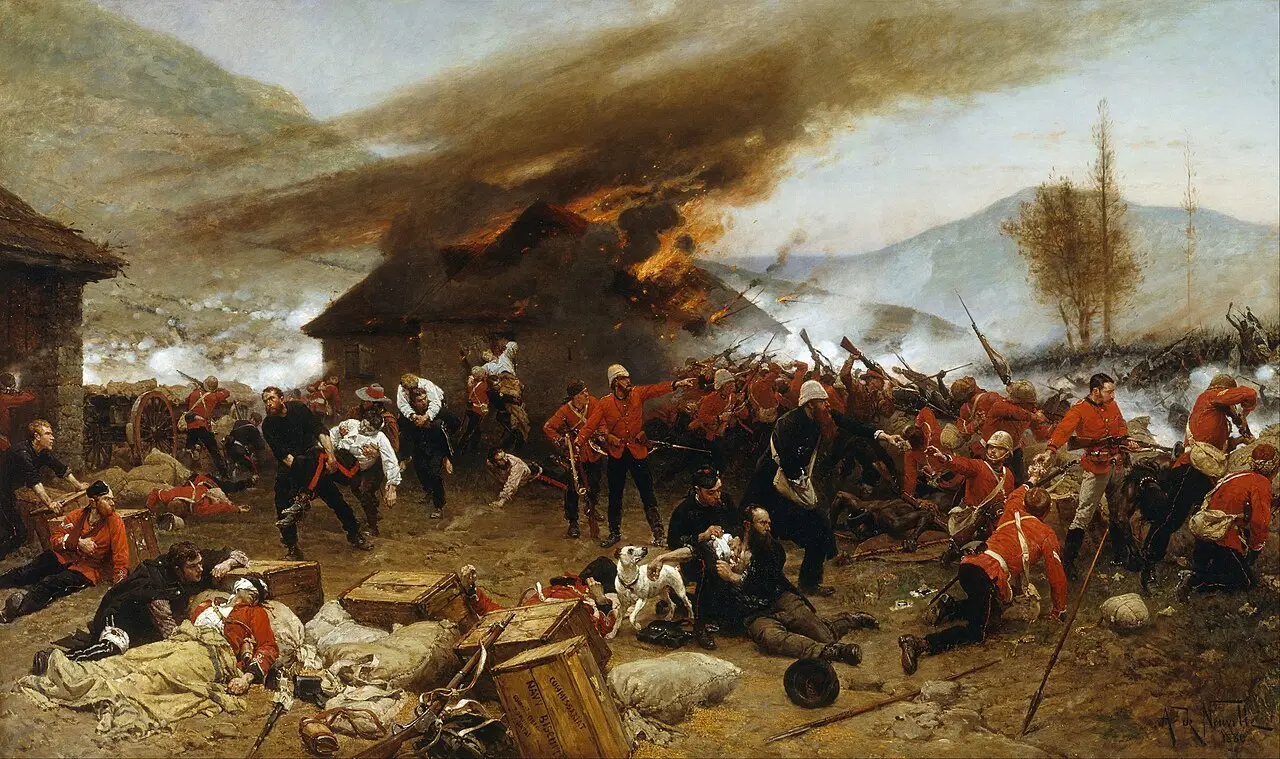
Their choices were stark: abandon the wounded and flee, or fortify and fight. They chose to fight. The men tore apart the station, stacking sacks of corn and boxes of biscuits into a waist-high perimeter wall linking the hospital and the storehouse. Ammunition was handed out, bayonets fixed, and the hospital's walking wounded took their places on the line.
At about 4:30 in the afternoon, some 4,000 Zulu warriors of the Undi corps, led by Prince Dabulamanzi kaMpande, swept down on the station. Most carried only the short stabbing spear called the assegai and shields of cowhide, but their numbers were overwhelming, and they attacked with extraordinary courage again and again through the night. The British, armed with modern rifles, fired in disciplined volleys from behind their barricade, then fell back to an inner wall of biscuit boxes when the hospital caught fire and had to be abandoned.
The fighting turned savage and personal. Privates Henry Hook and John Williams dragged wounded patients out of the burning hospital under direct attack, going back again and again through rooms already held by Zulu fighters. Around the shrinking perimeter, men fought hand to hand with bayonet and spear butt as the walls were assaulted wave after wave.
By 4 in the morning the attacks stopped. As dawn broke on January 23, the defenders looked out and saw the plain empty. The Zulus were gone, leaving behind hundreds of their dead. Seventeen British soldiers had been killed and fifteen wounded, but the station still stood.
The news reached London weeks later and electrified a nation reeling from the catastrophe at Isandlwana. Eleven Victoria Crosses, Britain's highest award for bravery, were given to the defenders of Rorke's Drift, more than for any other single action. The stand was later immortalized in the 1964 film Zulu, which made a star of a young Michael Caine.
Why does it matter? Rorke's Drift endures because it is the purest story of resolve under impossible odds, ordinary soldiers, engineers, a Swiss missionary's station, a commissary officer, holding a corn-sack wall through a night that should have destroyed them. It is remembered alongside the discipline that saved them, and it remains one of history's most studied examples of what a small, well-led force can do when retreat is not an option.
Painting: Alphonse de Neuville's 1880 depiction of the battle, painted the year after the events shown, public domain (via Wikimedia Commons).