The Handkerchief That Ended Pain
On September 30, 1846, a Boston dentist pulled a tooth from an unconscious patient using ether — and surgery would never hurt the same way again.
The patient was terrified of the dentist's chair. He asked if he could be mesmerized instead. The dentist told him he had something better — and picked up a handkerchief.
The dentist was William T. G. Morton, 27, of Boston. A year earlier he had watched his former partner Horace Wells humiliate himself at Massachusetts General Hospital, when a tooth extraction under nitrous oxide went wrong before a jeering crowd of students who chanted "Humbug!" Morton had also sat through chemistry lectures by Professor Charles Jackson, who had shown his classes that breathing sulphuric ether could knock a person unconscious. Morton began experimenting — on animals, and then on himself — until he was convinced ether could be used safely.
On the evening of September 30, 1846, his chance walked through the door. Eben Frost, a Boston businessman, arrived with an aching, firmly rooted bicuspid tooth and a dread of the operation. As it grew dark, Morton saturated his handkerchief with ether and had Frost breathe it in. Frost was unconscious almost immediately. While a Dr. Hayden held the lamp, Morton pulled the tooth — no cry, no flinch, no change in the patient's pulse. Frost woke a minute later with no memory of what had happened. By luck, a newspaper reporter named Albert Tenney witnessed the whole thing, and the Boston Daily Journal printed the story the next day.
That newspaper account changed everything. MGH surgeon Henry Jacob Bigelow read it, visited Morton's office, and watched more painless extractions over the following days. Then he invited Morton to demonstrate his mysterious preparation at the hospital.
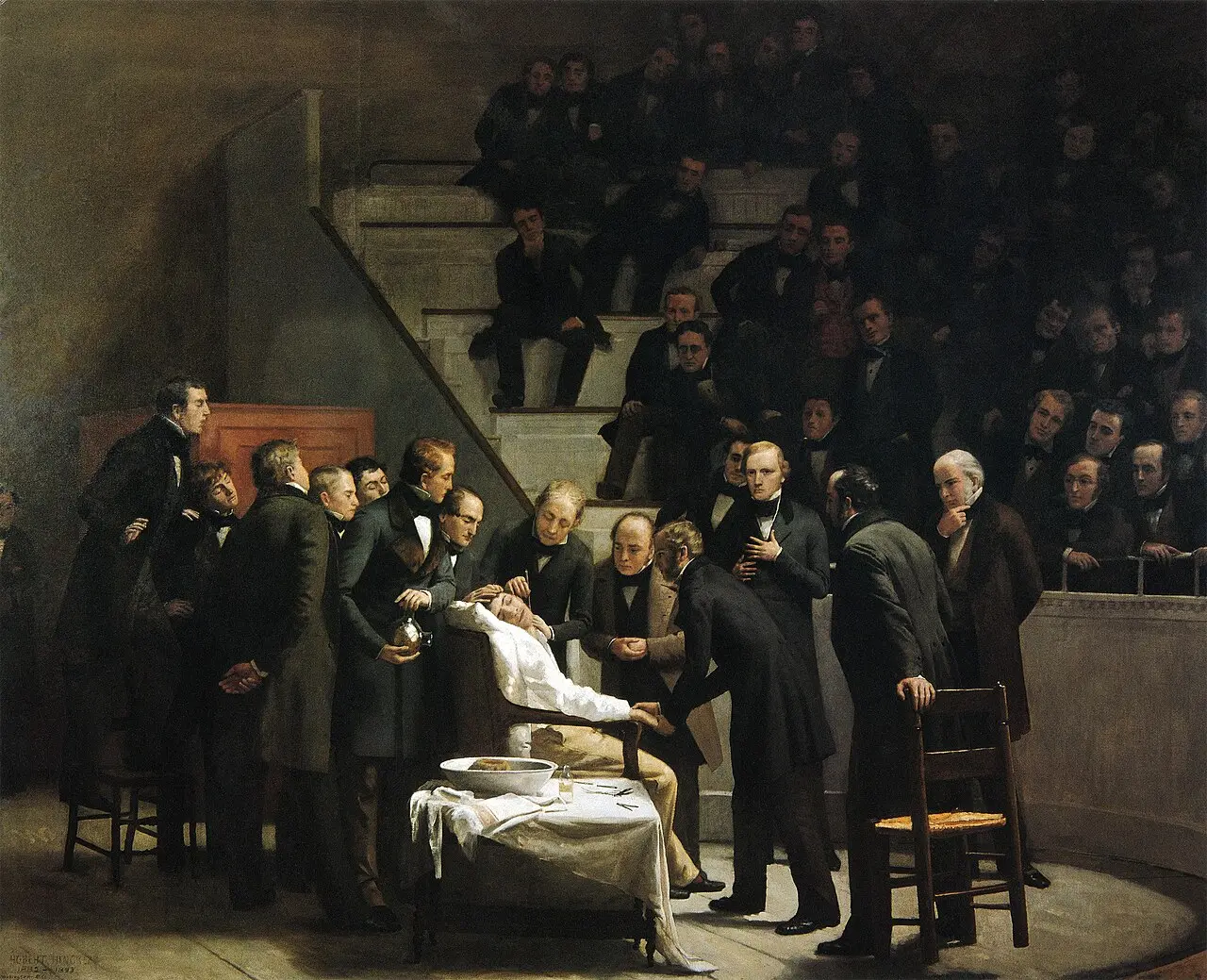
On October 16, 1846, in the hospital's surgical amphitheater — later preserved as the Ether Dome — surgeon John Collins Warren removed a tumor from the neck of Edward Gilbert Abbott while Morton administered the ether. When Abbott felt nothing, Warren reportedly told the watching students: "Gentlemen, this is no humbug." Three weeks later, a below-the-knee amputation performed under ether removed the last doubts. Morton had tried to protect his secret by calling the substance "Letheon," but it was soon revealed as ordinary ether, and he spent years quarreling over credit and a patent with Jackson and Wells.
Word traveled fast. That December, a London dentist used ether for the first recorded operation outside America. Within a few years, ether and its successors were in use on both sides of the Atlantic.
Before that handkerchief, surgery meant agony endured fully awake — speed was a surgeon's greatest virtue because every extra minute was torment. After it, the deepest operations became thinkable. Modern anesthesia, and everything it makes possible, traces back to a September evening in a Boston dentist's office, a frightened patient, and a handkerchief soaked in ether.
Painting: Robert C. Hinckley, "The First Operation Under Ether" (1882–1893), public domain (via Wikimedia Commons).