I Came, I Saw, I Was Conquered
On September 30, 1935, Franklin Roosevelt dedicated Hoover Dam before 10,000 people in 102-degree heat — and called it mankind's greatest feat.
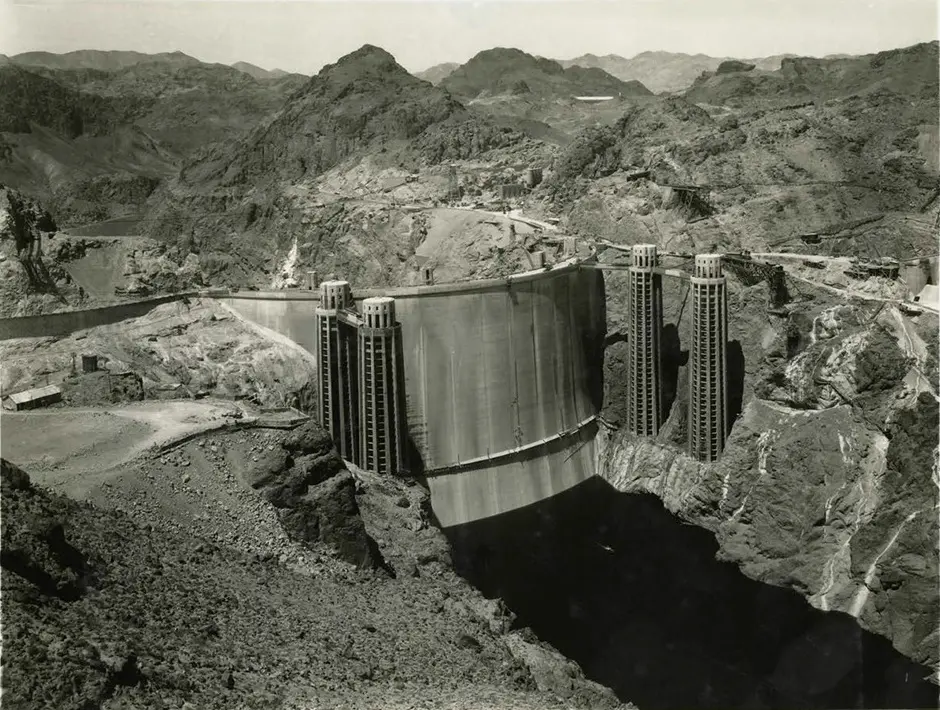
The thermometer read 102 degrees. Ten thousand people stood in the desert heat anyway, staring up at a curved wall of concrete 726 feet high — and waiting for the president.
The ceremony almost didn't start on time. It had been scheduled for 2 p.m., but that morning it was rushed forward three hours to 11 a.m. — because the Interior Secretary had booked the president a 2 p.m. radio slot, and nobody had realized until the day of the event that the slot was for 2 p.m. Eastern time, not Pacific.
When Franklin Roosevelt finally spoke, he avoided one name entirely. Former President Herbert Hoover — for whom the dam would eventually be named — had not been invited, and Roosevelt never mentioned him, calling the structure Boulder Dam, its official name at the time. What he did say became famous: "This morning I came, I saw, and I was conquered, as everyone would be who sees for the first time this great feat of mankind." He praised a lake 115 miles long, "holding enough water, for example, to cover the State of Connecticut to a depth of ten feet," and a powerhouse nearing completion with machinery to supply "nearly two million horsepower of electric energy." To the workers he said simply: "Well done." A three-cent stamp issued that day bore the name Boulder Dam.
The dam had been five years in the making. A consortium called Six Companies had poured the concrete — enough, it was said, to pave a two-lane highway from San Francisco to New York — into the Black Canyon of the Colorado River. At the peak in July 1934, more than 5,200 men worked on the project; some 21,000 labored on it in total. Summer temperatures reached 119 degrees, and in a single brutal month sixteen workers and residents died of the heat. All told, more than a hundred men lost their lives — including the high-scalers who dangled from ropes to blast the canyon walls smooth. The powerhouse wasn't even finished when Roosevelt spoke; the government formally accepted the dam on March 1, 1936.
The purpose was as big as the structure. The Colorado had been a menace in flood season and a trickle in drought; the dam tamed it into irrigation water for farms across the Southwest and electricity for a growing region. To house the workforce, the government had built an entire town in the desert — Boulder City, Nevada.
After the ceremony, Roosevelt drove on to Las Vegas — the first sitting president ever to visit. The dam he dedicated would power the city's famous lights within a few years.
Hoover Dam was the boldest symbol of the New Deal: proof that a country in the depths of the Depression could still attempt the biggest thing ever built in concrete — and finish it. It made the modern Southwest, its farms, its cities, and its lights, possible.
Photo: a 1935 photograph of Hoover Dam, public domain (via Wikimedia Commons).