The Eight-Year-Old Who Helped Defeat Smallpox
On May 14, 1796, Dr. Edward Jenner inoculated 8-year-old James Phipps with cowpox, proving the principle behind the world's first vaccine.
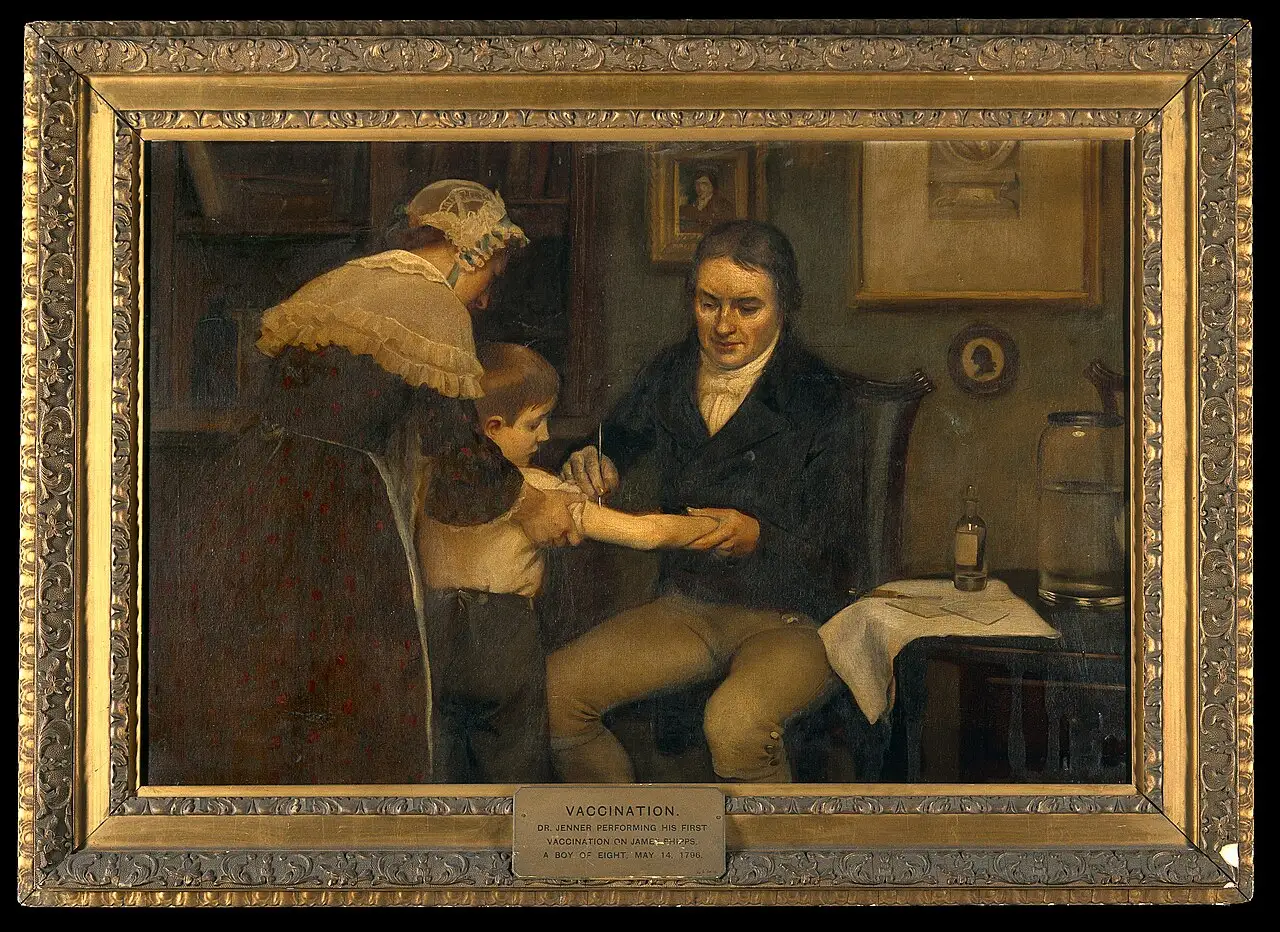
In the spring of 1796, a country doctor in the village of Berkeley, Gloucestershire, did something to an eight-year-old boy that could easily have been a disaster. Instead, it changed medicine forever.
Smallpox was the scourge of mankind. It killed millions over the centuries, and in the 20th century alone it would claim roughly 300 million lives. Those who survived were often left blind, their faces deeply pitted with scars. It struck everywhere — cities, villages, palaces — and nothing could stop it.
Edward Jenner had heard a piece of country folklore since his days as a medical apprentice: that dairymaids who caught cowpox — a mild disease that blistered cows' udders — never seemed to catch smallpox. In May 1796, Jenner found a young dairymaid, Sarah Nelms, with fresh cowpox sores on her hands. On May 14, he took fluid from her blisters and scratched it into the arm of James Phipps, an eight-year-old boy — the son of Jenner's own gardener — making two small cuts in the skin.
Jenner watched and took notes. On the seventh day, James complained of uneasiness under his arm. On the ninth, he felt chilly, lost his appetite, and had a slight headache. The next day, Jenner wrote, the boy was 'perfectly well.' Then came the true test. Weeks later, Jenner inoculated the boy with matter from an actual smallpox lesion. No disease developed. The boy was protected. James Phipps would later be exposed to smallpox more than twenty times in his life — and never fell ill.
To be fair to history, Jenner was not the first to try this. Farmers had known the lore for years, and a Dorset farmer named Benjamin Jesty had inoculated his own family with cowpox back in 1774. Jenner's true achievement was proving it systematically and publishing it. In the pamphlet where he set out his findings, he coined the word 'vaccine,' from the Latin vacca, meaning cow. Doctors across Europe adopted the technique, and smallpox began its long retreat.
James Phipps never became famous, but Jenner never forgot him. Later in life, Jenner gave Phipps — by then married with children — a free lease on a house on his estate. Phipps was grateful, and when Jenner died, James Phipps walked in the funeral procession in February 1823.
That scratch on a boy's arm in a Gloucestershire village led, step by step, to the entire field of vaccination — polio, measles, whooping cough, tetanus, and all the rest. And it ended with smallpox itself: in 1980, the World Health Organization declared it eradicated, the only human disease ever wiped from the Earth. It all began on May 14, 1796, with a doctor, a dairymaid, and an eight-year-old boy.
Photo: Wellcome Collection, CC BY 4.0 (via Wikimedia Commons).