45 Men, One Keelboat, and an Unknown West
On May 14, 1804, the Lewis and Clark expedition pushed up the Missouri River into the vast Louisiana Purchase — and into American legend.
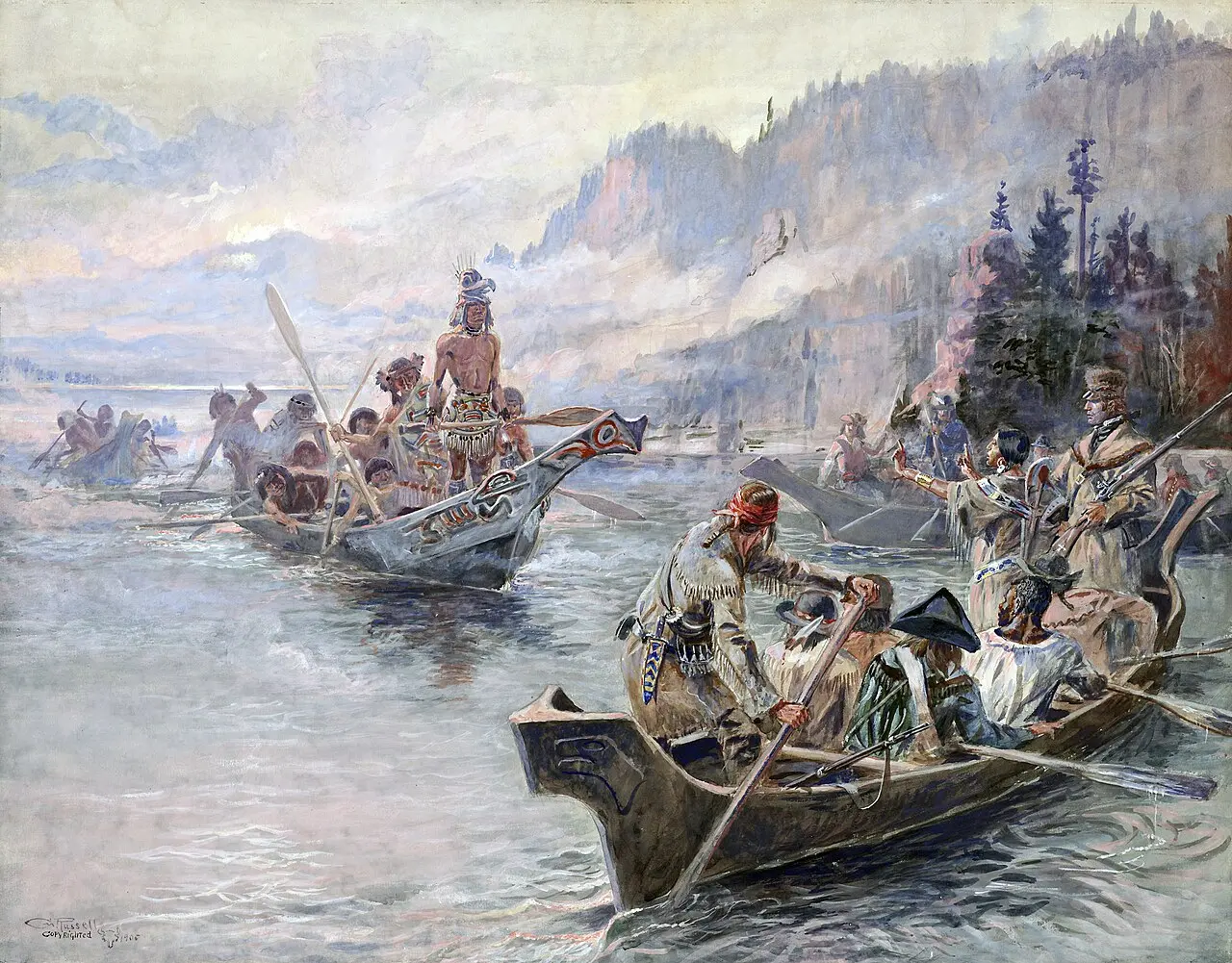
On the afternoon of May 14, 1804, a 55-foot keelboat and two smaller pirogues pushed off into the Missouri River carrying about 45 men, enough food for a year, scientific instruments, and the most ambitious instruction a president had ever given: find out what I just bought.
A year earlier, Thomas Jefferson had bought the Louisiana Territory from France for $15 million — 828,000 square miles that doubled the size of the United States — and he had almost no idea what was in it. Before the purchase was even final, he had commissioned his private secretary, Meriwether Lewis, and Lewis's friend William Clark to explore it: find a practical water route to the Pacific, plant an American presence, document the land, and make peace and trade with the Native nations who lived there. Jefferson was convinced a water route existed. The Rocky Mountains had other plans.
Through the winter of 1803–04, Clark had recruited and trained his men at Camp Dubois, north of St. Louis — unmarried, healthy, good hunters. On May 14, they left camp, met Lewis at St. Charles, Missouri, and headed upstream against the Missouri's current, poling and rowing ten to twenty grueling miles a day through heat, insects, and snags. Carpenter Patrick Gass wrote in his journal that 'the determined and resolute character of the corps, and the confidence which pervaded all ranks dispelled every emotion of fear and anxiety for the present.'
What followed is one of the great journeys in American history: 8,000 miles round trip over 28 months. They wintered in 1804–05 at Fort Mandan in present-day North Dakota, where they were joined by the young Shoshone woman Sacagawea, her French-Canadian husband Toussaint Charbonneau, and their newborn son — and where Sacagawea's knowledge and interpreting would prove vital. They crossed the Continental Divide, reached the Pacific in November 1805, and returned to St. Louis on September 23, 1806. Lewis documented 178 plants and 122 animals new to science. Astonishingly, only one man died: Sergeant Charles Floyd, of a suspected ruptured appendix, in August 1804. The expedition passed through some 55 Native homelands, and the food, shelter, guides, and knowledge offered by Native peoples were integral to its success.
The Corps of Discovery returned with maps, journals, and specimens that became the founding documents of the American West. It established the United States' claim to the far Northwest and proved the continent could be crossed. But it also marked the beginning of the end for the world the expedition found: the land they mapped belonged to Native nations, and the maps they brought home would help others take it.
That is the full measure of May 14, 1804 — a keelboat, 45 men, and a journey that opened a continent and changed it forever.
Photo: Charles M. Russell, public domain (via Wikimedia Commons).